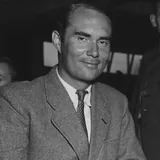
Albéric O'Kelly de Galway
Albéric O'Kelly de Galway was the leading Belgian chess player for more than two decades. He won the Belgian championship thirteen times between 1937 and 1959, played in eight Olympiads, and after the Second World War won tournaments at Beverwijk, Hilversum, São Paulo and Dortmund. FIDE made him one of its first International Masters in 1950 and a grandmaster in 1956. He also became the third World Correspondence Champion, in the final played from 1959 to 1962, and as an International Arbiter he was chief arbiter of the Petrosian–Spassky World Championship matches of 1966 and 1969. The O'Kelly Variation of the Sicilian Defense, 1.e4 c5 2.Nf3 a6, carries his name.
Brussels
O'Kelly was born on 17 May 1911 in Anderlecht, near Brussels. His family descended from John O'Kelly, an Irish-born officer who was granted a title of nobility in 1720 in what were then the Austrian Low Countries, and he was often styled Count O'Kelly de Galway. As a youth he took lessons from Akiba Rubinstein, who was then living in Belgium.
He won his first Belgian championship in 1937, sharing the title with Paul Devos, and the same year he played for Belgium at the Stockholm Olympiad. Between 1937 and 1959 he won the national title thirteen times; in 1957 he took it a point ahead of Arthur Dunkelblum, and in 1959 he tied with Jozef Boey.
The post-war years
O'Kelly's strongest period came after the Second World War. He won the Hoogovens tournament at Beverwijk in 1946. In 1947 he won the West European zonal tournament at Hilversum, a point ahead of Luděk Pachman and Petar Trifunović, tied for first with Vasja Pirc at Teplice-Šanov and shared second place at Venice. In 1948 he won at São Paulo ahead of Erich Eliskases and Héctor Rossetto.
FIDE awarded him the International Master title on its first title list in 1950. That year he scored 11 points from 15 games on Belgium's top board at the Dubrovnik Olympiad, and in 1951 he won the international tournament at Dortmund. Chessmetrics ranks him No. 27 in the world at his peak in 1953–54.
David Bronstein gives a memorable account of his resistance in 200 Open Games (1974), pp. 102–103. Their Hastings game occupied New Year’s Day 1954, beginning at nine in the morning and finishing around midnight, with the tournament’s session breaks. Bronstein tried successive plans against a defence he described as remarkably accurate. O’Kelly remained close to a draw in the ending for some time before Bronstein finally won.
“We must not forget that, as positions are equal at the beginning of the game, to insist on attacking at all times is logically unreasonable.”
“it is always dangerous to reduce a chess game to a memory contest.”
“In politics, and often in chess, it is minorities that lay down the law.”
“But even my new tactics remained for a long time unrewarded: my opponent defended remarkably accurately.”
“During his best years ... he was known for his clarity of vision and what Harry Golombek has described as a sort of super competence.”
“he writes a lot about the game and probably knows most about what's currently fashionable.”
Grandmaster
FIDE made him a grandmaster in 1956, and in 1958 Belgium awarded him the Golden Palm of the Order of the Crown for his chess successes. He finished second at Gijón in 1949 and fourth there in 1956. In 1961 he won the round-robin at Utrecht with 6½/9, ahead of Karl Robatsch, Arthur Bisguier and Aleksandar Matanović.
He played in eight Olympiads for Belgium between 1937 and 1968, 118 games in all. In later years he played team chess in West Germany for Solingen, and he was still playing international tournaments in the 1970s.
He played in the fourth series of the BBC's The Master Game (1979), in which the players' recorded thoughts were heard as the moves were shown. With White against Tony Miles in the first round, he resigned a Queen's Indian after 26 moves. Jeremy James and William Hartston, in The Master Game, Book Two (1981), judged that he “played far too passively throughout”, and note that after 17 moves all but one of his pieces stood on black squares. Thinking aloud during the game, he recalled: “I remember a game that I won with Black against the late Ossip Bernstein about twenty-five years ago” (pp. 19, 23–26).
Correspondence chess
In the Dyckhoff Memorial correspondence tournament of 1954–56, O'Kelly finished second to Lothar Schmid with ten wins, four draws and one loss, and his win over Olaf Barda received the first brilliancy prize, judged by the former World Champion Max Euwe. In his book 34 mal Schachlogik he called his game against Julius Nielsen from that event probably the most complicated game he had played.
He then won the final of the third World Correspondence Championship, played from 1959 to 1962, ahead of Piotr Dubinin, and became the third World Correspondence Champion, after Cecil Purdy and Viacheslav Ragozin. ICCF awarded him the International Correspondence Grandmaster title in 1962.
Arbiter and author
O'Kelly became an International Arbiter in 1962. He was chief arbiter of the World Championship matches between Tigran Petrosian and Boris Spassky in 1966 and 1969, and in 1974 he was the arbiter of the Karpov–Korchnoi Candidates final in Moscow.
He spoke French, Dutch, German, English, Spanish and Russian fluently, and some Italian, and he wrote books and articles in several of those languages. His books include Tigran Petrosian: World Champion (Pergamon, 1965), thirty annotated Petrosian games with a short biography, translated into English by John Littlewood; The Sicilian Flank Game (1969), on the Najdorf Variation; and Assess Your Chess Fast and Improve Your Chess Fast (1978).
In the Petrosian book he recalled that he first met Petrosian at the Maróczy Memorial in Budapest in 1952, soon after Petrosian had been nicknamed “the black panther”. Petrosian shared seventh place there with 9½ points from 19, and O'Kelly was ninth with 9 (p. 3). Writing after the 1963 match, he called Petrosian's win indisputable and found it “difficult to see anyone taking the title from him in the next 10 years” (p. 11). Petrosian kept the title against Spassky in 1966 and lost it to him in 1969, and O'Kelly was chief arbiter of both matches.
The practical demands of arbitration appear in Garry Kasparov’s My Great Predecessors, Part IV (2004), “A vertical Ascent”, before Game 85. O’Kelly was chief arbiter of the 1970 Palma de Mallorca Interzonal. In Evgeny Vasyukov’s recollection, after Larsen objected to an early Friday start against Fischer, O’Kelly proposed exchanging the seventh and ninth rounds. Soviet players threatened countermeasures, including withdrawal. The rounds remained in place, and Larsen and Fischer eventually began at 11:30.
Legacy
O'Kelly died in Brussels on 3 October 1980, at sixty-nine. He had won thirteen Belgian championships, held both the over-the-board and correspondence grandmaster titles, and been world champion at correspondence chess. The opening line 1.e4 c5 2.Nf3 a6 is still called the O'Kelly Variation, and an international correspondence tournament, the O'Kelly Memorial, was held in his honor from 1984 to 1989.
Books
Books Albéric O'Kelly de Galway wrote, co-wrote, edited, or contributed to. Translations and reprints are grouped under the same work.
-
Match Botvinnik–Smyslov 1957
Author
-
34 mal Schachlogik
Author
-
Tigran Petrosian, World Champion
Author
-
The Sicilian Flank Game: Najdorf Variation
Author
-
Assess Your Chess Fast / Les Leçons d’un champion: Vers la maîtrise
Author
-
Improve Your Chess Fast / Les Leçons d’un champion: Progresser rapidement
Author
-
The Master Game, Book Two
Contributor — own game annotations