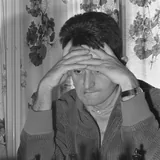
Aleksandar Matanovic
For most of the chess world after 1966, the important games arrived twice a year in a thick volume that contained almost no words at all. Aleksandar Matanović had worked out that chess did not need translating — that a small set of agreed symbols could carry a grandmaster's judgement across every border and alphabet on earth. He was a fine player in his own right: grandmaster at twenty-five, three times champion of Yugoslavia, the only man to beat Mikhail Tal at the Portorož Interzonal. But his monument is the Chess Informant, and the encyclopaedia that gave every opening in the game an address.
◈A Belgrade boyhood under occupation
He was born in Belgrade on 23 May 1930 and never lived anywhere else. In April 1941, weeks before his eleventh birthday, Germany invaded Yugoslavia and bombed the city; his father died that year. Whatever else the war took from him, it left him a board, and he gave the rest of his life to it — as player, coach, editor, journalist and publisher.
The chess came quickly once the country was free again. In 1948, at eighteen, he won the Yugoslav Junior Championship. He was a national master by 1949, an international master by 1951, and a grandmaster in 1955 at twenty-five.
◈The golden age of Yugoslav chess
He arrived exactly when his country did. Through the 1950s, 60s and 70s Yugoslavia was the second chess power on earth after the Soviet Union, and Matanović belonged to the generation — with Svetozar Gligorić, Borislav Ivkov and Milan Matulović — that made it so. At home they were public figures, familiar from newspapers and television in a way chess players almost nowhere else were.
He won the Yugoslav Championship three times: in 1962 shared with Dragoljub Minić, then outright in 1969 and 1978. He finished second in six others, including 1950 as a twenty-year-old and 1975 in a tie with Gligorić and Ljubomir Ljubojević. Abroad he took first at Opatija 1953, Hamburg 1955, Beverwijk 1957 and Zevenaar 1961, and shared first at Buenos Aires 1961. He qualified for four Interzonal tournaments spread across a quarter of a century — Saltsjöbaden 1952, Portorož 1958, Sousse 1967 and Biel 1976 — and his rating peaked at 2525 in January 1976, then fifty-fourth in the world.
For Yugoslavia he played eleven Chess Olympiads between 1954 and 1978, collecting nine team medals and four board medals — thirteen in all, more than any Yugoslav or Serbian player except one. At Siegen in 1970 he took the individual gold on board four. He added five European Team Championship appearances on top of that.
◈The man who beat Tal
The game everyone remembers came at the Portorož Interzonal of 1958. Mikhail Tal was twenty-one and two years from the world title, playing the chess that would make his name; he won the tournament. He lost exactly one game in it, to Matanović. The Dutch grandmaster Hein Donner, who was there, wrote that only Matanović managed to hold his own against him — that the Yugoslav unleashed such concentrated violence that Tal caved in.
It was not a solitary scalp. Across a career that ran from the late 1940s to the 1980s he beat Savielly Tartakower and Efim Bogoljubov at one end and Jan Timman and Ulf Andersson at the other, with Paul Keres, Efim Geller, Bent Larsen, Lajos Portisch, Leonid Stein, Vlastimil Hort, Fridrik Ólafsson, Lev Polugaevsky, Tigran Petrosian, Gligorić and Ivkov in between.
◈Šahovski Informator
In 1966, with Milivoje Molerović and Aleksandar Božić, he founded Šahovski Informator — the Chess Informant. The problem it solved was the defining problem of Cold War chess: the best games in the world were played on both sides of a closed border, and there was no reliable way for a player in Belgrade or Buenos Aires to see what had been played in Moscow, or the reverse. Twice a year, the Informant simply collected them and printed them.
The innovation that made it universal was that it contained almost no prose. Matanović and his colleagues used figurine algebraic notation, so the pieces were drawn rather than named, and built a system of symbols for everything an annotator would otherwise have had to say — the small marks for a clear advantage, an unclear position, compensation, zugzwang, a better move, a decisive attack. He called it a chess language. A Soviet grandmaster's annotations could be read by a Spaniard, a Dane or an Argentine with no translation at all, and within a few years the symbols were the international standard for annotating chess. They still are.
The scale of what followed is easy to understate. The first 112 volumes, from 1966 to 2011, carried more than 110,000 games annotated by over 5,000 players, among them every world champion from Max Euwe to Viswanathan Anand. Bobby Fischer worked through each issue as it came; the copies he owned are in the World Chess Hall of Fame in Saint Louis. Garry Kasparov's verdict on his own generation was blunt: “We are all children of Informant.”
◈Giving every opening an address
From 1974 the Informant published the Encyclopaedia of Chess Openings, five volumes lettered A to E, which Matanović edited. It did to opening theory what the Informant had done to games: stripped out the language, tabulated the variations, and — crucially — gave each of them a code. The A00–E99 system is his encyclopaedia's, and it is the reason a player anywhere in the world can say B33 or D85 and be understood exactly. Every database and opening book in use today still runs on those addresses.
The house went on to produce the Encyclopaedia of Chess Endings in five volumes as well. Matanović was editor-in-chief for decades and later headed the management board; he also wrote for the Yugoslav press throughout, and published a memoir, Chess as a Destiny. He served as a vice-president of FIDE from 1990 to 1994, and pushed hard for chess in schools.
◈Krčedin, and the last years
He married Vesna, whom he met through Gligorić: at a party during a championship in Zagreb his friend asked the young woman to dance, succeeded, and she went on to become Matanović's wife. They spent their summers at a cottage in Krčedin, a village on the Danube outside Belgrade. In the 1970s and 80s he was a familiar face on Yugoslav television, presenting chess to a country that wanted to watch it.
He kept playing long past any obligation to — he was still winning rated games at seventy-two — and his last competitive appearance came in 2007 in Moscow, at a tournament commemorating the old USSR–Yugoslavia matches, where he drew both games with Mark Taimanov. When Yuri Averbakh died in May 2022, Matanović became the oldest living grandmaster in the world. His last public appearance was in February 2023, at the celebration of Gligorić's centenary in Belgrade: “We were opponents on the chessboard, friends for 64 years. These 64 black and white squares brought us together.” On the eve of his ninety-third birthday he published a farewell piece in Politika, remembering the Dubrovnik Olympiad of 1950 and how, after it, chess grew wings.
“Little did we know that we were trailblazing a path towards an era yet to come — the information era.”
“We were opponents on the chessboard, friends for 64 years. These 64 black and white squares brought us together.”
“After our team's victory at the Dubrovnik Olympiad, chess grew wings.”
“We are all children of Informant.”
“Only Matanović managed to hold his own against him… The Yugoslav unleashed such concentrated violence that Tal caved in.”
◈From the archive
◈Legacy
Matanović died in Belgrade on 9 August 2023, aged ninety-three, in the city he had never left. His playing record would have been enough for a respected life — a grandmaster at twenty-five, three national titles, eleven Olympiads, the man who beat Tal at Portorož. But he is remembered for something rarer than results. Before the Informant, chess knowledge moved slowly and stopped at borders and alphabets; after it, the whole world read the same games in the same notation and argued about them in the same symbols. The Encyclopaedia gave every opening a name that everyone agreed on. Half a century later the volumes still appear, four a year, and every annotated game and every opening code in every database on earth is written in the language he helped invent.