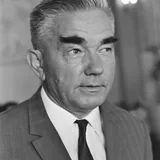
Alexander Kotov was an engineer who taught the world how grandmasters think. At the board he was a fearless attacker, the man who won the 1952 Interzonal by three clear points without losing a game and who played one of the most famous queen sacrifices in history. But he left his biggest mark with a pen. In Think Like a Grandmaster he tried to do something no one had quite managed before: describe, honestly and step by step, what goes on in a master's head when the position is complicated and the clock is running. Generations of players learned to look for candidate moves and build a tree of analysis through Kotov's explanations of his own practice.
The engineer from Tula
Kotov was born in 1913 in Tula, a city of gunsmiths and steel south of Moscow, to a working-class family. In his memoir Zapiski shakhmatista he dates his entry into the Tula Mechanical Institute to autumn 1930, a Moscow factory placement to spring 1934, and his diploma defence to winter 1935. After graduating he moved to Moscow to work in an aviation design bureau. Chess grew alongside that career: in 1939, in his very first Soviet Championship, he stunned the chess world by finishing second — losing the title to Mikhail Botvinnik only in the final round. The result earned him the Soviet Grandmaster title, making him just the third holder after Botvinnik and Grigory Levenfish.
His engineering was no hobby. When war came, Kotov worked as an engineer in the Soviet defence industry, and for his contributions to the development of new armaments he was awarded the Order of Lenin — one of the country's highest honours. V. Ragozin's account in The Soviet School of Chess dates the award to 1944 and describes his wartime work at a Moscow factory. Kotov later made the engineering analogy explicit in Think Like a Grandmaster: examine the parts and their interaction, then assess the whole machine, just as a player assesses a position.
His attacking education had begun with school friends. In The Art of the Middle Game he recalled staying behind after lessons and playing up to a hundred games in an afternoon. They castled on opposite sides and raced to reach the other king; whoever attacked first won. He traced his later instruction on these positions back to that exuberant practice.
The attacker
Over the board Kotov was anything but cautious. He embraced complications, played sharp and combative chess, and was willing to hurl his pieces forward in pursuit of the king. He favoured closed openings with White and was a dangerous handler of the Sicilian Defence with Black, where his taste for double-edged positions found its natural home.
After the war his results climbed. At Groningen in 1946 he defeated both Botvinnik and Euwe, beating Euwe in the final round and leaving him half a point behind Botvinnik. Kotov took the Soviet title jointly with David Bronstein in 1948, won at Venice in 1950 ahead of Vasily Smyslov, and represented the USSR at the Helsinki (1952) and Amsterdam (1954) Olympiads, helping his team to gold both times. He would also win Hastings in 1963.
“We repeat the rule: candidate moves must be established straight away and they must be clearly enumerated.”
“The trunk of this tree is the main move we are considering.”
“Fickle fortune rules in chess, though is this true only of chess?”
“I tried to follow Botvinnik’s example, and found it hard since I am not that sort of character. However when I managed it my results greatly improved.”
“As for Kotov, the writer, he has left behind a rich legacy of chess experience which will always be with us.”
“Kotov has a poorly developed sense of danger”
“One can only be surprised at the potential defensive strength of White’s position and the skill of Kotov, who maintains the balance, albeit with great difficulty.”
Saltsjöbaden 1952
Kotov's supreme result as a player came at the Saltsjöbaden Interzonal of 1952. In a field stacked with the world's best, he scored an overwhelming 16½ out of 20 — and won by three full points ahead of Tigran Petrosian and Mark Taimanov, without losing a single game. It remains one of the most dominant performances in the history of the qualifying cycle.
The triumph carried him into the Candidates Tournament at Zurich in 1953, the famous double-round marathon that decided Botvinnik's challenger. There, against Yuri Averbakh, Kotov produced the game that would carry his name into legend.
The famous queen sacrifice
At Zurich in 1953, playing Black against Averbakh, Kotov sacrificed his queen deep in the middlegame — not for an immediate forced win, but for a lasting, suffocating attack against the white king. Move by move the pieces closed in, and Averbakh resigned after 51...Rg8. The game won the tournament's Brilliancy Prize and is still studied as one of the greatest sacrificial achievements ever played.
His own notes in Chess Tactics make the achievement more human. Excitement caused him to overlook a quicker win with 33...Ng4!, and he repeated checks to gain thinking time. The queen sacrifice reveals his courage; the annotations reveal a writer willing to explain the uncertainty and missed opportunities inside a celebrated victory.
How grandmasters think
Kotov's greatest legacy is on the page. In Think Like a Grandmaster (1971) he set out to describe the actual mechanics of master calculation. Rather than telling readers where to put their pieces, he taught them a method: identify the serious candidate moves in a position, then analyse each in turn — building a “tree of analysis” whose trunk is the move under consideration and whose branches are the opponent's replies — until each line reaches a clear verdict.
The method grew out of work on his own weaknesses. In Think Like a Grandmaster he describes reviewing his old games in 1935–36 and filling notebooks with blunt criticism of his mistakes. He then covered the notes to master games, analysed the positions without moving the pieces, wrote down his conclusions and compared them with the published commentary. He began with half an hour or an hour for a position, then shortened the allowance as he improved.
He experimented with habits as well as variations. In Play Like a Grandmaster he described trying to stay seated throughout a game, following Botvinnik's example. It did not suit his temperament, but when he managed it, he found that his results improved.
His 106-move win over Arnlaugsson at the 1954 Amsterdam Olympiad became a lesson in changing plans. Several morning adjournments left his team-mates carrying extra afternoon duties. After Arnlaugsson's 84...Qg5! stopped his intended breakthrough, Kotov sat in dismay, then found a fourth plan despite their pitying glances. He stressed that the adjournments had given him time to analyse at leisure; this was no model of foreseeing an entire game at the board.
His stories could be funny at his own expense. At Budapest in 1950 he expected an ending against Smyslov to be an easy draw and spoke cheerfully of adjourning it for his second to handle. In Kotov's account, Najdorf then joined the spectators beside Smyslov; both suddenly froze when they saw the same tactical refutation. Kotov saw it too and resigned. The teacher of disciplined calculation had ample experience of confidence getting ahead of analysis.
He was also honest about how calculation goes wrong. He described what is now called the “Kotov syndrome”: a player thinks hard for a long time in a complicated position, can't find a clear way forward, and then, short of time, suddenly plays a poor move, often a blunder. Alongside the trilogy of Think, Play and Train Like a Grandmaster, he wrote a two-volume Russian study of Alexander Alekhine that helped restore the émigré champion's reputation in the Soviet Union, served as deputy chairman of the Soviet Chess Federation, and even wrote a novel and play, Black and White, about Alekhine's life. He died in Moscow in 1981.
His Alekhine project joined research to teaching. The revised Shakhmatnoe nasledie Alekhina arranged the games by theme for chess schools and independent study: openings, combinations and attacks in the first volume, positional play and endings in the second. Its editorial note says that Kotov delivered the revision shortly before his death and eagerly awaited publication; the books appeared in 1982, after he had died.
In 1973 Kotov also published a one-volume life of Alekhine, which appeared in Spanish as Alekhine in 1975. Its prologue says the two volumes had begun about twenty-five years earlier, when chess players and admirers around the world helped him collect more than five hundred of Alekhine's games; the new book chose a selection of them and added the story of the life. At the 1956 Moscow Olympiad he had asked grandmasters for their memories of Alekhine, and he questioned Euwe, Flohr, Lilienthal and Sir George Thomas. In his archive he kept a photocopy of Alekhine's April 1921 travel permit, which he cited against the belief that Alekhine had left Soviet Russia illegally. Researching Black and White, he went through the émigré papers' reports of Alekhine's 1928 speech at the Russian Club in Paris. Several did not mention the remark about the myth of Bolshevik invincibility that led Soviet chess to break with Alekhine, and no one he asked who knew émigré Paris would confirm that Alekhine had said it. Having read many of Alekhine's articles and books, Kotov admitted that he had always envied their precision of language.
His teaching reached television as well as print. In the foreword to Shakhmatnaya shkola, Yuri Averbakh recalls Kotov proposing televised chess lessons and recruiting him and Mikhail Yudovich as fellow presenters. Their weekly programme set homework; viewers sent back answers and asked for the lectures in a book. Kotov wrote its section on combinations and positional play, Yudovich the openings, and Averbakh the endings.
He also remained involved in the world championship struggle beyond his own playing peak. Kasparov records him among Taimanov's helpers in Vancouver in 1971 and among the advisers named to support Spassky in 1972. In 1973 Kotov served as chief arbiter of the Leningrad Interzonal, observing the young Karpov's progress at close quarters.
Legacy
Kotov died in Moscow in January 1981, but his influence has only grown. Think Like a Grandmaster and its companions, Play Like a Grandmaster and Train Like a Grandmaster, are among the most widely read chess books ever written, and the terms they introduced, candidate moves, the tree of analysis and the dreaded “Kotov syndrome” of the rushed blunder after long thought, are simply how players talk about calculation now. His two-volume Russian study of Alexander Alekhine helped restore the exiled champion's name in his homeland. He is remembered as a brilliant attacker, as a wartime engineer decorated for his work, and above all as the man who put the grandmaster's thought process into words.
Books
Books Alexander Kotov wrote, co-wrote, edited, or contributed to. Translations and reprints are grouped under the same work.
-
Межзональный шахматный турнир в Стокгольме 1952 года: Сборник партий
Editor — compiler; annotations contributed by Averbakh, Geller, Petrosian, Taimanov and Flohr
-
Sowjetschach I: Schach in der UdSSR 1917–1935
Coauthor — Alexander Kotov, Salo Flohr
-
Записки шахматиста
Author
-
The Soviet School of Chess
Coauthor — Alexander Kotov, Mikhail Yudovich
-
The Art of the Middle Game
Coauthor — Paul Keres, Alexander Kotov
-
Think Like a Grandmaster / Тайны мышления шахматиста
Author
-
Play Like a Grandmaster
Author
-
Alexander Alekhine
Author
-
Train Like a Grandmaster
Author
-
Шахматное наследие Алехина. Том 1
Author
-
Шахматное наследие Алехина. Том 2
Author
-
Chess Tactics
Author
-
Как стать гроссмейстером
Author
-
Grandmaster at Work
Author
-
Ohne Bauern läuft nichts
Author
-
Шахматная школа: Курс лекций для шахматистов-разрядников
Coauthor — Yuri Averbakh, Alexander Kotov, Mikhail Yudovich
-
The Science of Strategy
Author
-
Шахматная Академия: 24 лекции (Chess Academy: 24 Lectures)
Contributor — lecture on calculating variations