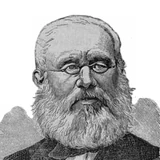
Alexander Petrov
Russian chess begins with him. Before Alexander Petrov there was no Russian chess literature, no Russian master anyone abroad had heard of, and no Russian claim on the theory of the game; when he died in 1867 there was a national school with a founder. He was the strongest player in the empire for more than half a century, wrote its first chess book, gave the language of the openings a defence that still carries his name, and turned Napoleon's retreat from Moscow into a chess problem. Pushkin owned two copies of his manual, one of them inscribed by the author.
◈The boy who beat St Petersburg
He was born on 12 February 1794 at Biserovo in the Pskov Governorate, into a noble family, and came to St Petersburg as a child in 1804. At fifteen he had beaten the leading players of the capital, and from that point — by the reckoning of every account of Russian chess — he was the strongest player in the empire. He held that standing, effectively unchallenged at home, for more than fifty years.
Chess was never his profession. He entered state service in 1808 as a clerk in the Chancellery of Petition Affairs, rose to Actual State Councillor in 1848, and ended as a Privy Councillor holding the Orders of St Stanislaus, St Anna and St Vladimir. The chess was done in the evenings, for half a century, by a senior official of the Russian civil service.
◈The first Russian chess book
In 1824, aged thirty, he published Shakhmatnaya igra, privedyonnaya v sistematicheskiy poryadok — The Game of Chess, Brought into Systematic Order — in St Petersburg. It was the first comprehensive chess manual in the Russian language, five sections covering theory and practice, and it did for a Russian reader what Philidor's book had done for a French one.
It was read well outside chess circles. Pushkin, Turgenev and Chernyshevsky all worked through it; Pushkin's library held two copies, one inscribed “To the esteemed Aleksandr Sergeevich Pushkin in token of genuine respect. From the creator.” Three years later Petrov produced the first Russian manual on draughts as well. His contemporaries called him the Northern Philidor, and like Philidor he was an original rather than a copyist — the assessment recorded of him is of a man unafraid to disagree with Philidor's own ideas.
◈Napoleon's retreat, in fourteen moves
His most famous composition is an allegory. Published in Le Palamède in 1838, The Flight of Napoleon from Moscow to Paris is a mate in fourteen in which every element of the position stands for something: b1 is Moscow and h8 is Paris, the long diagonal is the Berezina, the black king is Napoleon, the white king is Alexander I, and the white knights are Russian cavalry. The solution opens with a double check — 1.Nd2+ Ka2 2.Nc3+ Ka3 — and drives the black king the length of the board to be mated in the far corner.
Petrov attached a note to it that is pure nineteenth-century Russia: had the white queen stood on a8 at move six, Napoleon would have been taken at the river instead of ever reaching Paris.
◈The defence that carries his name
1.e4 e5 2.Nf3 Nf6 — Black declines to defend the e-pawn and counter-attacks instead. Petrov analysed the line with Carl Jaenisch, the other pillar of early Russian theory, and it has been called Petrov's Defence, or simply the Russian Game, ever since. It is C42 in the modern encyclopaedia, and in the two centuries since it has been played at every level of the game, world championship matches included.
He left his name on two other lines as well: a variation of the Bishop's Opening and a gambit in the King's Gambit Accepted. The archive here catches him handling his own defence from the White side against Jaenisch himself in their 1844 match, winning in twenty-six moves — 21.Qg5+ Ng6 22.Nxg6 Rxf1+ 23.Kxf1, and then a king hunt that ends 25.Qh5+ Kxe7 26.Bg5+.
◈Warsaw
From 1840 he lived in Warsaw, holding senior posts in the administration of the Kingdom of Poland, and his house there became the meeting place for Russian and Polish players alike — Alexander Hoffmann, Szymański, Hieronim Czarnowski, and later the young Szymon Winawer, who would go on to be one of the strongest masters in the world.
The most celebrated game of Petrov's life was played in Warsaw in 1844 against Hoffmann, and it survives in this archive. He gave up a knight on f2 at move seven, and what follows is one of the great king hunts of the nineteenth century: the white king is driven from f2 to g3, g4, h3, h4, h5 and finally g5, where 23...Be3 is mate. Ten of Black's last eleven moves are checks.
Staunton invited him to the London tournament of 1851 — the first international tournament ever held, and the event that settled the informal championship of the world. Petrov could not go. It is one of the great might-have-beens of the era.
◈The last years
He kept playing into old age, and kept winning. He beat Prince Sergey Urusov 3–1 at St Petersburg in 1853 and again 13½–7½ at Warsaw in 1859, at sixty-five; he beat Ilya Shumov 4–2 in 1862.
In 1863, with the January Uprising underway in Poland and his wife reportedly aiding the insurgents, Petrov left the country rather than fall under suspicion of revolutionary sympathies. He went to Vienna and then Paris, met the leading masters of Western Europe — though never Morphy — and went on playing: the last two games in this archive are Paris wins from 1863 and 1864, both of them against the King's Gambit, the second played in his seventieth year.
He returned to Warsaw and died there of apoplexy on 22 April 1867, aged seventy-three. He was buried in the city's Orthodox Cemetery; the grave has not survived.
“To the esteemed Aleksandr Sergeevich Pushkin in token of genuine respect. From the creator.”
“An original chess thinker, not afraid to disagree with the ideas of Philidor.”
“The Northern Philidor.”
◈From the archive
◈Legacy
Petrov is the point at which Russian chess starts being written down. He was the empire's first master, its first chess author and its first theorist to be read abroad, and the thread that runs from him through Chigorin to the Soviet school is unbroken. His defence remains one of the soundest answers to 1.e4 at the highest level, played by world champions from both sides of the board. And the Napoleon problem still says something nineteenth-century Russia understood instinctively — that a chessboard could carry a national memory as easily as a mate in fourteen.