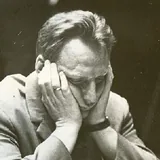
Alexey Suetin was a mechanical engineer who became the first grandmaster of Soviet Belarus, a six-time Belarusian champion and a trainer to World Champion Tigran Petrosian. He shared fourth place in the USSR Championship twice, won or shared first in a long list of international tournaments from Sarajevo 1965 to Dubna 1979, and beat Petrosian, Spassky, Smyslov and Tal. He wrote more than forty books on the opening and the middlegame, commentated for Pravda, radio and television, and won the World Senior Championship in 1996.
Tula and Minsk
Suetin was born on 16 November 1926 in Zinovievsk, the city later called Kirovohrad. He studied at the Tula Mechanical Institute and qualified as a mechanical engineer. He lived in Tula until 1953, in Minsk from 1953 to 1968, and then in Moscow. He first reached the USSR Championship final in 1950, and in the first round at Moscow he beat Tigran Petrosian.
In Soviet Chess Strategy, a collection of his writing published in English in 2010, Suetin recalled that in 1948 he analysed a position from the Meran Variation of the Semi-Slav Defence and sent the work to Chess in the USSR, which printed it. About half a year later Paul Keres, in a survey in the same magazine, showed that it had a “hole”: Keres and Igor Bondarevsky had found 24...e5 for Black. Suetin wrote that the setback made him analyse better: “If you are dissatisfied, it means you are searching, you are improving.” In the same book he recalled first meeting Mikhail Tal, at the USSR Team Championship of 1953, when Tal “was only just sixteen”; what stood out, he wrote, was Tal's “exceptional tenacity in defence”.
At the 1955 World Student Team Championship he scored 80% and won individual and team gold medals. In Belarus he won the national championship six times, in 1953 (jointly with Vladimir Saigin), 1955, 1957, 1959, 1960 and 1961, and he became the first grandmaster of the Belarusian SSR.
In the 1958 match between Yugoslavia and the USSR in Zagreb he played Braslav Rabar, who had just published a long monograph on the Spanish Game. Suetin chose the little-known line with 12.b4, and, as he wrote in Plan Like a Grandmaster, “on encountering this line for the first time Rabar was not able to work things out, despite a great deal of thought.” Rabar came under a crushing attack and lost. At Leningrad in 1960 Suetin sealed a move in a difficult adjourned position against David Bronstein, who then found a reply Suetin had not analysed; Suetin had to find the defence at the board, and drew. Afterwards Bronstein told him that against 41.Kg3, the other move Suetin had considered sealing, he had found “a very delicate forced win”.
Grandmaster
Suetin became an International Master in 1961, a grandmaster of the USSR in 1964 and an international grandmaster in 1965. He played in ten USSR Championship finals, and his best results were shares of fourth place at Leningrad in 1963 and at Tallinn in 1965. In 1963 he also beat Boris Spassky with Black in the Soviet team championship.
In 1965 he won at Sarajevo and shared first at Copenhagen with Mark Taimanov and Svetozar Gligorić, and in 1966 he shared first at Titovo Užice with Aleksandar Matanović. He went on to win or share first at Hastings 1967/68, Havana 1969, Albena 1970, Kecskemét 1972, Brno 1975, Lublin 1976 and Dubna 1979. His highest rating was 2560, in January 1971.
“Exercising chess skill also means not being afraid to take a healthy risk, and knowing how to apply the principles of the chess struggle flexibly.”
“In my view, in modern chess the art of counterattack is indeed the most widespread defensive resource.”
“When he is playing, Karpov the student is all the time learning. And the teachers, when they capitulate, give him high marks.”
“Suetin is not conventional, looks for the new and doubts the old, even if it has been tested a thousand times.”
“Suetin attaches the greatest importance to the dynamic handling of a position, and to the harmonious connection between opening mobilization and the subsequent development of ideas in the middlegame.”
Petrosian's trainer
In the last round of the 1951 USSR Championship Lev Aronin had an adjourned game against Vasily Smyslov that he needed to win to qualify for the Interzonal. “I was assisting him during the adjournment,” Suetin wrote in Soviet Chess Strategy, but Smyslov had a defence that the two had not examined, and Aronin had to take a draw.
Suetin was a second and trainer to Tigran Petrosian in many of his most important matches, including the 1963 match in which Petrosian became World Champion, and he worked with him again in 1979–80. In 1970 he also helped Boris Spassky. For many years he was Moscow's senior coach, and from 1972 to 1988 he was a state coach of the USSR Sports Committee for Russia and Moscow; the young players he oversaw included Vassily Ivanchuk and Andrei Sokolov.
In Garry Kasparov on My Great Predecessors Part IV, Petrosian recalls a bet with Suetin during the 1971 Fischer–Taimanov match: he predicted that Fischer would lead 2–0 after two games. Suetin conceded the bet after the first adjournment of game two; after the second, with a drawn position on the board, Petrosian conceded it himself. Fischer eventually won the game, and Petrosian won the bet.
Author and commentator
From 1965 Suetin was the chess correspondent of Pravda, and he was often heard on Moscow radio and television in the 1970s and 1980s. He wrote more than forty books, most of them on the opening and the middlegame, among them Modern Chess Opening Theory (1965), Plan Like a Grandmaster (1988) and A Contemporary Approach to the Middle Game. In the Closed Ruy Lopez he worked out the system with 9.a3. Chess through the Prism of Time was published in Moscow in 1998, and his opening manual Shkola debyuta (School of the Opening) went to press there in October 2001, a month after his death. In 2010 Quality Chess published Soviet Chess Strategy, a collection of his writing compiled by Ilya Odessky and translated by John Sugden.
Senior champion
Suetin kept playing into the 1990s. He won the Hastings Challengers of 1990/91, and in 1996 he won the World Senior Championship. He was married first to Woman Grandmaster Kira Zvorykina, with whom he had a son, Aleksandr, born in 1951; they divorced in the early 1960s and he married again.
Legacy
Suetin died in Moscow on 10 September 2001, at seventy-four, of a heart attack shortly after returning from the Russian Senior Championship, and he is buried at the Donskoye Cemetery. He had been Belarus's first grandmaster, part of Petrosian's team in the 1963 world championship match, a coach of Moscow's young players and the author of more than forty books, and he won the World Senior Championship five years before his death.
Books
Books Alexei Suetin wrote, co-wrote, edited, or contributed to. Translations and reprints are grouped under the same work.
-
Laboratorium van de schaker
Author
-
Modern Chess Opening Theory / Hoe men de opening speelt / Lehrbuch der Schachtheorie
Author
-
Modernes Mittelspiel / Contemporary Approach to the Middle Game
Author
-
Schachstrategie für Fortgeschrittene, Band 1
Author
-
Schachstrategie für Fortgeschrittene, Band 2
Author
-
Typische Fehler
Author
-
Дебют и миттельшпиль
Author
-
Путь к мастерству
Author
-
Schachlehrbuch für Fortgeschrittene
Author
-
Spanisch: Klassisches System bis Offene Verteidigung
Author
-
Spanisch: Rubinstein-Aufbau bis Breyer-System
Author
-
Französisch bis Nimzowitsch-Verteidigung / French Defence
Author
-
Caro-Kann-Verteidigung bis Aljechin-Verteidigung
Author
-
Pirc-Ufimzew-Verteidigung bis Skandinavisch
Author
-
Schachstrategie der Weltmeister
Author
-
Grünfeld-Indisch / The Complete Grünfeld
Author
-
Grünfeld-Indisch bis Königs-Indisch
Author
-
Выдающиеся советские шахматисты
Author
-
Moderne Denkmethoden des Schachspielers
Author
-
Schachtraining
Author
-
Schachgenie Paul Keres
Author
-
Plan Like a Grandmaster
Author
-
Russisch bis Königsgambit
Author
-
Schachgenie Botwinnik
Author
-
The Complete Spanish
Author
-
David Bronstein: Die Kunst der Schachtaktik
Author
-
Three Steps to Chess Mastery / Ступени к мастерству в шахматах
Author
-
Шахматы сквозь призму времени
Author
-
Soviet Chess Strategy
Author
-
Школа дебюта
Author — Alexei Suetin