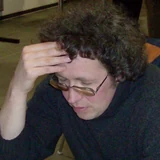
Andrei Sokolov won the World Junior Championship in 1982 and, at his first attempt, the USSR Championship of 1984, the year he became a grandmaster. In the 1985–87 world championship cycle he finished third at the Biel Interzonal, shared first place at the Montpellier Candidates Tournament, and won Candidates matches against Rafael Vaganian, 6–2, and Artur Yusupov, 7½–6½, after trailing Yusupov 4–6. The January 1987 rating list placed him joint third in the world at 2645; a few weeks later he lost the final at Linares to Anatoly Karpov, 3½–7½. He beat Karpov in tournament games at Bugojno in 1986 and Belfort in 1988 and Garry Kasparov at Reykjavik in 1988, won Olympiad gold with the Soviet team in 1984 and 1986, and has played for France since 2000.
Vorkuta to Moscow
Sokolov was born in Vorkuta, in the Komi ASSR, on 20 March 1963, and his family moved to Moscow a few years later. According to the Russian Chess Federation, his father, Yuri Sokolov, headed the juniors' commission of the Soviet chess federation, and his elder brother became a master. His father taught him the game when he was six. On his website Sokolov recalls that one of his first chess books was a collection of Alexander Alekhine's games, which he took as his model.
At 12 he entered one of Moscow's specialized chess schools, where he worked with the trainer Vladimir Yurkov. Garry Kasparov, a few weeks younger, later described him as "a pupil of the experienced Moscow trainer Vladimir Yurkov". Alexei Suetin, who followed his progress as a senior Moscow coach, called him "a practical-minded chess player". In 1981 Sokolov shared first place in the Moscow championship with V. Arbakov.
World Junior and USSR Champion
In 1982 Sokolov won the Soviet qualifying tournament and then the World Junior Championship in Copenhagen with 10/13, a point ahead of Igor Stohl, in a field that included Joel Benjamin, Curt Hansen and Nigel Short. The victory brought him the International Master title.
He qualified for the 1984 USSR Championship from the semifinal at Nikolayev and won the final in Lviv, held from 2 to 28 April, with 12½/17 and no losses, a point ahead of Konstantin Lerner. In round 17 he beat the former champion Alexander Beliavsky with Black. He became a grandmaster the same year and finished second at Novi Sad.
In June 1984 he played on tenth board for the Soviet Union against the Rest of the World in London. At the Thessaloniki Olympiad later that year he was the Soviet team's second reserve and scored 5½/8, and the team won the gold medal. By January 1985 his rating had reached 2550.
“The great champion's flexible, infiltrating manner of play proved an unresolvable mystery for Andrey. Unfortunately, he was subsequently unable to learn fully the lessons from his match defeat and to correct his chess deficiencies.”
“Andrey possesses a memorable attacking style, he splendidly and accurately calculates complicated variations, and he is adept at handling a dynamic endgame.”
“Sokolov's great strength appears to be kingside attacks begun late in the middle game”
“Sokolov seems to be a happy-go-lucky sort of young man, described as casual in his appearance, fond of strumming the guitar — in short, fairly typical of a modern young Muscovite.”
The 1985–87 Candidates cycle
His website records a shared fourth to sixth place in the 1985 USSR Championship at Riga, which was also a zonal tournament and sent him to the Interzonal. At Biel in July 1985 he finished third with 11 points, behind Vaganian and Yasser Seirawan, and in November he won gold with the Soviet team at the first World Team Championship in Lucerne. At the Montpellier Candidates Tournament in October and November 1985 he scored 9/15 to share first place with Yusupov and Vaganian. His wins there included games against Viktor Korchnoi and Zoltan Ribli.
The top four players went on to knockout matches. In the quarterfinal at Minsk in January 1986 Sokolov beat Vaganian 6–2; on his website he notes that he led 3½–½ after four games. In the semifinal at Riga that autumn Yusupov led 6–4 after ten games. Sokolov won the next three, and a draw in the 14th game gave him the match, 7½–6½. Kasparov wrote that the comeback confirmed his reputation as a player without nerves.
Between the two matches Sokolov shared second place with Ljubomir Ljubojevic at Bugojno in 1986, behind Karpov. His win over Karpov there was the former champion's only loss of the tournament and, according to Kasparov, his only defeat over a period of six months. At the Dubai Olympiad that year Sokolov scored 6/9 on third board, and the Soviet team again won gold.
Linares 1987
Because the 1986 return match between Kasparov and Karpov left its loser no time to take part in the qualifying cycle, FIDE decided that the winner of the Candidates matches would meet the loser of that match, Karpov, in a "super-final" for the right to challenge the champion. The match was played at Linares in February and March 1987, over a maximum of 14 games. On the January 1987 rating list Sokolov stood at 2645, joint third in the world.
Karpov won the 2nd and 6th games, then the 10th and 11th, and took the match 7½–3½ after 11 games without a loss. The players used only two openings, the Caro-Kann Defense and the Queen's Indian Defense. The 6th game turned on a long ending that Karpov won in 90 moves. Igor Zaitsev, one of Karpov's seconds, remarked afterward that "Sokolov is one of the few who can endure a defeat comparatively easily".
On his website Sokolov writes that his win at Bugojno had left him a little too optimistic before the match and that the defeat was a severe one. Kasparov judged that Sokolov never fully learned the lessons of the match and that within a few years he had dropped out of the world elite.
The World Cup and later cycles
Sokolov played four events of the 1988–89 GMA World Cup, at Brussels, Belfort, Reykjavik and Rotterdam, and finished 11th overall. At Belfort in June 1988 he beat Karpov in the first round. At Reykjavik in October he beat Kasparov, who wrote that he had outplayed Sokolov with Black before leaving his queen en prise on the 37th move.
In the next cycle he lost his first Candidates match to Kevin Spraggett at Saint John in 1988, 5½–6½, and he did not reach the Candidates matches again. In 1990 he won the Moscow Open ahead of Mikhail Tal and Vaganian. At the 1995 Russian Championship in Elista he shared first place with 7½/11 alongside Evgeny Bareev, Igor Glek, Alexander Khalifman and Peter Svidler, and Svidler took the title on tiebreak.
France
Sokolov has represented France since 2000. He appears under the French flag from the July 2000 FIDE rating list, and he became a French citizen at the end of that year. He played third board for France at the Olympiads of Bled 2002 and Turin 2006 and fourth board at the 2003 European Team Championship in Plovdiv.
In the 2003 French Championship at Aix-les-Bains he tied for first place with Étienne Bacrot and Joël Lautier, and Bacrot took the title on tiebreak. In 2005 at Chartres he finished behind only Lautier. He has played for and coached the Mulhouse club, and his website describes him as a master trainer of the French Chess Federation.
Legacy
Sokolov went from World Junior Champion in 1982 to the final of the Candidates cycle in 1987, beating Vaganian and Yusupov on the way, and between 1986 and 1988 he won tournament games against both Karpov and Kasparov. Since 2000 he has played for France, at two Olympiads and in its national championships, and has worked there as a coach.
Books
No authored or contributed books are documented in the available sources.