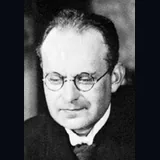
Aron Nimzowitsch never wore the world crown, and for most of his life the chess establishment treated him as a heretic and a crank. He answered with a book. My System taught a whole century how to think about a chessboard — that the centre could be held with pieces instead of pawns, that an opponent's plan could be strangled before it was born, that a passed pawn was a criminal to be locked away. He died poor in a single rented room in Copenhagen, convinced he had been cheated of the recognition he was owed. He was right about the recognition, and right about the chess: the game we play today is, in large part, the game he imagined.
A son of Riga
Aron Nimzowitsch was born in Riga in 1886, in what was then the Russian Empire, into a Jewish merchant family. He learned the moves from his father at eight. In 1902 he left Riga for Germany, living first in Königsberg and then in Berlin. His father expected him to enter a university, but in his memoir How I Became a Grandmaster (1929), reprinted in the 1984 Russian edition of My System, he recalled spending much of those years in chess cafés. After a heavy failure at Barmen in 1905 he enrolled as a student in Zurich in 1906 and settled down to systematic chess study; that November he won a double-round tournament in Munich with 8½ of 10. The biographical note in the 1930 English edition of My System describes his early interest in combinations at the expense of positional play. It dates the development of his system to 1906–1913, following those early disappointments.
History was not kind to his footing in the world. The Russian Empire that issued his papers dissolved in 1917, leaving him stateless for five years until, in 1922, he settled in Copenhagen and took Danish citizenship. There he would live the rest of his life, often in a single rented room, scraping a living from tournaments, exhibitions and the books that would outlast him. He carried, by every account, the wound of a man who believed the world owed him a recognition it kept withholding.
The war on dogma
Chess in Nimzowitsch's youth had a high priest: Siegbert Tarrasch, who taught that the centre must be occupied by pawns, that pieces existed to support that occupation, and that wing play and cramped set-ups were simply errors. Generations of amateurs took these rules as gospel. Nimzowitsch took them as a target.
He argued — and, more dangerously, demonstrated — that the centre could be controlled from a distance, by pieces and by pressure, that a position could be deliberately surrendered space in order to be counter-attacked, that the rules Tarrasch carved in stone were at best useful approximations. The feud between the two men was bitter, public and personal; it ran through the chess press for years. Out of it grew the hypermodern school, the movement Nimzowitsch is rightly called the father of, and a clutch of openings — the Nimzo-Indian Defence, the Nimzowitsch Defence, the Nimzo-Larsen Attack — that bear his name to this day.
In How I Became a Grandmaster he traced the feud to 1904. While the two of them were going over Nimzowitsch's game with Hilse from that year's Coburg tournament, Tarrasch told him that a certain rook move was correct because that was how one played in such positions, and Nimzowitsch resolved to find the laws that governed such decisions. About two months later Tarrasch, ten moves into a private game between them, announced that never in his life had he stood so clearly winning after ten moves; the game was drawn. To play stronger than Tarrasch, Nimzowitsch wrote, was his whole aim from 1904 to 1906. After San Sebastián 1912, where nerves cost Nimzowitsch the decisive game against Rubinstein and he shared second place with Spielmann, Tarrasch remarked that it would have been a scandal for such unaesthetic play to win first prize.
In the historical appendix to My System, Nimzowitsch described how he tested these ideas. During the summer of 1913 he played about twenty or twenty-five serious games with his student and training partner, the agronomist Giese, deliberately avoiding occupation of the center with pawns. They found no refutation, and he tried the approach at the All-Russian Masters' Tournament in St. Petersburg in 1913–1914. His account shows the practice games behind the published arguments.
His influences extended beyond his dispute with Tarrasch. In My Great Predecessors, Part I, Kasparov writes that Nimzowitsch regarded Chigorin as his teacher and adopted his flexible Indian piece arrangements. Kasparov places him among the early developers of the King’s Indian Defence; this was an intellectual influence, rather than an account of personal lessons.
“The passed pawn is a criminal, who should be kept under lock and key. Mild measures, such as police surveillance, are not sufficient.”
“First restrain, then blockade, and finally destroy!”
“Real humor often contains more inner truth than the most earnest seriousness.”
“In the final analysis, it is precisely in the realm of thought that beauty in chess is to be found.”
“On the whole, I have a hard time remembering someone else's published analysis, a failing I have no cause to regret. Such analysis is in most cases simply ballast, weighing down the free flight of fantasy!”
“He pretends to be crazy in order to drive us all crazy.”
“He was too much of an artist to be able to prove he was right, and was regarded as something of a madman in his time. He would be understood only long after his death.”
“Carlsbad 1929 was fated to remain Nimzovich's finest hour.”
“For nearly twenty years Nimzowitsch has been the stormy petrel of the chess world.”
My System
Nimzowitsch is remembered less for results than for a method. In My System (1925–27) and Chess Praxis (1929) he did something no one had done so thoroughly before: he turned the intuitions of positional chess into a vocabulary that could be taught. He named the blockade, stopping an enemy pawn by occupying the square in front of it. He named overprotection, defending a strong point more than it strictly needs so that the defenders gain strength from it. Above all he named prophylaxis: anticipating and preventing the opponent's plan before pursuing your own.
He used everyday comparisons to explain his ideas. In Philip Hereford's translation of My System, he wrote: "The passed pawn is a criminal, who should be kept under lock and key. Mild measures, such as police surveillance, are not sufficient." His method against a mobile enemy pawn center was summarized in Robert Sherwood's translation as "First restrain, then blockade, and finally destroy!" In the foreword he defended this way of teaching: "Real humor often contains more inner truth than the most earnest seriousness."
His assessment of his own games could differ from their reputation. In My System he placed his win over Paul Johner at Dresden in 1926 above the celebrated Sämisch game from Copenhagen in 1923. In Chess Praxis, introducing his 1927 New York win over Alekhine, he argued that moves which looked awkward could still express a coherent plan. "In the final analysis, it is precisely in the realm of thought that beauty in chess is to be found." He could also laugh at his own doctrine. Annotating his win over Karl Gilg at Carlsbad in 1929, he wrote that he "might have paid dearly for my dogmatism" after giving in to the urge to overprotect his kingside "in accordance with my system."
Carlsbad and his peak years
For a stretch in the late 1920s and early 1930s the eccentric from Copenhagen was, by retrospective rankings, the third strongest player in the world, behind only José Raúl Capablanca and Alexander Alekhine, the two men who held the world title between them. He won Copenhagen 1923, shared first with Akiba Rubinstein at Marienbad 1925 and won Dresden 1926. In his memoir he counted Dresden, where he scored 8½ of 9 and finished a point and a half ahead of Alekhine, as his greatest success. At San Remo 1930 he finished second, behind only Alekhine at his very best.
His monument was Carlsbad 1929. In a twenty-two-player field that included Capablanca, Spielmann, Rubinstein, Vidmar, Euwe and Bogoljubov, Nimzowitsch finished first with 15 out of 21 — half a point clear of Capablanca and Spielmann. It was the greatest tournament triumph of his life, and his win over Bogoljubov shared the prize for the best-played game. In his book of the tournament, published in Russian in 1930 and in Jim Marfia's English translation as Carlsbad International Chess Tournament 1929, he put his calm down to J. P. Müller's home exercises: "three months before the tournament began I undertook a strict program of Muller's exercises." Müller's best-selling exercise book, Marfia notes, was also called My System. In the first round, Nimzowitsch admitted, he was still nervous enough to complain, "How is anyone to come up with a decent training partner in Denmark?" He ended his account of the tournament with a demand: "The chess world is obligated to organize a match between the champion of the world and the winner of this Carlsbad tournament — indeed, this is a moral obligation." The match never came. The editors of the 1984 Russian edition of My System point to the $10,000 purse a challenger then had to raise, and Marfia adds that he "regularly made more enemies than friends," a handicap for a man who needed a wealthy patron. Nor could he solve Capablanca, against whom he scored not a single win in eleven games. Kasparov judges in My Great Predecessors, Part I that, despite his challenges and tournament successes, Nimzowitsch never came close to winning the world title.
The man who was too much of an artist
Nimzowitsch was as singular off the board as on it. His friend and chronicler Hans Kmoch documented a vanity and a persecution complex that shaded into comedy: at the dinner table he was convinced he was always served the smaller portion, and would not be talked out of it even when the plates were swapped. Losing a Berlin game to Friedrich Sämisch, he is said to have leapt onto the table and cried, "Why must I lose to this idiot?"
The most famous Nimzowitsch story — probably apocryphal, entirely in character — has him protesting to an arbiter that an opponent had set an unlit cigar on the table, reasoning that "the threat is stronger than the execution." Savielly Tartakower, who knew him well, offered the kindest diagnosis: "He pretends to be crazy in order to drive us all crazy." Behind the eccentricity was a thin-skinned artist who needed, as Kmoch put it, only a little praise to blossom — and who got far too little of it in his lifetime.
His annotations also record the effect a mistake could have on him. In Chess Praxis he revisited his draw with Milan Vidmar at Carlsbad in 1907. A blunder on move forty lost a winning position; when another opportunity to win arose three moves later, he missed it too. He explained that "I was still suffering from the after-effects of my horrible mistake."
Legacy
Nimzowitsch died of pneumonia in Copenhagen on March 16, 1935, aged forty-eight, and was buried in the city's Bispebjerg Cemetery, still, after a decade as a Danish citizen, living in one small rented room. He never got the title match he was so clearly built for. The Dutch grandmaster Jan Hein Donner described him well: he was "too much of an artist to be able to prove he was right," a man "regarded as something of a madman in his time" who "would be understood only long after his death." He was. My System has never gone out of print and is often named among the most influential chess books ever written; the prophylaxis and blockade he described became the common language of positional play, taken up by Botvinnik, Petrosian (who as a boy spent ration money on Nimzowitsch's Chess Praxis), Larsen, Korchnoi and every player who has since fianchettoed a bishop and dared to leave the center alone. The Nimzo-Indian Defense is still played at the very top of the game.
Books
Books Aron Nimzowitsch wrote, co-wrote, edited, or contributed to. Translations and reprints are grouped under the same work.