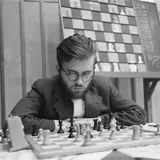
Bent Larsen was Denmark's strongest player and, for much of the 1960s and 1970s, the leading non-Soviet grandmaster alongside Bobby Fischer. He won the first Chess Oscar, played board one ahead of Fischer in the 1970 USSR–Rest of the World match, and defeated all seven world champions from Botvinnik to Karpov. His openings included 1.b3, Bird's Opening and the Philidor Defense. His books explain the preparation behind those choices, with frank assessments of his own play and a dry sense of humor.
Choosing chess
Larsen was born in 1935 in the Jutland village of Tilsted, near Thisted. In his chapter of How to Open a Chess Game (1974) he recalled: “I learned the rules of the game before I was seven, my teacher was nine.” The young teacher’s father was one of the best players in the town, and Larsen beat him seven years later. An old chess book he found at home when he was nine started him on the King’s Gambit, and he joined the chess club at twelve because he “wanted to play stronger opponents than my father.” At seventeen he moved to Copenhagen to study civil engineering, but left without graduating to play professionally. He was Danish Champion six times — in 1954, 1955, 1956, 1959, 1963 and 1964 — and in 1956, on board one for Denmark at the Moscow Olympiad, he made the best score on first board and was awarded the Grandmaster title. “I beat Gligoric but drew with all the other grandmasters,” he wrote. “But I wanted to beat grandmasters.” He began to experiment with his openings.
His interest in composed endgames began early. In the introduction to the endgame section of Bent Larsen's Good Move Guide, he recalled an early fondness for studies. The book's exercises also drew on his own tournament games and the practical problems he had met at the board.
The best of the West
Through the 1960s Larsen joined the small group of players who could regularly trouble the Soviets. He shared first place at the 1964 Amsterdam Interzonal, alongside Smyslov, Spassky and Tal, and qualified for the Candidates. In the 1965 cycle he beat Borislav Ivkov, then took Mikhail Tal to the very end of their semifinal before losing 4½–5½; four years later he turned the tables and beat Tal 5½–2½ in a 1969 rematch. Larsen wrote that he liked the story of Ivkov’s preparation for their 1965 match: “He studied 200 games with Bird’s Opening!” Larsen did not play it, and Ivkov later used it himself with White. Larsen won the 1967 Sousse Interzonal by a clear margin and followed it with a run of tournament wins, Havana, Palma de Mallorca, Monte Carlo, and the U.S. and Canadian Opens, that made him widely regarded as the second-strongest non-Soviet player in the world after Fischer.
The recognition was made literal in 1970. When a USSR team met a Rest of the World side in Belgrade, the question of who would take board one for the West came down to Larsen and Fischer — and it was Fischer who stepped aside, ceding the top board to the Dane. Larsen scored 2½ of 4. Against the reigning world champion Boris Spassky he drew the first game, lost the second and won the third with Black, and in the last round he beat Leonid Stein, who replaced Spassky. The loss was a 17-move game with 1.b3, an opening Larsen had first played internationally in 1968. He later wrote that it “has become popular even among grandmasters, especially since I lost disastrously to Spassky in Belgrade 1970.” In 1967 he had already been voted the very first Chess Oscar as the year's outstanding player.
He also saw Fischer’s rise from the other side of the board. Kasparov records in My Great Predecessors, Part IV that Larsen served as Fischer’s second at the 1959 Candidates tournament in Yugoslavia, twelve years before their semifinal in Denver.
“I find it unpleasant to annotate this game, which more or less ruined the tournament for me. But perhaps someone will learn from it to keep his eyes open.”
“But I decided that so close to the Alamo I could not allow myself to be a coward ...”
“I don't often play a move I know how to refute. Twice a year maybe, and even then a move which I think my opponent would be able to refute only in correspondence chess.”
“Ne5 looks natural, but I hate making natural moves.”
“a firm believer in the value of surprise”
“He prefers reality to mysticism, although he sometimes creates the impression that most things are a bit absurd.”
“To Petrosian a draw is winning half a point; to Larsen it is losing half a point.”
“Only Larsen would play a move like that, it's ridiculous.”
Denver, 1971
In the 1971 Candidates, Larsen beat Wolfgang Uhlmann and reached a semifinal against Bobby Fischer. Fischer had just defeated Mark Taimanov 6–0 and repeated that score against Larsen in Denver: six games, six wins, without a draw.
Larsen later attributed part of the defeat to the timing and the heat. He described himself as languid in those conditions and Fischer as better prepared for them. He continued to win major tournaments afterward, including the 1976 Biel Interzonal, which brought him another Candidates appearance.
Why not the Philidor?
Larsen used 1.b3 — the Nimzo–Larsen Attack — at the highest level, along with Bird's Opening, the Grand Prix Attack against the Sicilian, the Scandinavian and the Philidor Defense. In 1971 he published Why Not the Philidor Defense?. His Scandinavian win over Anatoly Karpov came at Montreal in 1979, when Karpov was the reigning world champion.
Samuel Reshevsky described him as "a firm believer in the value of surprise." Larsen gave a practical explanation in Teoría y práctica en los juegos abiertos, translated into Spanish by Franco L. Di Luca. He recommended concentrating on a small repertoire and understanding its dangers. He would not copy Polugaevsky's sharp Najdorf line without the study and experience it required. Unfashionable openings offered surprise and less scope for an opponent's exhaustive theoretical preparation. His Larsen's Selected Games of Chess, 1948–69 likewise discusses psychology and his own decisions.
Bent Larsen’s Good Move Guide also shows his humour as a teacher. In chapter 3, game 4, he explained that an opening trap still brought him occasional wins in simultaneous displays, and jokingly advised its victims to read his books.
Playing and reporting at San Antonio
At San Antonio in 1972, Larsen was both a competitor and a reporter. In San Antonio '72, tournament coordinator George Koltanowski attributed some of his difficulties to that workload: "Bent was reporting the tournament and had too much work on his hands." Larsen shared eighth place with 8½ points from fifteen games. Sherry Rittenhouse, writing about the players from a spectator's viewpoint, recalled his quick humor and his visits to local schools and the San Antonio Chess Club.
His loss to Paul Keres drew a frank account of his own mistakes. Larsen wrote that it "more or less ruined the tournament for me" and called his sixtieth move "Blunder of the year!"
His notes to his win over Larry Evans describe why he chose a Queen's Indian setup that could sustain a long struggle. When Evans offered a draw, Larsen hesitated because he had been suffering from stomach trouble for several days, then played on. "But I decided that so close to the Alamo I could not allow myself to be a coward ..." he wrote. He won in 43 moves.
The same book shows his humor as an annotator. Against Kenneth Smith, Mario Campos-Lopez answered 1.e4 with the French Defense. Larsen suggested that 1…c5 was stronger because it "wins a pawn": Smith kept offering the Morra Gambit and had been getting poor results with it at the tournament.
The long Argentine evening
From the early 1970s Larsen divided his life between Las Palmas and Buenos Aires, settling at last in Argentina with his wife Laura Beatriz Benedini. He kept writing — books, columns, tournament reports turned out with a journalist's speed — and kept playing into old age, even as diabetes slowed him.
In 1979 Larsen won the fourth series of the BBC television program The Master Game, in which the players’ thoughts, recorded after each game, were heard over the moves. In the final he drew four games with Vlastimil Hort and won the fifth when Hort lost on time. In his foreword to Jeremy James and William Hartston’s The Master Game, Book Two (1981), Larsen wrote that he had the initiative in three of the draws and in the fifth game “got only one advantage out of it: four minutes against two! ... Then I gambled and won.” The authors noted that when asked for his best game or tournament, he “simply smiles and says it has not been played yet.”
Larsen’s newspaper work could reach directly into tournament preparation. Emmanuel Sztein, Korchnoi’s press attaché, recalled in My Great Predecessors, Part V that a 1980 Clarín column analyzed the very line Korchnoi’s team had been preparing overnight against Polugayevsky. Larsen was reporting on the simultaneous Hübner–Portisch match in Italy and supplied improvements for both sides. Korchnoi played the line anyway, trusting that his opponent had not read the column.
In 1988 he became the first grandmaster to lose to a computer in tournament play, falling to Deep Thought; in 1993 he took his revenge, winning a Copenhagen match against an early Deep Blue 2½–1½.
He won games against every world champion from Botvinnik to Karpov and remained Scandinavia's strongest player until Magnus Carlsen. Bent Larsen died of a cerebral hemorrhage in Buenos Aires in 2010, aged 75.
Legacy
Larsen's tournament results made Denmark a presence in the world championship contests of the 1960s and 1970s. The Nimzo–Larsen Attack carries his name, and his books preserve his assessments of familiar positions, unusual openings and his own mistakes. His willingness to play long games for a win was accompanied by a practical concern for preparation and the positions he understood. He was Scandinavia's strongest player before Magnus Carlsen.
Books
Books Bent Larsen wrote, co-wrote, edited, or contributed to. Translations and reprints are grouped under the same work.
-
XII. Skakolympiade Moskva1956: De danske partier
Author
-
Åbningsspillet i skak
Author
-
Lærebog i skak
Author
-
Hvad skal sort spille? Den åbne variant i spansk
Author
-
Krylbo1966: Schackklubbs50års jubilæumsturnering
Author
-
Second Piatigorsky Cup International Grandmaster Chess Tournament
Contributor — own game annotations
-
Larsen's Selected Games of Chess1948–1969
Author
-
Why Not the Philidor Defense?
Author
-
San Antonio 1972
Coauthor — David Levy
-
Spasskij–Fischer72: Verdensmesterskabet i skak Reykjavik1972
Author
-
How to Open a Chess Game
Coauthor — Larry Evans, Svetozar Gligoric, Vlastimil Hort, Tigran Petrosian, Lajos Portisch, Paul Keres
-
Otte om kongen: Da Larsen scorede83% i Manila!
Author
-
Bent Larsens skakskole, 1: Find kombinationen
Author
-
Bent Larsens skakskole, 2: Find planen
Author
-
Learn from the Grandmasters
Contributor — own game annotations
-
Bent Larsens skakskole, 3: Find mestertrækkene
Author
-
Bent Larsens skakskole, 4: Praktiske slutspil
Author
-
Karpov vs. Korchnoi: World Chess Championship1978
Author
-
Vi spiller skak, 1
Coauthor — Bjarne Tønnies, Jørn Lorenzen
-
Vi spiller skak, 2
Coauthor — Bjarne Tønnies, Jørn Lorenzen
-
Vi spiller skak, 3
Coauthor — Bjarne Tønnies, Jørn Lorenzen
-
Vi spiller skak, 4
Coauthor — Bjarne Tønnies, Jørn Lorenzen
-
Zoom001: Zero Hour for Operative Opening Models
Coauthor — Steffen Zeuthen
-
3points' forspring: Clarin-turneringen1979
Author
-
Bent Larsens skakskole, 5: Solide åbninger
Author
-
Vi spiller skak, 5
Coauthor — Bjarne Tønnies, Jørn Lorenzen
-
Vi spiller skak, 6
Coauthor — Bjarne Tønnies, Jørn Lorenzen
-
The Master Game, Book Two
Contributor — game annotations
-
Vi spiller skak, 7
Coauthor — Bjarne Tønnies, Jørn Lorenzen
-
Vi spiller skak, 8
Coauthor — Bjarne Tønnies, Jørn Lorenzen
-
Vi spiller skak, 10
Coauthor — Bjarne Tønnies, Jørn Lorenzen
-
Vi spiller skak, 9
Coauthor — Bjarne Tønnies, Jørn Lorenzen
-
Vi spiller mere skak, 1
Author
-
Vi spiller mere skak, 2
Author
-
Bent Larsens skakskole, 6: Skarpe åbninger
Author
-
Bent Larsens skakskole, 7: Flere mestertræk
Author
-
Todas las piezas atacan
Author
-
Bent Larsen's Best Games: Fighting Chess with the Great Dane
Author
-
Teoría y práctica de los juegos abiertos
Author
-
The Master Game, Book One
Contributor — game annotations