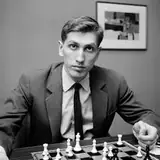
A boy from Brooklyn who learned Russian so he could follow the Soviet masters' games grew up to beat the Soviet chess school, then walked away from the game at the height of his powers. Bobby Fischer wanted to win every game, with both colors, against everyone. In 1970 and 1971 he came close to doing exactly that, beating the world's strongest players by scores no one had thought possible. In the summer of 1972, in Reykjavík, he won the title that Soviet players had held since 1948.
The boy from Brooklyn
Robert James Fischer was born in Chicago on 9 March 1943 and raised, after his parents separated, in Brooklyn by his mother Regina, a nurse and teacher. "I learned to play chess when I was six from my older sister, Joan," he wrote in 1966, in the first of his Boys' Life columns. Garry Kasparov, in My Great Predecessors, adds that Joan had been given the set by a grocer for being a regular customer and taught her brother from its instructions; after a few wins she began to lose to him.
The game took hold of him so completely that it worried his mother. She placed a newspaper advertisement looking for a teacher and opponent for him, and Hermann Helms, who read it, invited the boy to a simultaneous exhibition by the master Max Pavey on 17 January 1951. Pavey beat him in fifteen minutes. Watching was Carmine Nigro, president of the Brooklyn Chess Club, who took him on as a pupil. The lessons cost a dollar an hour, Fischer recalled: "I'm sure he wasn't interested in the dollar, but this was his way of making sure I took the lessons seriously." Years later he said: "Mr Nigro was possibly not the best player in the world, but he was a very good teacher."
His talent showed early and fast. At thirteen, against Donald Byrne in the 1956 Rosenwald tournament in New York, he played the game that became known as the Game of the Century; Kasparov writes that Fischer later called it the best of his career. In the summer of 1957 he won the U.S. Junior and U.S. Open championships, and in January 1958, at fourteen, the United States Championship. At sixteen he dropped out of high school to give his life entirely to chess. "You don't learn anything in school," he said. He won every U.S. Championship he entered, eight in all, and in 1963/64 he won eleven games out of eleven against the strongest field in the country, still the only perfect score in the championship's history. In My 60 Memorable Games he recalled that "Dr Kmoch congratulated Evans (the runner up) on “winning” the tournament ... and then he congratulated me on “winning the exhibition.”"
The youngest grandmaster
Before the 1958 Portorož Interzonal the fifteen-year-old had a plan, as Kasparov tells it: "I will always be able to catch five “rabbits”, who I will defeat, and with the rest I will draw." He finished in the qualifying places, became the youngest Candidate for the world title and was awarded the Grandmaster title at fifteen years and six months, the youngest the world had then seen. The chess world struggled to make sense of him. "It was interesting for me to observe Fischer," David Bronstein admitted, "but for a long time I couldn't understand why this 15-year-old boy played chess so well."
Through the 1960s Fischer was clearly one of the best players alive, yet the world title kept slipping away amid disputes over the Soviet-dominated qualifying system, which he believed, with some reason, was rigged by collusion among the Soviet players. He finished fourth at the 1962 Candidates tournament in Curaçao, behind Petrosian, Geller and Keres, and then accused the three, in Sports Illustrated, of agreeing to draw among themselves. All twelve of their games against one another were drawn, in 14 to 27 moves. Jan Timman, who reconstructed the event in Curaçao 1962, analyzed one of them and wrote: "My conclusion is that Fischer was correct in declaring that Petrosian agreed to a draw in a winning position." In the 1990s Petrosian's former trainer Suetin wrote, as Kasparov reports, that the three had concluded a "non-aggression pact". FIDE abolished the Candidates tournament, and from the next cycle the Candidates were decided by matches. The tournament showed another side of him too: Tal spent much of it in hospital, and the only player who visited him there was Fischer.
In 1967 Fischer withdrew from the Sousse Interzonal while leading it. When a press attaché from the American embassy reminded him that he was representing the United States, he replied, "I represent no one here but myself." He kept working. My 60 Memorable Games (1969), annotated, he wrote, to be "both candid and precise," became one of the most admired game collections in chess literature. Its notes show him at the board. At Bled in 1961, with Tal close to clinching first place, Petrosian offered him a draw: "I was ready to accept, but Tal happened to be standing there ... So I refused – not because I thought White has anything in the position, but because I didn't want to give Tal the satisfaction!" He went on to win the game. Fischer thanked his friend Larry Evans, who wrote the book's introductions, for his "invaluable aid in the preparation of the text."
“In top-flight chess, you have to drive your advantage home unmercifully.”
“I've made this sacrifice so often, I feel like applying for a patent!”
“Chess requires total concentration. ... I always try to put my best foot forward. This means I want to win. No one’s interested in excuses if I lose.”
“I’ve never played a computer. Eventually, though, I think a computer can become champion. After all, it can’t be as hard as getting a man on the moon. But I hope it doesn’t happen during my lifetime!”
“The only thing in chess that Fischer does without pleasure is losing. Then the pieces are instantly set up again, for revenge ...”
“After the sixth game, Fischer really did become a genius.”
“Well, I still have my music.”
“Fischer – and this is his chief merit – placed chess on a professional footing. He was the first genuine chess pro!”
The march of 1971
Then came a run no one has matched since. Fischer won the 1970 Palma de Mallorca Interzonal with 18½ out of 23, three and a half points clear, and went on to the Candidates matches. In the quarter-final at Vancouver he met Mark Taimanov, who came with Evgeny Vasiukov, Yuri Balashov and the delegation head Alexander Kotov. Fischer had no second: Larry Evans had pulled out over Fischer's demands, and only Colonel Ed Edmondson came with him, Taimanov recalls in I Was a Victim of Bobby Fischer. Fischer won six games to nil. In the fifth game, when Taimanov blundered just after the adjournment, Fischer said "I'm sorry" as he played the winning reply. Afterwards he said: "The 6-0 result was too high. ... It is easier to be a gentleman when you win, than when you lose." At home Taimanov paid for the score: he was stripped of his title of Honoured Master of Sport, dropped from the Soviet team and barred from playing abroad for almost two years.
In the semi-final he faced Bent Larsen, who had been given first board ahead of him for the Rest of the World against the USSR in Belgrade in 1970, and beat him by the same score, 6–0. By the time Tigran Petrosian, the former world champion, won a game from him in the final, Fischer had won twenty consecutive games against the elite of world chess, one of them by forfeit when Oscar Panno defaulted at Palma. He took the final 6½–2½. "After the sixth game," Petrosian said, "Fischer really did become a genius." Kasparov wrote that not even Lasker's wins over Marshall and Janowski could be compared with Fischer's 12–0 against Taimanov and Larsen.
Reykjavík, 1972
The challenge was set: Fischer against Boris Spassky, the reigning World Champion, in Reykjavík in the summer of 1972. It became the Match of the Century, broadcast in American prime time and front-page news around the world in the middle of the Cold War. Fischer almost didn't come, complaining about money and conditions until the British financier Jim Slater doubled the prize fund to $250,000.
It began badly for him. In the first game, in a dead-drawn bishop endgame, he took a poisoned pawn and lost. He forfeited the second, refusing to play in front of the cameras: "During the resumption of the 1st game I suddenly noticed that the Chester Fox film crew were filming directly over the chessboard!" He trailed 0–2, and he had never beaten Spassky. The third game was moved to a back room away from the cameras; Spassky later said, "I saved Fischer, by playing the third game. In this game I essentially signed my capitulation of the entire match." Fischer, with William Lombardy as his second, won the title 12½–8½. He was the eleventh World Chess Champion, the first American to hold the title, and the first non-Soviet to take it in twenty-four years. New York's mayor declared 22 September 1972 Bobby Fischer Day, and membership of the U.S. Chess Federation doubled in a single year.
The vanishing
And then, at the height of his career, he stopped. When the time came to defend the title against Anatoly Karpov in 1975, Fischer set conditions FIDE wouldn't fully grant: a match to ten wins, no game limit, and a clause that let the champion keep his title on a 9–9 tie. At an extraordinary congress in Bergen in March 1975, FIDE accepted the unlimited match by 37 votes to 33 but rejected the 9–9 clause by 35 votes to 32. Fischer didn't reply by the deadline, and on April 3, 1975 Karpov became champion by default. Fischer never played a competitive game as World Champion, and he didn't sit down at a tournament board again for almost twenty years. In May 1981, while he was living in Pasadena, California, he was arrested there. In his own account, written that June and published by him the next year as a pamphlet, I Was Tortured in the Pasadena Jailhouse!, a police officer stopped him in the street, saying he fitted the description of a man who had just robbed a bank; he was held for about two days, charged with interfering with the duties of an officer and released on bail. He signed the pamphlet with the name Robert D. James. "I do not pretend that this is literature," he wrote.
He appeared once more, in 1992, for an unofficial rematch with Spassky in war-torn Yugoslavia, then under United Nations sanctions; he won 10–5, but playing there broke a U.S. executive order, and his own government issued a warrant for his arrest. He never went home. The later years were bleak: long stretches of isolation, increasingly bitter and extreme public statements, and a detention in Japan in 2004 over a revoked passport, until Iceland, remembering 1972, gave him citizenship by act of parliament. He died in Reykjavík on January 17, 2008, aged sixty-four. Even in exile he kept thinking about the game: he gave chess the time-increment clock that now bears his name, and invented Fischer Random Chess, Chess960, to free the game from the opening theory he feared had drained it dry.
Legacy
Fischer was champion for only three years, but every champion since has been measured against his preparation, fighting spirit and will to win. He took the game from a Cold War curiosity to front-page news and sent U.S. Chess Federation membership soaring. Players are paid better because of him: Taimanov, whose 1971 match against him carried a prize fund of three thousand dollars, credited him with standing up for his colleagues "like an influential and persistent trade union boss": "the millions in prizes and the many thousands in honorariums that govern modern chess life are above all due to him!" His later life was a long exile, stateless and estranged, his public statements increasingly bitter and extreme, until Iceland, where he had won the title, gave him citizenship in his last years; he died in Reykjavík in 2008 and is buried there. Two of his inventions are still used every day: the Fischer clock, whose time increment after each move is now standard at every level, and Fischer Random Chess, or Chess960, his answer to a game he feared had been studied to death. Bobby Fischer Teaches Chess and My 60 Memorable Games are still in print. Taimanov, who knew him for a decade, wrote: "I can swear that I never saw him without a chess set and a chess book."
Books
Books Bobby Fischer wrote, co-wrote, edited, or contributed to. Translations and reprints are grouped under the same work.
-
Bobby Fischer's Games of Chess
Author
-
Bobby Fischer Teaches Chess
Coauthor — Stuart Margulies, Donn Mosenfelder
-
Second Piatigorsky Cup International Grandmaster Chess Tournament
Contributor — own game annotations
-
My 60 Memorable Games
Author
-
I Was Tortured in the Pasadena Jailhouse!
Author
-
Checkmate: Bobby Fischer’s Boys’ Life Columns
Author