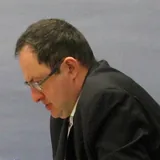
Some players shine briefly and disappear; Boris Gelfand simply stayed. For nearly three decades he was among the strongest players in the world, formed in the Minsk chess tradition of Isaac Boleslavsky and Albert Kapengut, and he carried patience, logic and long strategic plans into the computer age. He took the classical chess of his hero Akiba Rubinstein as his model, refusing shortcuts and trusting ideas. He won the Candidates in 2011 and, at forty-three, played Anand for the World Championship itself, coming very close to winning it.
A son of Minsk
Boris Abramovich Gelfand was born on 24 June 1968 in Minsk, the capital of the Byelorussian Soviet Socialist Republic, to Abram and Nella, both engineers. He came to chess very young. In Technical Decision Making in Chess (2020) he names his first trainer, Eduard Zelkind, “who was my trainer from age 6 to 11”, and remembers Zelkind explaining rook endings to him. Dirk Poldauf's biographical essay in Gelfand's My Most Memorable Games (2005, p. 10) adds that Zelkind usually taught only schoolchildren and made an exception for the boy, who was still in nursery school.
When Zelkind emigrated to the United States in 1979, he asked his friend Albert Kapengut to look after his best pupil, Gelfand writes in the Spanish edition of Dynamic Decision Making in Chess (La toma de decisiones en el ajedrez dinámico, 2018, p. 9). Poldauf records that Boris also studied with Tamara Golovey and that from 1980 he worked with Kapengut for twelve years. Kapengut had studied with Isaac Boleslavsky from the age of fourteen, and Yuri Razuvaev called Gelfand Boleslavsky's chess grandchild (My Most Memorable Games, p. 11). Gelfand himself says that the Soviet school of chess never existed as such and was only a metaphor; he places his own play in the Minsk tradition of Boleslavsky, passed on through Kapengut (La toma de decisiones, p. 36).
In Positional Decision Making in Chess (2015, pp. 5–7), Gelfand describes how his father taught him from Averbakh and Beilin's Journey to the Chess Kingdom, a chapter each day. One day Boris seemed to have lost interest; his father discovered that Boris had already finished the book on his own while his father was at work. At six, Boris played blitz on a beach in Crimea, and a friend of his father's recommended finding him a trainer. Abram kept scrapbooks of his son's results and searched for books for him, even trading a detective story for Larsen's selected games.
Petrosian also belonged to his education. Kasparov writes in My Great Predecessors, Part III that Gelfand attended the junior school Petrosian established for the Spartak club in Moscow in 1977. Petrosian worked with the children twice a year and, while his health allowed, attended every session. Gelfand had joined Spartak to train with Kapengut and was invited to the school after winning the club's under-18 championship. He attended its camps three times, in Sochi in 1980, when he was twelve, and in Moscow in 1981 and 1983 (La toma de decisiones, pp. 37–39). In My Most Memorable Games he remembered Petrosian telling him: “Never make a move without there being an idea behind it, even when playing blitz. Always think!” (p. 11).
When the 47th USSR Championship was held in Minsk in 1979, his father took him to the tournament regularly. Poldauf tells how Abram came to collect him late one evening and found one game still in progress and one spectator, his son, who would not leave until it had finished. Boris collected the autographs of all eighteen players and of the chief arbiter Salo Flohr, and his father remembered Kapengut's wife telling the boy: “Soon people will be asking you for your own autograph” (My Most Memorable Games, pp. 11–12).
From the beginning Gelfand looked backward to look forward. He fell in love with the games of Akiba Rubinstein, the tragic Polish master of the early twentieth century, and made Rubinstein's method — deep opening preparation, the patient realisation of a long strategic plan — the foundation of his own.
The Rubinstein connection began with a book too. At nine, he read Razuvaev and Murakhveri's collection straight through without a board, then started again from the beginning. He later became close to Yuri Razuvaev, who would telephone after a game in Rubinstein's style and call him the “Akiba of our time”. Even when terminally ill during the 2011 Candidates, Razuvaev encouraged him; when Gelfand called to ask about his health, he turned the conversation back to Gelfand's chances of winning (Positional Decision Making in Chess, p. 12).
At Minsk in 1986, his first international tournament, he needed 1½ points from the last two rounds for a grandmaster norm. Friends advised a draw with White against the experienced grandmaster Iosif Dorfman, but Gelfand played his favourite line of the Grünfeld and lost. He wrote in My Most Memorable Games that he “didn’t regret at all the fact that I missed the grandmaster norm” after such a fighting game, and spent the following month analysing it with Kapengut (pp. 17–20). The title came in 1989, when he was twenty-one: he won at Debrecen and exceeded his final norm by a point (p. 24). In the USSR Championship that year he took the bronze medal and the magazine 64's prize for the player who sacrificed the most material (p. 9).
Among the elite
The breakthrough came at Linares in February 1990. On his debut there he drew with Kasparov in the first round, won six games and finished second, half a point behind the world champion (My Most Memorable Games, p. 12). The Kasparov game won the best-game prize, “an extremely heavy statue”, and the two players tossed a coin for it: “it was a rare case when I was happy to lose, as I had no idea how I would be able to transport it back home!” (p. 80). In the July 1990 rating list, at twenty-two, Gelfand was equal third in the world, behind only Kasparov and Karpov. Later that year he shared first with Vassily Ivanchuk at the Manila Interzonal. He shared first at Wijk aan Zee and at the Alekhine Memorial in Moscow in 1992, won the Biel Interzonal outright in 1993, and beat the reigning generation of champions head to head, defeating Anatoly Karpov, Vladimir Kramnik, and his great contemporary Vassily Ivanchuk along the way.
Ivanchuk had finished half a point behind him in the 1985 USSR under-18 championship and the 1987 European Junior Championship (p. 12). Flying home from the 1988 World Junior Championship in Australia, Gelfand said he had dreamed that one day they would play together in the Soviet team. “Vasily instantly replied: ‘Sure, on the first two boards!’ I took this as a joke, but just two years later Vasily’s words came true.” At the 1990 Olympiad in Novi Sad the two shared third and fourth places on the world list, so the captain tossed a coin to set the board order, and the Soviet team won gold (p. 86).
When the Soviet Union dissolved, Gelfand's life changed with it. In 1998 he emigrated to Israel, settling in Rishon LeZion, and for the next decade and a half he was the heart of Israeli chess — leading its Olympiad team and carrying its flag at every World Championship cycle. He had become a wanderer between worlds, but his chess never wavered.
His book records a less secure moment behind that long career. Before the 1998 Rubinstein Memorial, he had received no tournament invitations for six months and feared his career was in ruins. He won the event, including a memorable victory over Alexei Shirov, and regarded the result as his return to form (Positional Decision Making in Chess, pp. 12–13).
“I am not one of those people who feel a need to pretend that I am a genius or that I invented everything on my own.”
“I am past the youthful need to prove to others that I understand chess, and ready to explain how chess is understood instead.”
“The day you give up the hope of beating young opponents with White, you have truly grown old!”
“But I answered that I just wanted to keep on enjoying playing chess and I still enjoy it.”
“Whenever something was obvious to Boris, I knew that it might not be obvious to many others; and that his explanation would be very instructive.”
“Akiba of our time”
“What impresses me most is his ability to create games, where all the moves, from the first to the last, are as though links in a single logical chain.”
The long pursuit
Few players have chased the World Championship as long, or as faithfully, as Gelfand. He was a Candidate again and again across more than two decades — in 1991, 1994–95, 2002, 2007, 2011, and 2013 — always near the prize, never quite through. Then, in his forties, when the chess world had filed him away as a permanent contender, he produced the run of his life.
In the 1994 Candidates matches he beat Michael Adams 5–3 and then, in the quarter-final at Sanghi Nagar in India, the eighteen-year-old Vladimir Kramnik 4½–3½. In Technical Decision Making in Chess he recalls that during the eighth game, in which he was a pawn up, a riot broke out over local problems, and his second Alexander Huzman feared the game would be abandoned and replayed, “which would be a novel way to lose an extra pawn”. Asked by the magazine Schach three years later whether the win had surprised him, he replied: “No, I was better prepared than Kramnik. I learned practically all his games by heart” (My Most Memorable Games, p. 13). In the semi-final, also at Sanghi Nagar, in 1995, he led Anatoly Karpov 2–1 but lost the match 3–6 (p. 14).
In 2009 he won the World Cup in Khanty-Mansiysk as top seed. At the semi-final stage, against Sergey Karjakin, so-called experts telephoned his wife to tell her he would be home in a few days; in the Spanish edition of Dynamic Decision Making he writes that he had been hearing such forecasts since 1998 and no longer minded them. In the final against Ruslan Ponomariov all four classical games were drawn, and Gelfand won the tiebreak by taking its last two games in a row (La toma de decisiones, pp. 239, 255). Two years later, in 2011, he won the Candidates matches — past Shakhriyar Mamedyarov, past Gata Kamsky, and finally past Alexander Grischuk in the final — to earn, at forty-two, the right to challenge for the World Championship. It was a triumph of endurance over fashion: the old classicist had out-lasted them all.
Moscow 2012
The match against the reigning champion Viswanathan Anand was held in May 2012 at the Tretyakov Gallery in Moscow, and it was desperately close. Gelfand struck the first blow, scoring the only classical win either man managed in the early going to take the lead in the match. Anand levelled almost at once — winning the next game in a startling seventeen moves, the shortest decisive game in World Championship history — and after twelve classical games the score stood even, 6–6.
It went to a rapid tiebreak, and Anand kept the crown 2½–1½. In his 2012 interview with Aagaard, reprinted in Positional Decision Making in Chess (pp. 266–277), Gelfand describes both his disappointment and his enjoyment of the match. He had studied rook endings since childhood, which made losing the tiebreak in one especially painful. He rejected the suggestion that nerves explained it: he thought he might have been too calm. Back in Israel, people stopped him in the street to congratulate him, and a billboard at the entrance to his city declared, “For us you are the champion.”
Asked whether winning the title or playing the match mattered more, he recalled a journalist visiting his chess club when he was ten. Other boys wanted to become masters or grandmasters; he wanted to go on enjoying chess. That still mattered to him in 2012. Winning would have meant another title match two years later, and the chance to play such a match was what he most wanted (Positional Decision Making in Chess, p. 277).
The teacher and the torch
In the preface to Positional Decision Making in Chess (p. 8), Gelfand explains that he wants to show how he made decisions at the board, including the limits of his thinking. Aagaard's foreword makes their division of work clear: he asked questions, recorded the answers, analysed positions and shaped the writing, while the ideas and reasoning came from Gelfand. Rubinstein was the strongest influence, followed by Geller and Polugaevsky; the book places their games alongside his to explain where his plans came from.
Age had not made him willing to settle for a draw. Before meeting Carlsen with White at the 2013 Tal Memorial, his old friend Mikhail Shereshevsky suggested playing safely against such a strong opponent. Gelfand laughed. He drew the game after missing chances and won the tournament with 6/9, half a point ahead of Carlsen (Positional Decision Making in Chess, p. 106).
His memory for games became part of his reputation. In Technical Decision Making in Chess he recalls waking from surgery to find the doctor asking whether he remembered him. Gelfand replied, “Of course! In 1982 we played a game in the Najdorf.” He then recited the moves to the end of the game, and the doctor was “totally in shock”. Of Fabiano Caruana, who stayed with him for a week in 2009, he wrote: “He is the only human who has ever managed to ‘out-work’ me. Of course super-human Korchnoi managed to do so easily.” He has enjoyed solving endgame studies since childhood and has composed a few, one of them with Mikhail Zinar. In his words, “No other sport has its own poetry.”
In his later career he became one of the game's great teachers. His books with Aagaard, Positional Decision Making in Chess, Dynamic Decision Making in Chess and Technical Decision Making in Chess, followed his own annotated collection My Most Memorable Games (2005). Away from the board he is a devoted family man, married to Maya and father of two, and a passionate supporter of FC Barcelona.
Legacy
Gelfand's career is about consistency. He was in the world's top thirty for twenty-seven straight years, from 1990 to 2017, a span almost no one in chess history can match, and in that time he won the World Cup, the Candidates matches and one elite tournament after another against four generations of rivals. His life took him from Soviet Minsk to Israel, where he became the leading player of his adopted country. After stepping back from the very top he turned to teaching, and his Decision Making series, written with Jacob Aagaard, is among the most admired chess instruction of the modern era. In the first volume he credits his father, his trainers and his wife Maya, and explains the decisions behind his games rather than presenting them as flawless performances. That willingness to show both his understanding and its limits gives readers a way to learn from a career spent among the world's strongest players.
Books
Books Boris Gelfand wrote, co-wrote, edited, or contributed to. Translations and reprints are grouped under the same work.
-
My Most Memorable Games
Author
-
Positional Decision Making in Chess
Coauthor — Jacob Aagaard
-
Dynamic Decision Making in Chess
Coauthor — Jacob Aagaard
-
Decision Making in Major Piece Endings
Coauthor — Jacob Aagaard
-
Technical Decision Making in Chess
Coauthor — Jacob Aagaard
-
Victor Kupreichik: The Maestro from Minsk
Contributor — written tribute