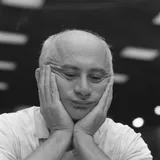
Boris Gulko
He is the only player who has ever won both the championship of the Soviet Union and the championship of the United States — and between those two crowns lie seven years in which he was barely permitted to play at all. Boris Gulko took the Soviet title at Leningrad in 1977 without losing a game, then applied to emigrate and was refused. What followed was hunger strikes, daily arrests, and a career suspended in mid-flight; “we were people of air,” he said of those years. He was thirty-nine when the door finally opened in 1986, an age at which most grandmasters are already descending. Instead he became the highest-rated player in America, won the U.S. Championship twice, and finished his lifetime account against Garry Kasparov — the strongest player of the age — in the black.
◈A boy born in the enemy's ruins
Boris Franzevich Gulko was born on 9 February 1947 in Erfurt, in the Soviet occupation zone of a defeated Germany, into a Jewish family; his father was a Red Army soldier stationed there. His parents had survived the war by fleeing east to the Urals, warned in time by a Polish tailor of what the Nazis intended. There was no bris — he would not have one until he was forty, in America. When he asked his mother why, she gave the only answer there was: “Exactly where would I find a mohel in Germany in 1947?”
He learned early what he was. At three, boys he did not know punched him in the street and told him he was Jewish. At nine his father told him about Khrushchev's secret speech against Stalin and destroyed the portrait of Stalin that hung in their home, and the boy's belief in communism went with it. In August 1968, at a chess tournament, he watched Soviet tanks roll into Czechoslovakia. “I wanted to fight,” he said. “This was such a shame for my country.” His verdict on the state he had been raised to serve was final: “I really lived in an empire of evil.”
Chess arrived at twelve, through the Soviet children's clubs. He won his school's junior championship three times and was a master before he graduated. He read psychology at Moscow University and worked in the field for three years before turning professional at twenty-seven — his salary, like every Soviet professional's, routed through the KGB's First Department. In 1967 he won the World Student Team Championship with the Soviet team. The International Master title came in 1975, the grandmaster title in 1976.
◈Champion of the Soviet Union
The 45th USSR Championship ran in Leningrad from 28 November to 22 December 1977: a sixteen-player final, the survivors of a sixty-four-player Swiss at Bălți and an eighteen-player First League at Baku. It was as hard a tournament as existed anywhere on earth. Three former world champions sat in it — Tigran Petrosian, Mikhail Tal and Vassily Smyslov — alongside Lev Polugaevsky, and Gulko went through the whole of it without losing a single game. He scored 9½ out of 15: four wins, eleven draws, no defeats. Smyslov he beat outright on 11 December.
It left him level with Iosif Dorfman and half a point clear of Polugaevsky. The tie was to be broken by a match, and the match settled nothing: six games in Moscow, one win each, four draws, 3–3. The title was awarded to both men. Gulko was thirty years old, champion of the Soviet Union, and by every ordinary measure standing at the doorway of the best years of his career. The following year he played for the USSR at the Buenos Aires Olympiad. It was the only time he would ever represent it.
◈People of air
In 1976 Viktor Korchnoi defected, and the Soviet chess establishment circulated a collective letter condemning him. Gulko was one of only four Soviet grandmasters who refused to sign it. It was noted. When he and his wife — Anna Akhsharumova, the 1976 Soviet women's champion — applied to emigrate at the end of the decade, permission was refused, and it was refused again, and again, for seven years. The funding stopped. The invitations stopped. A reigning Soviet champion simply vanished from the tournament tables. Their son David was born in 1979, into that vanishing. “We were people of air,” Gulko said.
They fought with the only instruments left to them: their bodies and their visibility. Three times they went on hunger strike, the longest of them thirty-seven days — “just the two of us, in our apartment.” In the spring of 1986 they took to Moscow's Arbat Square to demonstrate, one demonstration every day except Shabbat, and were arrested almost daily, losing hours at a time in a police station. Gulko described those weeks as a chess game, each morning demanding a fresh tactical idea against the same opponent. He was at one point arrested and beaten by KGB agents. Asked about it later, he did not dramatise: “It was the hardest time of my life.”
◈Thirty-nine
On 29 May 1986, on three days' notice, they were let out. They arrived in America with three hundred dollars. A chess foundation helped them find their feet; Gulko became grandmaster-in-residence at Harvard, and the family eventually settled in Fair Lawn, New Jersey. He was clear-eyed about what had been taken. “Thirty-nine is too old,” he said, “to start playing and training to reach the highest achievement in chess.” Seven years of a grandmaster's prime do not come back.
He built a second career regardless. By January 1988 he was the highest-rated player in the United States, and he held that place on the January 1989, July 1989, January 1990 and July 1990 lists as well; in January 1989 he stood fourteenth in the world. Anna won the U.S. Women's Championship in 1987. In 1994, at Key West, he won the U.S. Championship without losing a game — 9½ out of 13, six wins and seven draws, a point and a half clear of Larry Christiansen and Yasser Seirawan — and in 1999 he won it a second time, coming through the knockout to take the final against Grigory Serper.
He played nine Olympiads for the United States between 1988 and 2004, and took team gold at the 1993 World Team Championship with a silver in 1997. His tournament victories span two lives and two flags: the Capablanca Memorial in Havana in 1976, Nikšić in 1978 shared with Jan Timman, Biel in 1987, Malmö in 2001 with Timman again. In the PCA cycle he reached the Candidates quarter-finals and went out to Nigel Short.
◈The Kasparov account
Garry Kasparov lost to very few people more than once. Gulko beat him three times — at the Soviet Championship final of 1981, again in 1982, and at Linares in 1990, when Kasparov was the reigning world champion — against a single defeat and four draws across a rivalry running from 1978 to 2001. It is one of the very few plus scores anyone holds against the strongest player of the era, and it was assembled by a man who had lost seven of his best years to a visa office.
The shape of that record is the shape of his chess. Twice he took a national championship without conceding a loss — Leningrad 1977 and Key West 1994 — which is a rarer and harder thing than winning one. He was never the player who blew opponents off the board; he was the player they could not get past, and who was still there, undisturbed, when their ideas ran out.
He has written the rest down. Lessons with a Grandmaster, produced in 2011 with the psychologist Joel R. Sneed, walks through his own games as a dialogue between grandmaster and student rather than a lecture. The same year brought The KGB Plays Chess, on how the Soviet secret police ran the game — written with Yuri Felshtinsky, Vladimir Popov, and Viktor Korchnoi, the man whose condemnation he had once refused to sign.
“We were people of air.”
“It was the hardest time of my life.”
“Thirty-nine is too old to start playing and training to reach the highest achievement in chess.”
◈From the archive
◈Legacy
Gulko is in his late seventies now, and in 2019 he left Fair Lawn for Jerusalem — having become Orthodox in America and having written, for years, a syndicated Russian-language column for Jewish-American newspapers. The chess record is a curiosity that will probably never be repeated: one man, two national championships, on opposite sides of the Cold War. But it is the other thing that is honoured here. He was a Soviet champion who declined to sign a lie about Viktor Korchnoi, and who then paid seven years of his playing life for the crime of wanting to leave. He came out the far side at thirty-nine — the age at which careers end — and made himself the best player in his new country anyway. “American Jews do not know evil,” he has said. “We Russian Jews — we know evil.” He knew it, he refused it, and he never stopped playing.