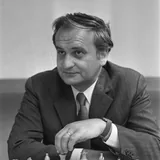
He was the very first. When FIDE created a world championship for players under twenty and held it in the English Midlands in June 1951, the winner who took the title home to Belgrade was a seventeen-year-old named Borislav Ivkov, and the list he started runs on through Spassky, Karpov, Kasparov and Anand. After that came a long career. Bora Ivkov played twelve Olympiads for Yugoslavia over twenty-four straight years, won fourteen medals and three national titles, reached the Candidates, and beat five men who held or would hold the world title: Smyslov, Tal, Petrosian, Fischer and Karpov. And all the while he said, with a shrug, that chess had never been the most important thing in his life. It was, he said, a way to see the world.
The boy from Belgrade
Borislav Ivkov was born in Belgrade on 12 November 1933, in the Kingdom of Yugoslavia, and the city held him for the whole of his eighty-eight years. He was champion of Belgrade's juniors at fourteen. At sixteen, in 1949, he walked into the Yugoslav Championship at Zagreb and came away with shared fourth to seventh place on 11/19 and a National Master title — the tournament was won by Svetozar Gligorić, the man who would be his measure, his teammate and his rival for the next quarter of a century.
The following year came Bled 1950 and his first international field, a strong one, won by Miguel Najdorf. Ivkov shared fifth and sixth places with 7½/14 and beat Hermann Pilnik, Milan Vidmar Jr. and Vasja Pirc along the way. On the strength of that debut Yugoslavia put him straight into national team matches against the United States and the Netherlands in 1950, and against West Germany in 1951. He was seventeen years old and already playing for his country.
A crown nobody had ever held
In June 1951, eighteen young players from across the world gathered in Coventry and Birmingham for eleven rounds of Swiss chess. FIDE had created a world championship for players under twenty, and it had never been contested; whoever won would be the first holder of a title with no history behind it at all. Ivkov won it, and he won it decisively — 9½ out of 11, a point and a half clear of England's Malcolm Barker. Somewhere down the crosstable, on 6½, was a Danish teenager named Bent Larsen, whose name would come back to him fourteen years later at the worst possible moment.
The rise from there was quick. He took the International Master title in 1954, the year he shared fourth and fifth places with Tigran Petrosian at Belgrade — the first Yugoslav tournament to welcome Soviet players after the war — and beat Petrosian in their individual game. Then came Argentina and the breakthrough. At Mar del Plata 1955 he scored 11½/15 to win ahead of Najdorf, Gligorić, Szabó, Pachman, Panno and Pilnik; at Buenos Aires later that year he won again with 13/17. The Grandmaster title followed in 1955. He was twenty-one, and he had joined the world elite.
Bronstein, who also played at Belgrade in 1954, recalled an embarrassing early loss in 200 Open Games (1974). Ivkov had a winning position and plenty of time, but forgot his clock and lost when his flag fell. A Yugoslav newspaper printed the appeal “Look up, Bora!” Bronstein adopted it as a greeting whenever they met; Ivkov would ask whether he still remembered.
In My Great Predecessors, Part II (2003), Kasparov recounts an early meeting with Tal. After the young Latvian beat Ivkov at the 1956 student world championship in Sweden, Ivkov published an article headed “Tal! Remember this name!”
“To be honest, my whole playing life, I did not understand chess. For me, chess was a way to see the world, and there are so many beautiful things to experience and learn out there…”
“Chess was never very important to me. I made a living out of it, but I acted unprofessionally. There were much more important things…”
“Do you remember, it was I who asked you for a draw in Moscow?”
“All I can add about Ivkov is that he bore up bravely under the hammer blows of fate.”
“A true gentleman, one of those people who can charm their way in and out of any conversation, showing their vast knowledge about almost every topic but never coming across as arrogant.”
Candidate
Three times he was champion of Yugoslavia: at Sarajevo in 1958, sharing the title with Gligorić on 12½/19; at Zenica in 1964, sharing it with Mijo Udovčić on 15/21; and alone at Umag in 1972 with 12/19. For more than fifteen years from the mid-1950s he was the second-ranked player in a country that was regularly among the three strongest chess nations in the world, behind only Gligorić, in a generation that also included Trifunović, Matanović, Matulović and Ljubojević.
The world title itself came into view in 1964. He finished seventh at the Amsterdam Interzonal on 15/23, but qualified for the Candidates matches because the country quota excluded Leonid Stein and David Bronstein, who had finished ahead of him. Kasparov describes these circumstances in My Great Predecessors, Part III (2004). In 1965 at Bled he met his quarter-final opponent: Bent Larsen, the boy from Birmingham, now one of the most dangerous players alive. Larsen won the match 5½–2½. Ivkov never came that close again, though he kept trying for another fifteen years — four more Interzonals at Sousse 1967, Palma de Mallorca 1970, Petrópolis 1973 and Rio de Janeiro 1979, where at the age of forty-six he finished sixth of eighteen and narrowly missed going through.
And yet 1965 was still the finest year of his life. At Zagreb he shared first place with Wolfgang Uhlmann on 13½/19, ahead of the reigning World Champion Petrosian, ahead of Portisch, ahead of Larsen and Bronstein — by common reckoning the most impressive tournament victory of his career. At the Capablanca Memorial in Havana that autumn he shared second to fourth places, and in the space of a week he beat Vasily Smyslov, who won the tournament, and Bobby Fischer, who very rarely lost a game with the white pieces. It was the second time Ivkov had beaten Fischer; almost nobody of his generation managed it twice.
At Caracas in 1970 Ivkov beat the nineteen-year-old Karpov and shared second place with Stein on 12/17, behind Kavalek. Kasparov notes in My Great Predecessors, Part V (2006) that Karpov had started with 6/7 and declined Ivkov’s draw offer before losing. The win is preserved in this archive.
Twelve Olympiads
His Olympiad record stands out most. From Moscow 1956 to Valletta 1980, twenty-four years without a break, Ivkov was picked twelve times for the Yugoslav Olympiad team, and in those twelve Olympiads he scored 82 wins, 13 losses and 76 draws: 70.2 percent. Twice he won an individual board gold, both times without losing a game: 13½/16 on board four at Varna 1962 (+11 −0 =5) and 10/13 on board two at Siegen 1970 (+7 −0 =6).
The medals add up to something extraordinary: ten team medals and four board medals, fourteen in all. That makes him the fifth-most decorated player in the history of the Chess Olympiad, level with Garry Kasparov, behind only Tal and Keres on fifteen, Petrosian on sixteen and Smyslov on seventeen. His ten team medals are the second-highest total ever recorded, tied with Petrosian and surpassed only by Gligorić's twelve. He added six European Team Championships, with a board gold at Bath in 1973 — and he played in sixteen editions of the USSR versus Yugoslavia match between 1956 and 1979, more than any other player on either side of the board.
The rooms outside chess
His style was classical and deliberately hard to prepare for. In his best years he opened with both 1.e4 and 1.d4; as Black against 1.e4 he played the Sicilian, the French and 1…e5, a repertoire wide enough that no opponent could pin him down. He leaned toward solid positional play but could switch to fierce tactics as soon as a position allowed. He beat five World Champions, Smyslov, Tal, Petrosian twice, Fischer twice and Karpov, and won games against nearly every leading player of his time. Only two of the great players escaped: Paul Keres, and Mikhail Botvinnik, with whom every game he played was drawn.
The same book records a kindness returned. At the Moscow Olympiad in 1956 Bronstein accepted Ivkov’s draw request because the Soviet team led the match and he did not want to take risks. Eight years later in Belgrade, when Bronstein had played the opening badly and was struggling, Ivkov offered him a draw. After they shook hands, he reminded Bronstein: “Do you remember, it was I who asked you for a draw in Moscow?”
Unusually, he never pretended chess was everything. “Chess was never very important to me,” he said. “I made a living out of it, but I acted unprofessionally. There were much more important things…”, by which he meant music, sport, the theater and the rest of a full life. He met his wife Olga María Kesic, Miss Mar del Plata 1954/55, at a tournament in Argentina. He wrote, and wrote well: an autobiography, My 60 Years in Chess, and books including Black on White and Mesmerized by Chess. Late in life he told an interviewer, with rare candor for a grandmaster, that in his whole playing life he had never really understood chess; it had simply been a way to see the world.
He kept playing long past the point where the game owed him anything. He took the International Arbiter title in 1986. He won the Capablanca Memorial at Cienfuegos in 1985 with 10/13. In 1999 he shared first place with Lajos Portisch at the Tigran Petrosian Memorial in Moscow on 5/9 — a strong modern field, conquered by a man who had won his first world title forty-eight years earlier. In 2006 he became European Senior Champion at Davos. His last FIDE-rated tournament came in late 2013, when he was seventy-nine.
Legacy
Borislav Ivkov died in Belgrade, the city where he was born, on February 14, 2022, aged eighty-eight, and is buried there; he was survived by his wife and two children. He had outlived the country he represented twelve times at the Olympiad, and most of the men he had played. His record is fourteen Olympiad medals, three Yugoslav titles, five World Champions beaten, and the 993 wins collected here, from 1949 to 2013: sixty-four years of chess, one for every square. And every World Junior Champion since, Spassky, Karpov, Kasparov, Anand and all who followed, holds a title that began when a Belgrade seventeen-year-old won it in Birmingham in the summer of 1951.
Books
Books Borislav Ivkov wrote, co-wrote, edited, or contributed to. Translations and reprints are grouped under the same work.
-
Second Piatigorsky Cup International Grandmaster Chess Tournament
Contributor — own game annotations
-
Šahovska azbuka
Contributor — instructional contributions
-
Kroz šahovski svet
Author
-
Bugojno '80
Coauthor — Dimitrije Bjelica, Miloš Petrović
-
Antologija šaha: Najbolje partije svetskih prvaka
Coauthor — David Bronstein, Borislav Ivkov
-
Povratak Bobi Fišera
Author
-
Krivougli lovac
Author
-
Mojih šezdeset godina u šahu 1: Oda umetničkom šahu
Author
-
Opčinjeni šahom: neznani šahovski junaci
Author
-
Crno na belo
Author
-
Chess Parallels I: Strategy and Tactics
Author
-
Chess Parallels II
Author
-
Škola šaha III: Teorija otvaranja I, otvorene i poluotvorene igre
Author