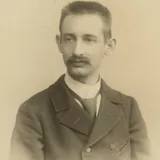
Carl Schlechter was one of the strongest players of the early twentieth century, known for his positional judgment, opening knowledge and courtesy towards opponents. In 1910 he drew a ten-game World Championship match with Emanuel Lasker. He led by one point before the final game, which Lasker won; the unpublished conditions governing a possible transfer of the title remain disputed. Schlechter died in Budapest in December 1918, aged forty-four.
A son of the Vienna cafés
Carl Adalbert Hermann Schlechter was born in Vienna on 2 March 1874, into the great age of Austro-Hungarian café chess. The smoke-filled coffeehouses of the capital were the finest finishing school a young master could have, and it was there that Schlechter sharpened a game built on the deep positional principles of Wilhelm Steinitz. He took up serious competition in 1893, and over the next two decades played in more than fifty international tournaments — a workload that made him one of the most travelled and respected professionals of his era.
His rise was steady rather than meteoric. First prizes and shared firsts accumulated at the strongest events of the day: Munich 1900, Coburg 1904 (a three-way tie in which the first three prizes were shared), the celebrated Ostend tournament of 1906, Stockholm 1906, Vienna and Prague in 1908, and the great Hamburg congress of 1910. Three times — 1911, 1912 and 1913 — he won the Trebitsch Memorial in his home city. By the eve of the First World War, no list of the world's elite was complete without his name.
The man without style
Schlechter was famous for his draws, and the nickname the Viennese drawing master clung to him for life. But the label flattered his caution and hid his range. “He plays all styles,” wrote Lasker, “aggressive, defensive, logical, simple, complicated, combinative, trappy, sound.” He was a profound student of the openings — feared above all in the Ruy Lopez — yet equally at home grinding an endgame or conjuring an attack out of a quiet position.
That very completeness was why contemporaries called him the man without style: he had no single weapon to prepare against, because he commanded them all. His high draw rate was the by-product of a player who almost never overreached and almost never lost — a steadiness that served him superbly in match play even as it sometimes cost him clear first in a tournament. At Karlsbad in 1907 he shared fourth and fifth prizes with Aron Nimzowitsch on 12½ points from 20, behind Akiba Rubinstein, Géza Maróczy and Paul Saladin Leonhardt. A review in the newspaper Bohemia, reprinted in the tournament book Das Internationale Schachmeisterturnier in Karlsbad 1907, thought him out of form and found draws among his games that he would usually have avoided, while still admiring the breadth and depth of his play.
“I have won enough. Let others get something too.”
“I did not want to play for a draw in the last game and I chose a little-known continuation, leading to interesting complications.”
“He plays all styles, aggressive, defensive, logical, simple, complicated, combinative, trappy, sound.”
“Schlechter was the one competitor who accepted all things and all arrangements with equanimity amounting almost to indifference.”
Ten games with Lasker
The 1910 title match was played in Vienna and Berlin. Schlechter won Game 5 and led by one point before the tenth and final game. Garry Kasparov’s My Great Predecessors, Part I (2003), before Game 57, describes the reduction of the proposed thirty-game match to ten games because of financial difficulties.
Schlechter did not choose a quiet opening in the last game. Kasparov quotes his explanation after 4...g6 in Game 58: “I did not want to play for a draw in the last game and I chose a little-known continuation, leading to interesting complications.” Lasker eventually won, leaving the match tied 5–5 (+1 −1 =8) and retaining the title.
The match agreement was not published in full. Kasparov considers it probable that Schlechter needed a two-point winning margin to take the title; Edward Winter’s historical investigation discusses the conflicting evidence. A draw in Game 10 would have won Schlechter the match on points, but it should not be treated as certain that it would also have made him World Champion.
The gentleman of the board
The chess public remembers Schlechter's results; those who knew him remembered his decency. By every account he was the kindest competitor of his time. When an opponent arrived late, he would quietly take the same amount of time off his own clock and say nothing. When an opponent looked ill, he offered a draw rather than press an unfair advantage. He helped younger rivals, among them Oldřich Duras.
At Ostend in 1906, having taken first prize, he declined to compete for any of the brilliancy prizes. “I have won enough,” he said. “Let others get something too.” Isidor Gunsberg, watching, wrote that Schlechter “accepted all things and all arrangements with equanimity amounting almost to indifference.” It was the equanimity of a man who simply did not need to win at another's expense.
He had shown the same consideration at Coburg in 1904, where he, Curt von Bardeleben and Rudolf Swiderski finished level on 7½ points from 12. According to the congress book, Der vierzehnte Kongress des Deutschen Schachbundes, Coburg 1904 (1905), which Schlechter edited with Paul Schellenberg and Georg Marco, the tournament committee thought a play-off for first prize could be required. Bardeleben and Swiderski did not want to stay another week, and Schlechter raised no objection so as not to harm his two rivals. The programme had no rule for a tie, so the first three prizes were shared. Marco, who annotated Schlechter's draw with Ossip Bernstein for the book, wrote that the famously sharp-eyed Schlechter, two pawns up, walked into a trap any beginner would have seen through, and called it the most incomprehensible lapse of recent years.
At Carlsbad in 1911 Schlechter watched the eighteen-year-old Alekhine defeat Milan Vidmar. Kasparov reports his reaction: “This is a future world champion!” (My Great Predecessors, Part I, introduction to Game 110).
Scholar of the openings
Away from the board Schlechter was a serious theoretician, journalist, and problem composer. His monument in chess literature is the eighth and final edition of Bilguer's Handbuch des Schachspiels — the great German openings encyclopedia. Published in eleven parts between 1912 and 1916 and running to more than a thousand pages, it drew on contributions from Spielmann, Tarrasch and Teichmann, and has been called the last work to encompass the whole of opening theory between two covers.
He also edited tournament books. He wrote the notes to most of the games in the Coburg 1904 congress book, and with Marco he edited Das Internationale Schachmeisterturnier in Karlsbad 1907, annotating most of the games from its last six rounds. Of his own loss to Nimzowitsch there he wrote that 16.d5 would have made sense only as the start of a queenside attack and was poor preparation for the kingside play he intended, that he played the rest of the game weakly and his opponent excellently, and he called the game a feat of strength by Nimzowitsch.
His name survives in the opening books too. The Schlechter Variation of the Slav Defense, with an early kingside fianchetto against the queen's pawn, is still a respected line, and there are Schlechter gambits and variations in the French, the Danish and Bird's Opening. For a player so often labeled a drawing master, he had a big influence on how the game is played.
Legacy
Schlechter died in Budapest on 27 December 1918, aged 44 — of pneumonia and starvation, a casualty of the famine that gripped central Europe in the wreckage of the First World War. He was buried there on 31 December. For decades he was remembered only as the man who drew with Lasker, but Warren Goldman's 537-page Carl Schlechter! Life and Times of the Austrian Chess Wizard (1994) restored the fuller picture: a universal master, a generous teacher, and one of the strongest players never to wear the crown. A memorial tournament has carried his name, and the unpublished conditions of his match with Lasker remain a subject of historical debate.
Books
Books Carl Schlechter wrote, co-wrote, edited, or contributed to. Translations and reprints are grouped under the same work.
-
Handbuch des Schachspiels, eighth edition
Editor
-
Der vierzehnte Kongress des Deutschen Schachbundes, Coburg 1904
Coauthor — Paul Schellenberg and Georg Marco
-
Der zwölfte Kongress des Deutschen Schachbundes, München 1900
Coauthor — Dr. Gebhardt and Georg Marco
-
Internationales Schachturnier Karlsbad 1907
Coauthor — Georg Marco
-
Das angenommene Königsgambit: Eine schachtheoretische Abhandlung in 5 Heften
Author