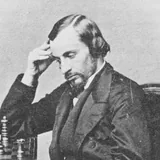
Daniel Harrwitz was a chess master from Breslau who made his name in Paris in 1845, above all as a blindfold player, and spent the next fifteen years among the leading players of Europe. He beat Bernhard Horwitz twice in matches, drew with Adolf Anderssen, came back from 2–9 down to beat Johann Löwenthal 11–10, and in 1858 won the first two games of his match against Paul Morphy before losing it. He founded the British Chess Review, wrote a chess textbook, and gave up active play in 1862. He later settled in the Tyrol, where he died in 1884.
Breslau and Paris
Harrwitz was born in Breslau on 22 February 1821, the son of Israel Harrwitz and Beate Harrwitz, née Friedländer. Older reference books gave his birth as 29 April 1823 and his death as 9 January 1884; the correct dates come from his gravestone and the death register in Bolzano, and from the Breslau Jewish birth register, as reported in Edward Winter's Chess Notes.
His name first came into notice in Paris in 1845, especially as a blindfold player. Among his early opponents there was Lionel Kieseritzky, and in London in 1846 the two played blindfold against each other. Harrwitz printed three of those games in his Lehrbuch des Schachspiels (1862). Two of them were played alongside a second blindfold game, with the first three moves for both sides set by people watching, and Harrwitz won two of the three (pp. 37–38, 92–93, 253–254).
England, 1846–1849
In 1846 Harrwitz came to England and played Howard Staunton over twenty-one games: seven on even terms, seven with Staunton giving the odds of pawn and move, and seven at pawn and two moves. Harrwitz lost all the even games and most of the pawn-and-two games, but won the pawn-and-move series, and Staunton took the match 12–9. Later that year Harrwitz beat Bernhard Horwitz by six wins to five, in a match arranged by the London Chess Club, and beat Elijah Williams in a short match.
Staunton admired his blindfold play. "Mr Harrwitz sees everything without the board as well as most players with one," he wrote in the Chess Player's Chronicle in 1847. Harrwitz gave blindfold exhibitions in Edinburgh and Glasgow from 1848, usually against two teams of consulting players at once.
“I had the good fortune to win the three in succession and – an unheard-of thing in England – they were all played at a sitting.”
“Chess, if it has not been otherwise profitable, has procured me many a dear friend, but now my career is closed.”
“Mr Harrwitz sees everything without the board as well as most players with one.”
“Few masters, Anderssen excepted, leave such a splendid record as the late Harrwitz.”
Anderssen and Löwenthal
Early in 1848 he played Adolf Anderssen in Breslau. After ten games each had won five, and the match was halted by the civil unrest in the city that year. In Berlin he beat Carl Mayet in a game that Wikipedia gives as the earliest recorded example of the Elephant Trap in the Queen's Gambit Declined.
Harrwitz lived in England from 1849. He won a second match against Horwitz, 7–6, in 1849, and in the autumn of 1852 beat Williams at the London Chess Club with seven wins and three draws. In 1853 he founded the British Chess Review, which printed sharp attacks on Staunton.
The same year he played Johann Löwenthal at the Ship Tavern, Charing Cross, for £50 a side, the first to eleven wins to take the match. Harrwitz won the first two games, then fell ill, lost a run of games and forfeited two more while recovering in Brighton, so that Löwenthal led 9–2. Harrwitz then won game after game and took the match 11–10.
Paris and Morphy
In 1856 Harrwitz moved to Paris, where he beat Jules Arnous de Rivière in a match. At the Manchester meeting of 1857 he lost his tournament game to Anderssen, then asked him for a short match to the first three wins and won three games in a row at a single sitting.
Harrwitz was the resident professional at the Café de la Régence when Paul Morphy arrived in Paris in 1858. He won a game against Morphy before their match, and he won the first two games of the match itself, which began at the Régence on 7 September. Morphy then won five games and drew one, and Harrwitz resigned the match, citing his health. Wikipedia counts him among the few masters who beat Morphy with the black pieces. Morphy later offered him a match at the odds of pawn and move, which Harrwitz declined.
In Garry Kasparov on My Great Predecessors, Part I, Kasparov notes that the match was meant to continue until one player had won seven games. He writes that Morphy regarded the contest as unfinished and used its prize money to pay for Anderssen's journey from Breslau to Paris. Anderssen accepted the invitation, but his teaching work meant he could come only during the Christmas holiday.
The Tyrol
About two years after the Morphy match Harrwitz lost to the young Ignatz Kolisch, and in 1862, in poor health, he gave up active play. His Lehrbuch des Schachspiels was published in Berlin that year; he signed its preface on the Isle of Wight in August 1862. In the preface he wrote that he had taught chess for more than fifteen years, that he had used mostly his own games because they were the easiest for him to get and the ones he had most right to, and that he had kept the simpler endings within reach of weaker players, whom he had often heard complain that chess books were written only for stronger ones (pp. III–IV). When his father died he settled with a family inheritance in Bozen, in the Tyrol. He came back to England once, about six years before his death, to see old friends.
The book's general advice is practical. A lost game, written down and replayed a few days later, alone or better with a good player, teaches more than ten won ones, and a learner should play only stronger players. He rejected the common belief that the onlooker sees more than the player: the onlooker is right barely once in ten times, he wrote, because he has no stake in the game (pp. 17–19). In the opening chapters he called 2...e6 Black's best reply to the Queen's Gambit and gave 3.Nc3 Nf6 4.Bf4, the line now called the Harrwitz Attack, illustrating it with his own wins over Löwenthal in London in 1853 and Morphy in Paris in 1858 (pp. 58–65).
He died in Bozen at five in the morning on 2 January 1884, aged 62, and was buried in the Jewish cemetery there. His gravestone describes him as "Professor D. Harrwitz".
Legacy
Harrwitz played chess for about fifteen years and then left it by choice. He won matches against Horwitz, Löwenthal and Arnous de Rivière, drew with Anderssen and won three games from Morphy, and his name is attached to the Harrwitz Attack in the Queen's Gambit Declined, 4.Bf4. His obituary in the Chess-monthly praised his decision to retire while still strong as "evidence of a great deal of common sense".
Books
Books Daniel Harrwitz wrote, co-wrote, edited, or contributed to. Translations and reprints are grouped under the same work.
-
Lehrbuch des Schachspiels
Author