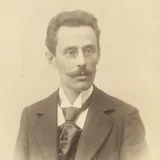
Dawid Janowski
Janowski played chess the way a man plays roulette — fast, beautifully, and without much thought for the odds. He came out of the Polish lands of the Russian Empire, made the Café de la Régence in Paris his address, and for a decade around the turn of the century there was hardly a more dangerous man alive over a board. He beat Steinitz, Lasker, Capablanca and Alekhine, a feat only Tarrasch matched. He loved the two bishops and detested the endgame, and he lost his winnings at the tables as fast as the boards produced them.
◈Wołkowysk, Warsaw, and the Régence
Dawid Markelowicz Janowski was born on 25 May 1868 in Wołkowysk, a small town in the Grodno Governorate of the Russian Empire — today Vawkavysk in Belarus — into a Polish-Jewish family. Sources differ over the exact day; the Julian and Gregorian calendars pull the date a fortnight apart, and 7 June is sometimes given instead. The family moved west, to Łódź and then Warsaw, and it was in a Warsaw chess club in the early 1880s that Janowski and his brother first found the game.
By about 1890 he had settled in Paris, and the Café de la Régence — the room where Philidor had once held court — became his address in every sense that mattered. His first recorded games date from 1892. In 1894 he turned professional and made his international debut at the Leipzig masters' tournament, finishing sixth in a field headed by Siegbert Tarrasch. In 1896 he won the championship of the Régence itself. He lived in France for the rest of his life and played for France, but he never stopped being the Pole from Wołkowysk.
◈The dangerous years
The climb was quick. At Nuremberg in 1896 he beat the reigning world champion, Emanuel Lasker. Then came the run that made his name: first at Monte Carlo in 1901, ahead of Schlechter; first at Hanover in 1902, the German Chess Federation's master tournament, holding off Harry Nelson Pillsbury; and a share of first at Vienna the same year. At Cambridge Springs in 1904 he finished second equal with Lasker behind Frank Marshall, and in 1905 he shared first place at Barmen with Géza Maróczy. Retrospective historical ratings put him, for a stretch of 1904, at the very top of the world list.
He was murderous against the generation above him — +17 −4 =4 against Mikhail Chigorin, +5 −2 against Wilhelm Steinitz, +6 −2 =2 against Joseph Blackburne. Against his own contemporaries the ledger turned over: minus scores against Tarrasch, Maróczy, Schlechter, Rubinstein and Marshall, and a lifetime record against Lasker of four wins to twenty-five defeats. But he beat each of the first four world champions at least once — Steinitz, Lasker, Capablanca, Alekhine — and in the whole history of the game only Tarrasch has done the same.
◈Two bishops, and no patience
He played very quickly, and he played for the initiative before the position had earned it, launching the attack first and looking for the fuel afterwards. His signature was the bishop pair. In an era that still weighed a bishop and a knight as roughly the same thing, Janowski knew exactly what two bishops could do to an open position, and he would trade almost anything to keep them. “The superiority of two bishops against two knights in a more or less equal position is a significant advantage,” he wrote in La Stratégie in 1902. Nearly half a century later Alekhine was still telling students that the way to learn the value of the two bishops was to play through Janowski's games.
The flaw sat at the other end of the board. “I detest the endgame,” he told Capablanca, who thought it the one thing holding him back — and who also said that Janowski in form was “one of the most feared opponents who can exist”. Ossip Bernstein put it plainly: no scientist, no theoretician, but an extraordinary intuition. It carried him into won positions again and again; it did not always carry him through them. A Budapest paper in 1898 passed on a remark of his own — that his play was like Mary Stuart, beautiful but unfortunate.
He was not always easy to sit across from. Reuben Fine called him the master of the alibi: a loss was the fault of the heat, or the cold, or a window open too far or not far enough. He would grind on in dead-lost positions in the hope of a blunder, a habit that did not endear him to his colleagues. And Frank Marshall, who faced him eighty times across two decades, left the line that has followed him ever since — Janowski “could follow the wrong path with greater determination than any man I ever met!”
◈Nardus
Somewhere around the turn of the century Janowski acquired a patron. Leonardus Salomon — born in the Netherlands the same year as Janowski, and from about 1910 calling himself Leo Nardus — had grown rich in New York and Philadelphia selling Old Masters to American millionaires, until Bernard Berenson and Roger Fry exposed his attributions in 1908 and he retreated to Europe. He was also a painter, a champion swordsman and a keen chess amateur who liked to keep masters about him. Janowski's 1908 return match with Marshall was played at Nardus's villa at Suresnes, outside Paris; four years later the two men met again at Biarritz with Nardus in attendance. For the better part of two decades he was the reason Janowski could live as a professional at all.
The money left as fast as it arrived. Edward Lasker remembered him as an inveterate and undisciplined gambler who would lose an entire tournament purse at the roulette wheel; when he was winning he could not stop, and he left the casino only once there was nothing in his pocket. It is the single fact that explains most of what came after.
◈Berlin, 1910
In 1909 Nardus paid for two matches with Lasker in Paris. The first, over four games, finished level at two wins each. The second, over ten, finished +1 −7 =2 against Janowski. Any sober reading of those numbers argued against a title match. Janowski read them the other way, talked Nardus into staking him, and on 8 November 1910 sat down in Berlin to play Emanuel Lasker for the championship of the world.
It ran a month, and it was not a contest. Lasker won eight games and drew three; Janowski won none. It remains the most one-sided world championship match ever played. The public barely followed it — Lasker had reserved exclusive rights to publish the games, so the newspapers could not print them — and Janowski spent his evenings at the casino trying to make good his losses. Georg Marco's verdict on the whole affair was that either Lasker won or Janowski lost.
◈War, America, and the road south
He was playing the German Chess Federation congress at Mannheim in July 1914 — four wins, four draws, three losses, seventh place — when the war broke out and the tournament was abandoned. Players from countries now at war with Germany were interned, and Janowski, like the young Alekhine, was held briefly before being released into Switzerland. In 1915 he left Europe for the United States and stayed nine years. There were good days: second equal with Oscar Chajes behind Capablanca at New York in 1916, first at Atlantic City in 1921, third at Lake Hopatcong in 1923. There were also long stretches of hard, unglamorous match play against opponents he would once have brushed aside.
The last great tournament of his life was New York 1924 — Lasker, Capablanca, Alekhine, Marshall, Réti, Maróczy, the strongest field assembled since before the war. Janowski finished eleventh of eleven with five points from twenty games. He returned to Europe, played the Hastings Christmas congress at the end of 1925, Semmering in March 1926, where he still had it in him to beat Tarrasch, and Ghent that October. Ghent was his last tournament.
“It is not in my temperament to wait.”
“I detest the endgame.”
“The superiority of two bishops against two knights in a more or less equal position is a significant advantage.”
“When in form, he is one of the most feared opponents who can exist.”
“He could follow the wrong path with greater determination than any man I ever met!”
“A lonely man (he had never married), no relatives near to him, no religion, no income and apparently no friends.”
◈From the archive
◈Legacy
In December 1926 he travelled down to Hyères, on the Mediterranean coast, for a tournament due to begin the following month. What he took for a heavy cold was tuberculosis in its last stage. Ossip Bernstein cabled Nardus, by then living in Tunisia, and money came at once; a benefactor named A. J. Maas saw that he was properly nursed. He died on 15 January 1927, aged 58, without having played a move in the tournament, and was buried high on a hillside in the north-west corner of the Hyères cemetery. On the stone they cut a verse attributed to Omar Khayyám: Nous sommes les pions de la mystérieuse partie d'Échecs jouée par Dieu — we are the pawns in the mysterious game of chess that God plays. Variations still carry his name in the Old Indian, the Queen's Gambit, the Albin Countergambit, the French Defence and the Four Knights, and Alekhine's advice stands: to understand what two bishops are worth, play through the games of Dawid Janowski.