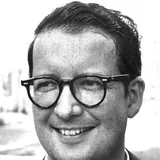
Donald Byrne was an American International Master and a professor of English who coached the chess team at Penn State. He won the 1953 U.S. Open, and in the 1954 match between the United States and the Soviet Union he beat Yuri Averbakh, the Soviet champion, 3–1. He beat Efim Geller in Moscow the next year, gave Samuel Reshevsky his only loss in the 1956 Rosenwald tournament and beat the former World Champion Vasily Smyslov at Mar del Plata in 1962. Between 1962 and 1972 he played for or captained five U.S. Olympiad teams. He is best known for the other side of a famous game: in 1956 he lost the "Game of the Century" to the thirteen-year-old Bobby Fischer. He died of lupus in 1976, at forty-five.
The Collins circle
Byrne was born in New York City on 12 June 1930, the younger brother of Robert Byrne, who became a grandmaster. Both brothers played at the Brooklyn club of the coach John W. Collins, who later wrote about them and the young Bobby Fischer in his book My Seven Chess Prodigies.
In 1953 he won the U.S. Open at Milwaukee with 10½/13, half a point ahead of Max Pavey. Around that time he had the second-highest rating in the country, behind Samuel Reshevsky, against whom he had a winning record.
Against the Soviet team
In June 1954 the Soviet team played the United States in New York. Byrne faced Yuri Averbakh, who had won the Soviet championship earlier that year, and beat him 3–1, which Chessgames.com calls the greatest over-the-board success of his career. In the return match in Moscow in 1955 he beat Efim Geller in a Dragon Sicilian.
“You have to remember, Bobby wasn't yet Bobby Fischer at that time.”
“Be careful with this lad – he plays very well!”
“Donald's aggressive, no-draw style made him a force on the international chess scene during the 1950s and 1960s.”
The Rosenwald tournament, 1956
The Third Rosenwald Trophy tournament in New York in October 1956 is remembered for one game. In round one Byrne beat Samuel Reshevsky, who went on to win the tournament with 9/11; it was Reshevsky's only loss. Later in the event Byrne lost to the thirteen-year-old Bobby Fischer in the game that became known as the "Game of the Century". Byrne later said that he played the game on to checkmate instead of resigning, as a tribute to Fischer's play.
Kasparov records in My Great Predecessors, Part IV (2004) that in 1957 Donald warned Robert about the fourteen-year-old Fischer: “Be careful with this lad – he plays very well!” Robert only managed a draw with difficulty.
International Master
FIDE awarded Byrne the International Master title in 1962. That spring, at Mar del Plata, he beat Vasily Smyslov, who lost no other game in the event, and Miguel Najdorf, and shared fourth place with 8½/15. In the autumn he played first reserve for the United States at the Varna Olympiad and scored 9½/12.
He played again at the Olympiads of 1964 and 1968, scoring 25 points from 34 games over the three events, and captained the team in 1970 and 1972. As Black he favored the Grünfeld and the Dragon Sicilian, and he popularized the ...a5 line against the Yugoslav Attack. As White he preferred the English Opening.
Penn State
After teaching at Valparaiso University in Indiana, Byrne joined Pennsylvania State University in 1961 as a professor of English and coach of the varsity chess team. In 1972 he led a Penn State team to victory in the U.S. Amateur Team Championship in Philadelphia. He contracted lupus in the late 1950s, and he taught at Penn State until his death in 1976.
The same book quotes Robert’s recollection that Donald carried recent novels to read in his spare time. Fischer repeatedly borrowed them, and the two argued about his habit of folding a page to mark where he had stopped reading.
Legacy
Byrne died in Philadelphia on 8 April 1976 of complications from lupus, at forty-five. The World Chess Hall of Fame describes him as a popular opponent and a beloved coach, and in 2003 he was inducted into the U.S. Chess Hall of Fame. His loss to Fischer is still the game most people know him by, but his record includes wins over Averbakh, Geller, Reshevsky and Smyslov.
Books
No authored or contributed books are documented in the available sources.