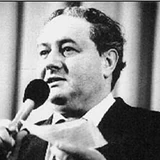
Eduard Gufeld was a Soviet grandmaster from Kyiv who played in eight USSR Championships and beat three World Champions: Mikhail Tal, Boris Spassky and, twice, Vasily Smyslov. In Tbilisi he trained Maia Chiburdanidze, who became Women's World Champion in 1978. He wrote more than eighty chess books. The game he valued most was his win over Vladimir Bagirov at Kirovabad in 1973, which he called his "Mona Lisa" and which John Nunn later included in his collection of the greatest games. After the Soviet Union broke up he moved to the United States, where he kept playing, teaching and writing until his death in Los Angeles in 2002.
Kyiv
Gufeld was born in Kyiv on 19 March 1936. He opened the memoir in Chess: The Search for Mona Lisa (2001) with: "Rumours circulate that Eduard Gufeld was born on the first of April. Having known myself for many years now, I can authoritatively declare that they are just rumours." His father was killed in the first months of the war. As German troops approached Kyiv, the family escaped on a freight car loaded with grain, and when a German plane fired on the train his grandmother pushed him into the grain, covered him with pillows and shielded him with her body. He came back with his mother from Samarkand to a ruined Kyiv.
As a boy he played football, but at eleven he joined the Spartak chess club and then the chess circle of the Kyiv Pioneers' Palace, where the greatest influence on him was the trainer and writer Isaac Lipnitsky. In 1953 he took second place in an adults' tournament and qualified as a candidate master, and the next year, at eighteen, he became Ukrainian junior champion.
In the autumn of 1957 he was drafted into the army, the start of what he called "my almost 20-year career in the Armed Forces Chess League." He became a USSR Master in 1958 and won the Armed Forces championship in 1960 and again in 1962, when the Defence Minister Rodion Malinovsky presented him with a Cuban chess set that had been a gift from Fidel Castro. He wrote: "I became the first grandmaster among military men."
He played in the Ukrainian Championship ten times between 1954 and 1968, and in 1960, 1962 and 1963 finished half a point short of first place. In 1961 he finished first in the Georgian championship, but as a Ukrainian player he did not receive the title.
The USSR Championship
Gufeld played in the USSR Championship eight times between 1959 and 1972 and usually finished with a minus score, but he beat several of the strongest players in the country there. In his first final, at Tbilisi in 1959, he finished twelfth but beat Mikhail Tal, who became World Champion the next year, as well as Ratmir Kholmov and Evgeni Vasiukov. At Leningrad in 1960 he beat Boris Spassky after losing five games in a row; in the tournament bulletin David Bronstein wrote that Gufeld, "who had been more than modest in the last five rounds, decided to remind Spassky of his existence."
He prepared for the 1961 final in Moscow with his Kyiv friend Leonid Stein, and against Mark Taimanov he played the knight sacrifice 15...Nf4+ that they had worked out together. "How young we were, and how we believed in ourselves!" he wrote of it.
His best result was at Leningrad in 1963: 11/19 and a share of seventh place, a point behind the winners. Before the last round he was a point behind Stein and half a point behind Kholmov and Spassky, and a place in the "tournament of seven" that followed, which decided the Soviet places in the Interzonal, was within reach. Stein lost that day, but Gufeld played irresolutely against his friend Janis Klovan: "Literally a moment before Klovan's flag would have dropped, I overlooked a mate in two moves." He lost the game and missed the play-off, and he never played in an Interzonal. Once, when reporters asked him and grandmaster Kuzmin about their greatest achievements, he answered for his hesitant colleague that Kuzmin had twice played in the Interzonal, and added: "As for me—I twice wanted to take part in the Interzonal."
FIDE made him an International Master in 1964, after a second norm at Sarajevo, and the 1967 Leningrad international tournament, where he scored 10/16, brought him the grandmaster title. That year, in the Soviet team championship in Moscow, he beat the former World Champion Vasily Smyslov by trapping his queen, one of the two wins he was proudest of. Mikhail Botvinnik studied the position and whispered something to Efim Geller. Many years later, Gufeld wrote, Geller told him what Botvinnik had said: "Who's this yobbo who's playing in our team?" The next day Botvinnik told him that he had analysed the game and agreed with him. Gufeld beat Smyslov again in 1975. His highest rating was 2570, in January 1977.
“Every painter dreams of creating his own "Mona Lisa". No other game has ever given me so much satisfaction.”
“Personally, I would never exchange my best games for a dozen first places.”
“For half a century I have felt tied to the King’s Indian chariot, and this slavery is a voluntary one.”
“It happened a long time ago—40 kilograms ago (I have my own method of measuring time) ...”
“I think that my English is better than your Russian!”
“Gufeld is a chessplayer who, when inspired, can defeat anybody. If he is out of sorts he can just as easily lose to anybody.”
“Ask any chessplayer to name his best game, and you can count on getting the stock retort: "I have yet to play it!" Everyone would answer that way except one grandmaster, who, gesticulating wildly, would begin enthusing about his "immortal" game ...”
“But if the grandmaster from Tbilisi has the initiative he skips among the chess tables like a shooting star, bestowing smiles all round.”
“He is an international chess grandmaster by title, chess journalist by education, chess author by avocation, chess promoter by profession, chess coach by choice, FIDE official by merit and a chess artist by nature.”
The Gufeld Bishop
Gufeld played the King's Indian Defence nearly all his life, and his dark-squared bishop on g7 became known as the "Gufeld bishop". Salo Flohr wrote that "when Gufeld plays Black his bishop can be put on g7 in advance. This bishop is his cup of tea." Gufeld agreed: "I admit it—there is no life for me without the 'Gufeld bishop'."
He placed himself in "the artistic, or, as I would rather call it, the romantic category of chessplayers", and admitted that in search of truth and beauty he sometimes forgot about points. Several of his games won best-game prizes, among them his attack against Božidar Ivanović at Sochi in 1979, his win over Lev Psakhis in the 1982 Soviet team championship at Kislovodsk, and his win over Jonathan Mestel at Hastings 1986/87. Winning with the Torre Attack (1993), which he wrote with Oleg Stetsko, records that his win with Black over Machulsky at Moscow in 1991 was given a prize by World Champion Garry Kasparov as the best game of the tournament (p. 153). He wrote that the Grandmasters Association's best-game contest, which Kasparov organized, had been his idea, and he sat on its jury.
Geller and Stein
Gufeld worked for many years as a trainer for Efim Geller. He came to the 1967 Interzonal at Sousse as Geller's trainer and met Bobby Fischer there, who greeted him: "Oh, Gufeld! I know you! I've seen your game against Smyslov." When Fischer left Sousse for Tunis in the middle of the tournament, Fischer later recalled, "first Bjelica, then Gufeld endlessly tried to call me" to persuade him to come back. In 1971 Gufeld was Geller's second in the Candidates quarter-final against Viktor Korchnoi, as Kasparov records in My Great Predecessors, Part V.
Leonid Stein died in 1973, at thirty-eight. With Efim Lazarev, Gufeld wrote a book about him, Leonid Stein, published in Moscow in 1980. At the Baku tournament that year he told the young Kasparov about it, and then, Kasparov recalled in My Great Predecessors, Part III, "after cautiously looking around, he quietly whispered in my ear: 'You know, in 1973 Stein was stronger than Karpov!' and promptly hurried away."
Tbilisi
Gufeld married a Georgian and made Tbilisi his second home, and by 1969 he was playing for Georgia in the Soviet team championship. In 1970, at the Tbilisi chess club, an instructor from Kutaisi asked him to look at a girl of eight or nine, Maia Chiburdanidze. He told Sovetsky Sport: "There is a girl in Kutaisi, who is just nine years old." Without naming her, he predicted that everybody would soon hear about her.
In January 1976, at the USSR Girls' Championship in Tbilisi, Chiburdanidze came to his room with her mother and her uncle, who told him: "Until you agree to be Maya's coach, we will not leave this room." He agreed, and she won all her remaining games and the title. In September 1977, when she trailed Elena Akhmilovskaya 5–4 in their semi-final match in Tallinn while he was playing in the Armed Forces team championship in Moscow, he flew between the two cities to prepare her for each game, calling himself a "flying coach". In 1978, at seventeen, she became the youngest Women's World Champion. He also coached the Soviet women's Olympiad team, and counted the 1982 Lucerne Olympiad, which the Soviet women won with four Tbilisi players, as one of the peaks of his coaching career.
He won tournaments at Gori and Tbilisi in 1971, shared first at Tbilisi in 1974, won again at Tbilisi in 1980, shared first at Havana in 1985 and shared first with Larry Christiansen at Canberra in 1988.
In 1973, at the USSR Championship semi-final in Kirovabad, he beat Vladimir Bagirov with Black in the Sämisch King's Indian, giving up the exchange to attack the white king. Gufeld called it his "Mona Lisa" and later titled a book Chess: The Search for Mona Lisa (2001). There he wrote: "If I had any genius, it woke up on the night I played against Bagirov. Sad as it may be, it turned out to be a 'genius of one evening.'" Later in 1973, flying with the Soviet players to the Interzonal in Brazil, he had them analyse the position as a warm-up, and he says it took a quarter of the way round the earth to defend his opinion that the chances were equal. John Nunn included the game in The Mammoth Book of the World's Greatest Chess Games.
The United States
After the fall of the Soviet Union, Gufeld travelled widely. In 1997 he told his co-author Oleg Stetsko: "I can't live in Tbilisi – everything has been plundered, and in Kiev there is altogether no chess life…" He emigrated to the United States and settled in Los Angeles. When Stetsko visited in 1998 he found a one-window apartment and, upstairs, a small room with a few chessboards and portraits of the world champions that Gufeld called the "Eduard Gufeld Chess Academy". He still went back to Kyiv every year to see his mother, Eva Yuryevna.
In his first senior tournament, at Las Vegas in 1995, he scored 4½/5 and became co-champion of the US Senior Championship, and in 1999 he won the American Open. He taught and wrote. He was one of the most prolific chess authors, with more than eighty books, among them Exploiting Small Advantages (1985), his autobiography My Life in Chess, Leonid Stein: Master of Risk Strategy (2000), Chess: The Search for Mona Lisa (2001) and The Art of the King's Indian, written with Stetsko. He also started FIDE's Committee on Chess Art and Exhibition, and as a member of the FIDE commission to assist developing countries he gave seminars and lectures abroad.
Legacy
He telephoned Stetsko nearly every morning; the last call came on 12 September 2002, and the next day there was none. Gufeld had had a stroke and a heart attack, and he died two weeks later at Cedars-Sinai Medical Center in Los Angeles, at sixty-six. He is buried at Hollywood Forever Cemetery. He had trained a Women's World Champion, written more than eighty books and beaten three World Champions, and his win over Bagirov is still known by the name he gave it.
Books
Books Eduard Gufeld wrote, co-wrote, edited, or contributed to. Translations and reprints are grouped under the same work.
-
Сицилианская защита: Вариант дракона
Author
-
Learn from the Grandmasters
Contributor — own game annotations
-
Семнадцать весен Майи
Coauthor — A. L. Yeremyan
-
The Sicilian Defence: The Tournament Player's Repertoire of Openings
Author
-
Benko Gambit Accepted
Author
-
The Sicilian for the Tournament Player
Author
-
My Life in Chess: The Search for La Gioconda
Author
-
Winning with the Torre Attack
Coauthor — Oleg Stetsko
-
The Giuoco Piano
Coauthor — Oleg Stetsko, Murray Chandler
-
The Modern French Tarrasch
Author
-
An Opening Repertoire for the Positional Player
Coauthor — Nikolai Kalinichenko
-
The Complete Dragon
Coauthor — Oleg Stetsko
-
Caro-Kann: Smyslov System4...Nd7
Coauthor — Oleg Stetsko
-
The Richter-Veresov System
Coauthor — Oleg Stetsko
-
Secrets of the King's Indian
Coauthor — Eric Schiller
-
Bobby Fischer: From Chess Genius to Legend
Coauthor — Mike Morris, Carlos Almarza-Mato, Wolfgang Unzicker
-
Chess: The Search for Mona Lisa
Author
-
Leonid Stein: Master of Risk Strategy
Coauthor — Efim Lazarev
-
Chess Strategy
Coauthor — Nikolai Kalinichenko
-
The Classical French
Coauthor — Oleg Stetsko
-
Ultimate Dragon, Volume One
Coauthor — Oleg Stetsko
-
Ultimate Dragon, Volume Two
Coauthor — Oleg Stetsko
-
Secrets of the Sicilian Dragon
Coauthor — Eric Schiller
-
The Art of the King’s Indian
Coauthor — Oleg Stetsko
-
Art of Mastering Chess
Author
-
Encyclopédie des ouvertures
Coauthor — Nikolai Kalinichenko
-
Exploiting Small Advantages
Author
-
Improving Chess by Tactics
Author
-
Obrona królewsko-indyjska
Author
-
Winning with the King's Indian
Author
-
Zweispringerspiel im Nachzuge
Author