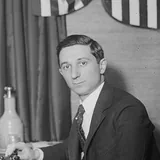
He was an engineer first — mechanical and electrical, degrees from Charlottenburg, a safety man for Sears, Roebuck, and the inventor of a breast pump that kept premature infants alive. Chess was what he did with everything else. Edward Lasker won five American open championships, came within a single point of the United States title, wrote a primer that taught more players than most world champions ever will, and did more than anyone alive to plant the game of Go in America. He was still at the board at ninety. And for a century he has been mistaken for his distant cousin.
Kempen, Breslau, Berlin
He was born Eduard Lasker on 3 December 1885 in Kempen, a small town in the Prussian Province of Posen that is now Kępno in Poland, the son of Sigismund Lasker and Flora Bornstein. He studied in Breslau, where Arnold Schottländer taught him chess, and then at the Technische Hochschule in Charlottenburg, taking undergraduate degrees in mechanical and electrical engineering in 1910. He would work as an engineer for most of his life. Chess was never the profession; it was, for the next seventy years, everything else.
In Chess for Fun and Chess for Blood (1942), he admitted that too much chess had made him take two years longer than he should have to graduate. His friends had told him what they thought of that. He still did not regret the time he had spent at the board, though he would advise parents to leave their children more time for schoolwork.
Berlin was then one of the great chess cities and he made his way in it, winning the city championship in 1909. In a Berlin club tournament of January 1907 he threw away a won king-and-pawn ending against Kurt Moll, resigned, and was leaning back from the board when a tall, strikingly handsome onlooker bent over his chair and showed him the move he had missed. The stranger was Ossip Bernstein. They went out to dinner and discovered they were both lovers of music, and that was a friendship. In 1911 Lasker published Schachstrategie, which appeared in English as Chess Strategy and went through edition after edition; by his own count it sold between forty and fifty thousand copies, more, he believed, than any chess book before it. In the author's preface to Chess Strategy, he explained that he wanted "to appeal less to the memory of my readers than to their common sense and intelligence."
The king that walked to g1
In 1911 he joined AEG in Berlin. He wanted the company's Tokyo office, because by then he had discovered Go, but AEG posted only fluent English speakers to Japan, so in 1912 he went to London to learn the language. "My first visit, of course, was to the City of London Chess Club," he wrote in 1918. "I was lucky enough to win the following game against the club champion, G.A. Thomas, which gave me the best possible introduction."
It is one of the most reproduced games ever played, and it was not a tournament game: the two men had agreed only that neither clock could run more than five minutes ahead of the other. It lasted eighteen moves. After Thomas answered 10.Qh5 with 10…Qe7, Lasker played 11.Qxh7+, gave up his queen for a check, and drove the black king out of its castle and down the entire length of the board to g1, where it was mated. Emanuel Lasker printed the game in his column in the Berlin daily B.Z. am Mittag under the heading "The tragi-comic journey of the black king". Thomas, checkmated in front of his own club, offered a compliment instead of an excuse; Lasker had no English yet and a spectator had to translate it for him. He never forgot the courtesy, and said so in print for the next fifty years, contrasting it with what a beaten Berlin amateur would have told him.
There is a permanent quarrel about the last move. Lasker mated with 18.Kd2. He could have done it by castling instead, and a great deal of the chess literature says he did — Edward Winter has spent decades correcting it, not helped by the fact that Lasker's own published accounts of the game contradict one another on the date, the move order and the circumstances. He won the London championship in May 1914. When war broke out he was stranded in England as a German national, and was allowed to sail for the United States by Sir William Haldane-Porter, head of what became the British immigration service, who remembered him as London's champion.
London also gave him his English translator. In Chess Secrets I Learned from the Masters (1951), Lasker recalled trying to translate Schachstrategie himself in the summer of 1913. Julius du Mont had to rewrite his English, and Lasker credited him with the literary style that helped Chess Strategy find its readers. Du Mont also taught him piano, though Lasker admitted that he gave practice very little time.
“After all, winning some chess title is an ephemeral pleasure; but a friendship formed through chess is apt to endure.”
“Instead of checkmating with K–Q2 I could have done it by castling, which would perhaps have been more spectacular… I actually considered castling, but the efficiency-minded engineer in me got the better of it and I played K–Q2, which required moving only one piece.”
“I did not discover that we were actually related until he told me shortly before his death that someone had shown him a Lasker family tree on one of whose branches I was dangling.”
“Although I did not win it, I have always treasured it as one of those games which make one glad to know chess.”
“This was very nice.”
“It contains 75 superbly annotated games by one of the best chess writers and annotators of all time. Each one is a work of art.”
“Lasker is reticent about the tragedies in his life: his charming and talented wife, to whom he had been happily married for only six months, died after a minor operation as a result of a surgeon's error; and his mother and brother perished in Nazi Germany.”
“He proved himself a true sportsman, and I want to express my gratitude.”
The safety engineer of Chicago
He reached America late in 1914 — it was his mother's birthplace — and found work in Chicago with Sears, Roebuck as a safety engineer. When the United States entered the war in 1917 he was sent enlistment papers with the right, as a German, to claim exemption; he waived it, having decided to remain in America. In Chess Secrets he described the shorter wait for citizenship as a welcome consequence. The armistice came before he was called up. Between 1921 and 1923 he designed a mechanical breast pump, patented in the United States, which saved the lives of premature infants and made him a considerable amount of money. His chess friends called him "the chest player", and he was still repeating the joke against himself thirty years later.
His work at Sears also led to Chess and Checkers: The Way to Mastership (1918). A colleague suggested a book for the company's catalog, and the colleague and his fiancée tested the manuscript without knowing anything about chess. Lasker recalled in Chess Secrets that he rewrote each unclear sentence until they could follow it. The primer's own preface names the readers as Eugene Fuller and Helen Dvorak and credits the checkers champion Alfred Jordan with much of that part's material. Lasker later recalled Capablanca calling it the best primer for beginners.
Chicago was where he became an American chess figure. He won the championship of the Western Chess Association five times — 1916, 1917, 1919, 1920 and 1921 — the event that is now the U.S. Open. It was never the national title; that belonged to Frank Marshall, unbroken, from 1909 until 1936, and Lasker never held it. By 1921 the American Chess Bulletin could describe him as a man "who in turn has been the champion of London, New York and Chicago". He won the New York tournament of 1922, where he beat a ten-year-old prodigy called Samuel Reshevsky. When Marshall assembled Chess Masterpieces in 1928 and asked the world's masters each to nominate a single best game, Lasker put forward his win as Black over Carlos Torre at Chicago in 1926.
The private life behind the record was harder than the record shows. In 1920 his wife, Cecile Mathilde Heller — a New Orleans watercolourist and the daughter of Rabbi Max Heller — died at thirty when a minor operation went wrong. They had been married six months. His mother and one of his brothers were later murdered in Nazi Germany; his niece Anita, the daughter of his brother Alfons, survived Auschwitz by playing cello in the camp orchestra. Lasker, who wrote hundreds of thousands of words about chess, said almost nothing about any of it.
Eighteen games against Marshall
After his fifth Western title he wrote to Marshall, on 30 October 1921, challenging him for the United States championship. It took a year and a half to arrange. The match ran from 15 March to 11 May 1923, eighteen games played in New York, Chicago, Milwaukee, Cleveland, Detroit, Cincinnati, Baltimore and Washington, for a purse of about five thousand dollars out of which the players paid their own expenses.
Lasker was leading when, with the seventh game adjourned, he was taken to hospital in Chicago with a severe kidney-stone attack. The match rules allowed a postponement of up to seven days for illness; Lasker recalled in Chess Secrets that Marshall argued this didn't cover an adjourned game. He left hospital against his doctor's orders to play it out: "Naturally, foolishness and ambition won." He lost the game and was in poor health for the rest of the match. Marshall kept the title 9½–8½. It was one point over eighteen games, and there was never a second chance.
The near-miss did earn him the invitation of his life. New York 1924 was a double round robin of eleven players — Capablanca reigning, Emanuel Lasker deposed, Alekhine, Réti, Bogoljubov, Tartakower, Marshall — and Edward Lasker, a working engineer, was the only amateur in it. He finished tenth of eleven with 6½ points. He also beat Réti and Tartakower, both then among the ten strongest players alive, drew both games with Alekhine, and drew with Capablanca. His draw with Emanuel Lasker ran to 103 moves and left something behind in the endgame books that had not been demonstrated before.
The estrangement from Marshall ended at Chicago in 1926. Lasker's last-round win over Carlos Torre gave Marshall first place. According to Lasker's account in Chess Secrets, Marshall acknowledged the debt at the banquet, praised him for playing to win despite their quarrel, and offered his hand. Lasker accepted the reconciliation and wrote that he always gave Marshall credit for the speech.
The other Lasker
The confusion began at once and has never stopped. His crushing win over Englund at Scheveningen in 1913 has been printed in books under Emanuel Lasker's name; Emanuel has been credited with Edward's seventy-move win over the boy Reshevsky; Edward has been called a five-time United States champion by writers who did not check which championship. Emanuel's wife Martha suspected him of trading on the surname. C.J.S. Purdy, reviewing him warmly in 1952, stated flatly that the two men were unrelated. Edward himself, going through the signatures collected at New York 1924, was startled to notice how nearly identical the two hands were.
What can be documented comes from Edward. He wrote that he had no idea they were related until Emanuel told him, a few weeks before his death in 1941, that a young man from Australia had come to him with a Lasker family tree with Edward on one of its branches. In a letter dated 8 February 1973 he set out the genealogy: the common forebear was Samuel Lasker, son of the rabbi of the Polish village of Łask, who moved to Kempen in 1769 — "He was the great-grandfather of my great-grandfather," Edward wrote — while Emanuel descended from Samuel's first-born son, who had gone on to Jarotschin. If the account holds, the two were third cousins twice removed. Distant relations, at any rate, and close friends: they walked in Central Park together during the 1924 tournament, and Edward filled his books with things Emanuel had said to him.
Go, and a very long last act
He first read about Go in an article by Oskar Korschelt that put the game forward as a rival to chess, a claim he found funny. Then, in the Berlin café where the chess players met, he noticed the record of a Go game printed on the back of a Japanese newspaper a customer was reading. He and his friend Max Lange took the paper after the man left and deciphered the diagram, and were certain from the position that Black had won; unable to read the note beneath it, they had to ask another Japanese customer, who told them Black had resigned. It took Lange three weeks of study to understand why. That was the beginning of the rest of his life.
He converted Emanuel Lasker, who was sceptical until he had been told the rules and played a single game. The two of them studied with a Japanese student, Yasugoro Kitabatake, until after two years they could beat him without a handicap — whereupon Kitabatake arranged a game against a visiting Japanese mathematician, who gave Edward, Emanuel and Emanuel's brother Berthold nine stones, let them consult over every move, and beat all three without appearing to think. Edward never did reach Tokyo. But in 1934 he wrote Go and Go-Moku, the book that introduced the game to a generation of Westerners, and in 1935 he and Karl Davis Robinson and Lee Hartman founded the American Go Association at a Greenwich Village restaurant. In 1971 the Nihon Ki-in awarded him the Okura Prize for the international promotion of Go.
The chess simply went on. In 1952, the year he turned sixty-seven, he crossed to Havana for a twenty-round international and beat Nicolas Rossolimo, who finished sixth in that field, and Arturo Pomar. He was still playing at the Marshall Chess Club in the late 1950s. FIDE made him an International Master in 1963, when he was seventy-seven. He was still writing chess letters in his own hand in 1975. On 11 September 1976, at ninety, he sat down to play in a telex match between New York and London.
Legacy
He died in New York on March 25, 1981, aged ninety-five, the last surviving player from New York 1924; as its only living participant he had written the tournament's fiftieth-anniversary memoir seven years earlier. Chess Strategy is still read more than a century after Schachstrategie first appeared, and Chess Secrets I Learned from the Masters, unreliable on dates but wonderful on people, is the book that keeps his voice alive. The Marshall Chess Club plays its annual championship as the Edward Lasker Memorial. The American Go Association gives an Edward Lasker Award for service to the game he called the greatest of all strategy games, chess included. He was inducted into the U.S. Chess Hall of Fame in 2017. He never won a national title, and it hardly matters: he is the amateur who beat Réti, the engineer who declined to give checkmate by castling because it would have meant moving two pieces, and the man who taught the West to play Go.
Books
Books Edward Lasker wrote, co-wrote, edited, or contributed to. Translations and reprints are grouped under the same work.
-
Chess: The Complete Self-Tutor
Author
-
Chess and Checkers: The Way to Mastership
Author
-
Chess for Fun and Chess for Blood
Author
-
Chess Secrets I Learned from the Masters
Author
-
Chess Strategy
Author
-
Go and Go-Moku: The Oriental Board Games
Author
-
Modern Chess Strategy
Author
-
The Game of Chess
Author
-
The Adventure of Chess
Author