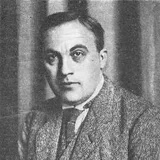
Efim Bogoljubov had complete, unshakable faith in himself. "When I am White, I win because I am White," he said, as Max Euwe quoted him, "when I am Black – because I am Bogoljubow." For a few years in the 1920s it was simply true: at Moscow 1925 he finished ahead of both Emanuel Lasker and the World Champion Capablanca, and twice he played Alexander Alekhine for the title. He never won it. He was interned in one war, disowned by the revolution, and judged harshly for his later compromises, but at the board he stayed a fighter to the end, sure that every position could be won.
From the seminary to the chessboard
Efim Dmitrievich Bogoljubov was born on 14 April 1889 in the village of Stanislavchik, near Kiev, in what was then the Russian Empire and is today Ukraine. His father was an Orthodox priest, and the path laid out for the boy ran toward the Church: he studied at a theological seminary in Kiev before turning to agriculture at the Kiev Polytechnic. He came to chess late — he did not learn the moves until he was about fifteen, and only took the game seriously a few years after that.
It was a late start for a future world-title challenger, but Bogoljubov made up the ground quickly. By 1911 he was sharing first place in the Kiev championship, and within a few years he had thrown over both the seminary and the farm for the only vocation that ever truly held him. In 1914, as he recorded in his opening book Die moderne Eröffnung 1. d2–d4!, he was still playing in Kiev, where he met Grekov in a tournament game and joined Fedor Bohatirchuk and Evenson in a consultation game against Capablanca. Chess was not a path he had been given; it was the one he chose for himself, and he gave it the whole of his life.
Interned in the Black Forest
In the summer of 1914 Bogoljubov travelled to Germany to play in the great tournament at Mannheim. He never finished it. When the First World War broke out, the Russian players on German soil were arrested as enemy aliens and interned — Bogoljubov among them — in the Black Forest town of Triberg, where they would remain for the duration of the war.
Before Triberg came prison. Garry Kasparov's My Great Predecessors, Part I tells how the Mannheim players were first held in a civil jail, where Alexander Alekhine shared a cell with Bogoljubov. Alekhine recalled: "There were no books, no newspapers and, of course, no chessboard. Bogoljubow and I played blindfold chess for hours." About a month later a German military medical commission at Baden-Baden released Alekhine and two others as unfit for service. Bohatirchuk noted that Bogoljubov was among those held back, although Russia had already exempted him from military service. He was interned with the rest, and in Kasparov's words "this changed Bogoljubow’s fate".
Captivity, oddly, made his career. Cut off from home, the interned masters organised tournaments and matches among themselves, and Bogoljubov played chess almost continuously through the war years, sharpening himself against strong opposition with nothing else to do. Some of his opening ideas date from there. In Die moderne Eröffnung he wrote that he had first tried the defence 1.d4 Nf6 2.c4 b6 at Triberg in 1914, and that he named it after Friedrich Sämisch, who later made it his favourite line; the book also cites his games against Rabinovich at Triberg in 1915. He also met a local woman, Frieda Kaltenbach, a schoolteacher's daughter; they married in 1920 and would raise two daughters. By the time peace returned, the young Russian had put down roots in Germany — and Triberg, the place of his confinement, had become the place he would call home for the rest of his life.
“When I am White, I win because I am White, when I am Black – because I am Bogoljubow.”
“I do not agree to consider myself completely defeated after this first loss.”
“People who understand nothing about chess or character analysis claim that I am an optimist. I maintain that I am by nature a pessimist.”
“The main trait of his character, his alpha and omega, is unbounded optimism. In this respect he is the image of Chigorin, who too was always convinced that he was about to win.”
“Capablanca pulverises his opponents, Alekhine fights, Lasker thinks, while Bogoljubow fantasises in chess ... A whole book could be written about him, but two words are also sufficient: amazing practician!”
“He regards his opponent as an excellent experimental field for applying his skill and never tries to study his opponent. He often hopes for a miracle, where what is needed is knowledge ...”
“He possesses inexhaustible fantasy. His disadvantage is that in a bad position he does not have the necessary calm.”
Moscow 1925
Bogoljubov's own collection of annotated games, Izbrannye partii (Selected Games, Part 1, published in Leningrad in 1926), records that he spent four and a half years at Triberg as a civilian prisoner before moving to Berlin in January 1919. The wins began at once. He took a four-player tournament in Berlin that March, then Stockholm in November and December with 12½ out of 15, ahead of Spielmann and Richard Réti. In January 1920 he lost a match to Akiba Rubinstein in Stockholm and Göteborg, +4 −5 =3, and in his notes he judged two of the losses accidental: in one he had been a piece up, and in the other he blundered a piece in time trouble while a pawn ahead. That September he beat Aron Nimzowitsch 3–1 in a short match in Stockholm, and in the autumn he won there again with 12½ out of 14, half a point ahead of Nimzowitsch.
The early 1920s were Bogoljubov's golden years. He won the great tournament at Bad Pistyan in 1922 with 15 out of 18, half a point ahead of Alekhine and Rudolf Spielmann, shared first with Alekhine and Géza Maróczy at Karlsbad in 1923, and in 1924 and 1925 took the Soviet Championship in successive years. In 1925 he managed something no one else ever has: he held the championships of both Germany and the Soviet Union in the same year.
His best result was Moscow 1925, at the time the strongest tournament ever held, with a field that included the reigning World Champion José Raúl Capablanca and the former champion Emanuel Lasker. Bogoljubov won it with 15½ out of 20, ahead of Lasker on 14 and Capablanca on 13½. He made the difference against the home players, scoring 8 out of 9 against the Soviet masters, and the result survived a loss to Capablanca three rounds from the end. Of the piece sacrifice that decided that game, his own notes say: "Considering himself morally obliged to play for a win at all costs, Capablanca made this move almost without thinking." Kasparov calls Moscow "the greatest success in his career".
Bogoljubov never doubted that it made him Capablanca's equal. When the Americans invited him to a six-player match-tournament in New York in 1927, Kasparov writes, he suggested that "instead of this mediocre tournament a Bogoljubow-Capablanca match should be arranged." He was replaced by Spielmann. In 1928 he beat the rising Max Euwe 5½–4½ in a match for the title of FIDE champion, and that August he won at Bad Kissingen (+6 −1 =4), a point ahead of Capablanca, although he lost their individual game. Over the turn of the year he beat Euwe again, by the same score. He signed the closing words of Die moderne Eröffnung, which he published himself, in Triberg in January 1929. In them he thanked Ernst Grünfeld for help revising the manuscript and said the idea for the book had come from the Swedish patron Ludvig Collijn, to whom it is dedicated. For several years there were few players anyone would have rated above him, and Bogoljubov, never a modest man, would have said there were none.
Two shots at the crown
Twice Bogoljubov played Alexander Alekhine for the World Championship, and twice he came home without it. In August 1928 the FIDE Congress at The Hague confirmed him as its official challenger, and four days after Bad Kissingen he sent Alekhine a formal challenge, which the champion accepted as "the first since I won the title". Money was the hard part. Bogoljubov struggled to raise even the $500 deposit, and in January 1929 Dutch players put it up for him. The match ran from September to November 1929 in Wiesbaden, Heidelberg, Berlin, where Lasker chaired the jury, and the Netherlands. Bogoljubov drew level at 2–2 and won the 13th and 14th games "to the applause of the audience", but Alekhine won 15½–9½ (+11 −5 =9). The German master Adolf Kramer watched the two friends at the board: "Like a massive boat he sits immobile at the board, whereas the nervy Alekhine is all the time drumming on the table with his fingers or restlessly moving his legs."
Bogoljubov did not accept the verdict. He told an interviewer that Alekhine would beat everyone he met, and added: "During the next four to five years I will follow his victories, and then we will play again. I do not agree to consider myself completely defeated after this first loss." His results declined, and he lost a match to Spielmann at Semmering in 1932, but in the spring of 1934 he raised the minimum prize fund in Germany himself. At his insistence it was billed as a "revenge match". It was played in towns across Germany from April to June 1934, and Alekhine won again, 15½–10½ (+8 −3 =15). Kasparov's verdict is that "the challenger was no longer the same player"; in the 21st game Bogoljubov had a winning position with White, threw it away with one move, 34 Rb5??, and lost.
He won games in both matches, but Kasparov describes the first as a duel "between two striking, but unequal opponents", and he titles his account of both matches "A Convenient Opponent". Regretting that the world never saw an Alekhine–Capablanca return match, he writes that Bogoljubov "was undoubtedly a more convenient opponent for the champion". His contemporaries saw the same quality from the other side. Spielmann called "unbounded optimism" the "alpha and omega" of his character, and Tartakower wrote that "Bogoljubow fantasises in chess". Bogoljubov himself claimed a likeness to Mikhail Chigorin. In the preface to his Izbrannye partii M. I. Chigorina (Selected Games of M. I. Chigorin, Leningrad, 1926), compiled, he wrote, in a small German town where he could not get all the material he needed from Russia, he said he felt an inseparable link between his own play and Chigorin's, saw the same likeness in Alekhine, and suggested that it might come from their shared Slavic origin. Bogoljubov's chess was dynamic and combative rather than coolly positional — he trusted his pieces, sought the initiative, and played for the win from the first move with White or Black alike. The Bogo-Indian Defence still carries his name, although in Die moderne Eröffnung he classed its defining line, 1.d4 Nf6 2.c4 e6 3.Nf3 Bb4+, under the Nimzowitsch Defence and recommended that Black answer 1.d4 with 1...d5.
Caught between empires
Bogoljubov went back to the Soviet Union in 1924 and won its championship twice, but the new regime kept its champions on a short leash — travel abroad required official permission. When the authorities forbade him to play at Merano in 1926, he gave up his Soviet citizenship and settled in Germany for good, becoming a German citizen in 1927. The All-Russian chess section called "citizen Bogoljubow a renegade", expelled him and stripped him of his title of USSR champion. His name was struck from the record, his achievements unmentioned, and the two-time world-title challenger became, in his homeland, a non-person for the rest of his life.
Germany didn't make things easy either. When the Nazis came to power he was barred for years from the national team and championship as a foreigner. At Nottingham in 1936 the young Mikhail Botvinnik beat him, and, as Kasparov's My Great Predecessors, Part II relates, Botvinnik later recalled Bogoljubov telling his card-playing partners Vidmar and Tartakower: "You are all dandies, I lose to you accidentally." Then, seeing Botvinnik, he added: "But to him – not accidentally!" In 1938 he joined the Nazi party, by his own account and that of people at the time to get his daughters into university, and sources have long disagreed about how far it reflected real conviction, with some who knew him insisting it was a formality he privately despised. It is the dark part of his story, and it can't be left out.
He kept playing through the war years in occupied Europe. In the summer of 1941 Euwe, who admitted that he "had a grudge against Bogoljubow", accepted only the invitation that let him play Bogoljubov, at Carlsbad, and won their ten-game match 6½–3½. After 1945 the German championships were open to him again; he won at Bad Pyrmont in 1949 and Augsburg in 1951. The man who had once finished ahead of Lasker and Capablanca spent his last years as a respected but diminished figure, a long way from the top.
Legacy
Bogoljubov died of a heart attack on 18 June 1952 in Triberg im Schwarzwald, the Black Forest town where the First World War had once interned him — aged 63, and still playing. FIDE had granted him the Grandmaster title only the year before, after Western masters protested its initial refusal. The Soviet Union, which had erased his name for a quarter-century, rehabilitated him only after perestroika. What survives is the chess: the Bogo-Indian Defence (1.d4 Nf6 2.c4 e6 3.Nf3 Bb4+) still bears his name in the opening books and at the highest level of play, a quiet monument to a player who fought every game as if the title still hung on it. He is remembered as one of the strongest players in the world in his prime, a two-time challenger for the highest honour in chess, and the most confident man ever to sit down at the board.
Books
Books Efim Bogoljubov wrote, co-wrote, edited, or contributed to. Translations and reprints are grouped under the same work.
-
Klassische Schachpartien aus modernen Zeiten, Part III
Author
-
Mikhail Chigorin: Selected Games
Author
-
Die moderne Eröffnung 1. d2–d4!
Author
-
Schach-Schule
Author
-
Избранные партии, часть 1 (Selected Games, Part I)
Author
-
Klassische Schachpartien aus modernen Zeiten, Teil I: 1919–1920
Author
-
Klassische Schachpartien aus modernen Zeiten, Teil II: 1920–1921
Author
-
Международный шахматный турнир в Москве 1925 г., Часть I (Moscow 1925, Part I)
Author
-
Международный шахматный турнир в Москве 1925 г., Часть II (Moscow 1925, Part II)
Author