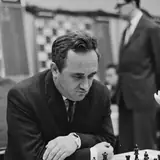
He never won the title, and for thirty years he frightened everyone who did. Efim Geller was the eternal Candidate: six times he came within reach of the world title and six times he fell short, yet he beat Botvinnik, Smyslov, Petrosian and Fischer more often than they beat him, and he taught his rivals how their own openings really worked. Botvinnik said it plainly: before Geller, nobody understood the King's Indian. His ideas outlasted his results, and the whole chess world got stronger by learning from them.
Out of Odessa
Geller was born in Odessa in 1925, into a Jewish family, and also played basketball before concentrating on chess. The Second World War delayed his development as a player. In The Application of Chess Theory, introducing his 1946 win over Kogan in the Odessa Team Championship, he recalled that his chess childhood had been extended by the war. He was still drawn to attacks on the king even when they broke the rules of sound strategy; a successful attack gave him enough pleasure to accept the occasional punishment (game 11, p. 24).
When his breakthrough came, it came fast. In 1949 he won a Soviet Championship semifinal at Tbilisi with 11½/16 and went through to the final, and there, almost unknown, he tied for third and fourth at the 17th USSR Championship in Moscow with 12½/19, behind only David Bronstein and Vasily Smyslov. He became an International Master in 1951 and a grandmaster in 1952. The early Geller was a fierce, original attacker, and that aggression never completely left him as his understanding deepened.
The man who explained the King's Indian
Geller's deepest mark on chess was made in the opening. He helped establish the King's Indian Defence as a major counterattacking system, alongside Isaac Boleslavsky and David Bronstein. In King's Indian Defence: 4 e4, his own historical account credited the earlier work of Alexander Konstantinopolsky and Boleslavsky, followed by Bronstein, and described his own contribution to its theory (p. xiii). Tal's foreword to The Application of Chess Theory records Botvinnik's verdict: “Before Geller we did not understand the King’s Indian Defence” (p. vi).
His theoretical reach went far beyond one defence. He was a central figure in the Sicilian — his quiet 6.Be2 against the Najdorf became a main line, and it was with such restrained, deeply prepared systems that he repeatedly cut down Bobby Fischer. The Geller Gambit against the Slav (1.d4 d5 2.c4 c6 3.Nf3 Nf6 4.Nc3 dxc4 5.e4) bears his name, and his work on the Ruy Lopez and the Queen's Gambit Declined shaped how those openings are played still.
Genna Sosonko's foreword to El ajedrez creativo de Efim Geller (1946–1967) gives a sense of the work behind those ideas. Geller's wife Oksana recalled that he sometimes woke at night to write down variations that had occurred to him. At the 1982 Lucerne Olympiad, Sosonko asked how long it would take him to learn the Chigorin Variation of the Ruy Lopez. Geller considered Sosonko's level and estimated a year and a half for gathering the material, understanding it, and learning to use it (p. 11).
His account of Gothenburg 1955 shows what could happen when preparation met an unexpected reply. Geller–Panno, Keres–Najdorf, and Spassky–Pilnik reached the same sharp Sicilian position. In The Application of Chess Theory, Geller recalled Najdorf coming over while the other Soviet players were still thinking and declaring, “Your game is lost; all this has been analyzed by us!” Geller answered with 13.Bb5. The Argentinians' prepared defense contained a flaw, and all three lost. He also noted that analysis much later suggested a drawing defense (game 18, pp. 41–42).
Some of his preparation paid off a year later. In The Nemesis, the 2019 English collection of his annotated games, Geller recalled a King's Indian combination he found against Samuel Reshevsky at the 1967 Sousse Interzonal. It did not work there, because Reshevsky's queen stood on e7, so he worked out at home exactly when it did. At the 1968 Lugano Olympiad it beat Jan Adamski; two rounds later Holm of Denmark reached the same position, thought on move twelve and stopped the clock; and at Gori soon afterwards Chikovani fell into it too. Geller compared himself to Baron Munchausen, who speared seven partridges with one shot: “I was no exception – until, with a single shot, I “killed” three opponents” (Game 66, pp. 257–259).
“…it was clear to me that the vulnerable point of the American grandmaster was in double-edged, “hanging”, irrational positions. When the play was of this nature, Fischer often failed to find a win, even in a won position.”
“But, firstly, just as it is wrong to work on chess by studying only the first 10–15 moves, so it is wrong to play one and the same opening system, even though it be rich in variations and nuances.”
“I wanted to sacrifice, I wanted to attack. And the attack succeeded!”
“Time and practice are the best judges. And that which for us is dead can tomorrow be restored to life by some inquisitive idea, and vice versa.”
“Before Geller we did not understand the King’s Indian Defence”
“On the other hand, for his wealth of ideas in the most varied chess directions, Geller is one of the most prominent grandmasters of all time.”
“When the topic of ‘the best player never to be World Champion’ is raised, Korchnoi and Keres are often mentioned, but Geller deserves to be on the shortlist.”
So near the crown
Six times, in the cycles from 1953 to 1971, Geller reached the Candidates, the small group of players one step from a world title match, and six times he was knocked out. He played the Candidates at Zurich 1953 and Amsterdam 1956. He came closest at Curaçao 1962: after finishing second to Fischer at the Stockholm Interzonal, he scored 17/27 in the Candidates Tournament and tied for second, half a point behind Tigran Petrosian, who went on to win the title.
In the match era that followed he beat Smyslov 5½–2½ in 1965 before losing to Boris Spassky by the same score; Spassky stopped him again at Sukhumi in 1968, and Viktor Korchnoi did so in 1971. He kept arriving at the threshold and kept being denied. If the title is the only measure, Geller failed at it longer and more honourably than almost anyone in history.
The scourge of champions
The head-to-head records tell a different story, though. He finished his career with a plus score against a remarkable list of world champions: +4 −1 against Botvinnik, +5 −3 against Petrosian, +11 −8 against Smyslov, and most famously +5 −3 against Bobby Fischer, something almost no one else of that generation could claim. Botvinnik, who knew the field as well as anyone, thought Geller was the strongest player in the world in the late 1960s.
The Fischer record was no accident. Introducing their Monte Carlo 1967 game in The Application of Chess Theory, Geller identified double-edged, unclear positions as Fischer's vulnerable point. For that game he chose a very sharp fight in Fischer's own favorite Poisoned Pawn variation, hoping that playing against a familiar system from the other side would be psychologically uncomfortable. He acknowledged the cost of that choice: Fischer knew the opening's subtleties better than he did (game 98, pp. 243–244).
Geller also offered a lighthearted set of rules for beating world champions. The first was to play them, even if only in a simultaneous exhibition. Then one should “always remember that they are Champions” and give the game full effort, while also trying to “completely forget that they are Champions” so that their reputation did not interfere with one's judgment. He immediately added that there was no scientifically established recipe for beating them (The Application of Chess Theory, p. 153).
The long autumn
Few great players aged so gracefully. Geller poured his understanding back into the next generations as a second and trainer — he was in Spassky's camp for the 1972 match against Fischer in Reykjavik, then Anatoly Karpov's second in the 1974 Candidates final against Viktor Korchnoi, and he took part in Karpov's preparation for the 1975 match with Fischer that was never played. His own play refused to fade: in 1979, at the age of 54, he won the Soviet Championship at Minsk — twenty-four years after his first title and still, to this day, the oldest man ever to win it.
His notes to Timman–Geller, Hilversum 1973, give a concrete example of his work as a second. After a difficult game against Semyon Furman in 1970, Geller found the Queen's Gambit improvement 14...Qb7 and analyzed it with Spassky before the 1972 world title match. Spassky chose the older continuation in game six and obtained an inferior position; Geller later used the prepared idea against Timman (The Application of Chess Theory, game 45, pp. 103–104).
That inside knowledge also worked against Karpov. Geller wrote in The Nemesis that their game at the 1976 Soviet Championship “began with an interesting psychological duel before we even sat down at the board.” Because Geller knew the champion's opening repertoire, Karpov departed from his usual schemes, and the game went into a French Defence line Geller knew and Karpov had not played. Geller won with a queen sacrifice on move 25 (Game 95, pp. 364–367).
Razuvaev’s account in My Great Predecessors, Part V shows how such work was organized during Karpov’s 1981 match at Merano. A senior sports official summoned Geller and Razuvaev to an office supplied with a chessboard, paper, mineral water, and caviar sandwiches, then locked the door and left them to analyze. Their day’s work produced the Ruy Lopez idea Karpov used in game fourteen; Zaitsev prepared their handwritten notes for him.
Kasparov gives a later example of Geller’s work in My Great Predecessors, Part II. During the 1993 championship match against Short, Geller recommended an anti-Marshall plan in the Ruy Lopez. The analysis was unfinished, but Kasparov trusted the idea, worked out the details during the match, and credits it with helping him win three games.
He went on winning into an age when most masters have long retired: clear first at Dortmund in 1989, and World Senior Champion in 1992 (after tying for first with his old rival Smyslov in 1991). His books — among them Grandmaster Geller at the Chessboard and The Application of Chess Theory — pass the same lucid, theory-first mind on to readers who never saw him play. He died in Moscow in 1998, aged 73.
Legacy
Geller shows that greatness and the world title are not the same thing. He never became champion, yet he beat the champions, trained them, and reshaped the openings they played: he made the King's Indian respectable, deepened systems in the Sicilian and the Ruy Lopez, and left a gambit that carries his name. He won a national championship at 54 and a world seniors title at 67, and kept competing almost to the end. Of the many strong players who never became world champion, Geller has a strong claim to be the best: the eternal Candidate whose ideas are still played half a century later.
Books
Books Efim Geller wrote, co-wrote, edited, or contributed to. Translations and reprints are grouped under the same work.
-
Межзональный шахматный турнир в Стокгольме 1952 года: Сборник партий
Contributor — game annotations
-
The Najdorf Variation of the Sicilian Defence
Coauthor — Svetozar Gligoric, Boris Spassky, Lubomir Kavalek
-
King’s Indian Defence
Author
-
The Application of Chess Theory
Author
-
The Complete Queen's Indian
Author
-
El ajedrez creativo de Efim Geller 1946–1967
Author
-
The Nemesis: Geller's Greatest Games
Author