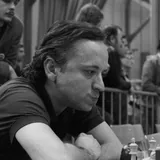
Florin Gheorghiu won the Romanian championship at 16, the World Junior Championship at 19 and, in 1965, became Romania's first grandmaster. He won the national title nine times, played for Romania in fourteen Olympiads, usually on board one, and won tournaments from Hastings to Lone Pine, including three straight U.S. Opens. At the Havana Olympiad of 1966 he beat Bobby Fischer with the early f3 against the Nimzo-Indian, the line now known as the Gheorghiu Variation. Away from the board he lectured in French at the University of Bucharest.
Ploiești and the first title
Gheorghiu was born in Bucharest on 6 April 1944 and moved to Ploiești with his family. He started to play chess at six, watching his father play with friends, and was discovered by the International Master Corvin Radovici. He attended the I. L. Caragiale High School in Ploiești and later graduated in philology from the University of Bucharest.
In Partide alese (1980), the first volume of his selected games, Gheorghiu recalls that his first international event was the World Student Team Championship in Leningrad, where the schoolboy was Romania's reserve, the only time he was ever a reserve for a Romanian team. In his first game he won the queen against the American master Anthony Saidy, then lost in time trouble, and he needed nearly three days to get over it. Brought back into the team, he scored 5½ from six, the best individual result on the Romanian side.
In 1960, at 16, he won the Romanian championship, the youngest player to do so. The final was played in the hall of the Central University Library in Bucharest. He beat the several-times champion Ion Bălănel in the first round and went into the last round needing a draw against the defending champion, Victor Ciocâltea. The game was adjourned, players from Ploiești analysed the position with him through the night, and after eight hours of play it was drawn. He gave much of the credit to them and to his former coach Radovici.
World Junior Champion
At the 1961 World Junior Championship in The Hague he played attacking chess, and a large Hague daily compared him with Tal. He led the final almost to the end, but lost to Bruno Parma in the penultimate round and finished second. According to Partide alese, his score of more than 67 per cent at the 1962 Varna Olympiad, his first, made the result needed for the International Master title, at 18; other records date the title to 1963 and connect it with his World Junior win.
In 1963 he won the World Junior Championship at Vrnjačka Banja. He scored 12 points from 14 games and was the only unbeaten player, but the Czechoslovak Janata matched his 7½ from 9 in the final, and for the first time the title went to a play-off match. All four games were drawn, and Gheorghiu took the title because he had beaten Janata in the final and had the clearly better Sonneborn-Berger score. He wrote that he cried with joy that November night.
His first grandmaster norm came at the Tel Aviv Olympiad of 1964. Near the end he needed to beat Wolfgang Unzicker with Black, and won after five hours for 12½ from 17, but he had met two grandmasters fewer than the rules required, so the title was not automatic. The second norm came from the European Team Championship: his 5 from 6 at the Sinaia semi-final in 1964 together with the Hamburg final in 1965, where on board one he drew both games with the world champion Tigran Petrosian and beat Unzicker again. In 1965 he became Romania's first grandmaster.
At home he won the championship nine times, in 1960, 1962, 1964, 1965, 1966, 1967, 1973, 1977 and 1987. In 1970 he tied for first with Victor Ciocâltea; their play-off match ended 5–5, and the title went to Ciocâltea.
Fourteen Olympiads
Gheorghiu played in every Olympiad from 1962 to 1990 except 1976, usually on board one. He went unbeaten at Lugano in 1968, with three wins and fourteen draws, and again at Nice 1974, Buenos Aires 1978 and Dubai 1986. At Havana in 1966 he beat Bobby Fischer. In all his games for Romania, Olympiads and matches together, he scored 145 wins, 272 draws and 42 losses in 459 games.
Kasparov's Garry Kasparov on My Great Predecessors, Part IV gives a detail of that Havana win: Gheorghiu offered a draw on move fifteen, out of respect for Fischer. Fischer replied, “No, there’s still a lot of play.” Gheorghiu went on to win, using less than an hour for the whole game (Fischer chapter, Havana 1966 narrative). Gheorghiu's own account in Partide alese agrees: he felt the weight of the game, stood better throughout, offered a draw at one point, probably out of respect, and won after three and a half hours of play. He chose the 4.f3 line because Fischer had analysed the usual 4.e3 b6 deeply, and because the same line had brought him the grandmaster title through his win over Unzicker at Hamburg in 1965. Fischer resigned under the reporters' flashbulbs and, Gheorghiu wrote, behaved impeccably.
Tournament victories
Partide alese records his first international tournament wins: Belgrade 1965, shared with Milan Matulović; Bucharest 1967, the first Romanian victory in that tournament; and the 1969 Philippine Open in Manila, where he won all eleven games and finished three and a half points clear. He won or shared first place at Hastings 1967/68 with Vlastimil Hort, Alexey Suetin and Leonid Stein, unbeaten on 6 from 9, Reykjavik 1972 with Hort and Friðrik Ólafsson, Orense 1973, Torremolinos 1974 with Eugenio Torre, Lone Pine 1979 with Svetozar Gligorić, Vladimir Liberzon and Hort, Novi Sad 1979, Biel 1982 with John Nunn, and Lenk 1990. He also finished first at the U.S. Open three years running: alone in 1979, with John Fedorowicz in 1980 and with Larry Christiansen and three others in 1981.
His highest rating, 2605, came in 1980, when he was tenth in the world.
Interzonals and the Gheorghiu Variation
He twice came close to an Interzonal before reaching one. At the 1967 zonal in Vrnjačka Banja, Barczay had adjourned a lost position against Watzka; a draw there would practically have qualified Gheorghiu, but Watzka sealed an illegal move and was declared lost. At the Athens zonal of 1969 Gheorghiu scored 12 from 17 without a loss and finished fourth, when only three qualified.
Gheorghiu played in four Interzonals: he was 14th at Petrópolis in 1973, shared 10th–13th at Manila in 1976, shared 5th–6th at Riga in 1979, where he narrowly missed a place in the Candidates, and was 12th at Moscow in 1982.
He was known for his results against the Nimzo-Indian Defense. His system with an early f3 for White, related to the Sämisch Variation, became his trademark and is now called the Gheorghiu Variation. Besides his chess he lectured in French at the University of Bucharest, and he also speaks English, Russian, German and Spanish.
Legacy
Gheorghiu was Romania's first grandmaster and had few rivals at home through the 1960s, 1970s and 1980s. He won the national title nine times, represented Romania at fourteen Olympiads, and gave his name to a variation of the Nimzo-Indian Defense.
Books
Books Florin Gheorghiu wrote, co-wrote, edited, or contributed to. Translations and reprints are grouped under the same work.