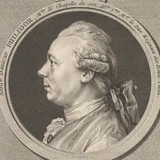
François-André Philidor
François-André Danican Philidor was the best chess player alive for fifty years and did not regard it as his career. He was a working composer with two dozen stage works to his name, and chess was the thing he happened to do better than anyone in Europe. In 1749 he wrote the book that changed how the game was understood — the one that said the pawns are the soul of chess and then proved it — and no one overtook him in his lifetime.
◈A musician who played chess
He was born into a dynasty of court musicians at Dreux in 1726 and trained as a choirboy in the royal chapel. Chess came at the Café de la Régence in Paris, the room where French chess lived, and he learned it from Legall de Kermeur — the only player who ever gave him odds and the last to hold an advantage over him.
The music never stopped. Philidor wrote more than twenty stage works, Tom Jones and Le Maréchal ferrant among them, and was one of the founders of the French comic opera. For most of his life the chess was what paid when the music did not.
◈The pawns are the soul of chess
L'Analyse du jeu des Échecs appeared in 1749, when he was twenty-two, and it reorganised the game around an idea nobody had pressed before: that the pawn structure governs everything. Les pions sont l'âme des échecs — the pawns are the soul of chess. They are not filler between the pieces; their chains, their advances and the squares they surrender decide where a game can be won.
It ran to more than forty editions and stayed the leading textbook in Europe for a century. The defence he advocated, 1.e4 e5 2.Nf3 d6, still carries his name, as does the standard drawing method in rook and pawn against rook — the Philidor position, which every endgame course still teaches.
◈Blindfold, and exile
In London he gave blindfold displays against two and three opponents at once at Parsloe's Club, and they were reported as something close to a marvel of the age; contemporaries recorded them as feats scarcely to be believed.
The Revolution stranded him. Philidor was in London when his name appeared on the list of émigrés, and he was never able to return to France or to his family. He died in London on 31 August 1795, aged sixty-eight.
“The pawns are the soul of chess.”
◈Legacy
Philidor is the first modern chess thinker. Before him the game was a catalogue of attacks; after him it had a theory, and the theory was structural. Players spent the next hundred years catching up with the 1749 book, and the two things that carry his name today — a defence to 1.e4 and the drawing position in rook endings — are both still live, still played, still taught.