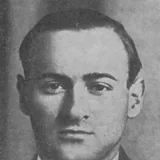
Friedrich Sämisch was a bookbinder's apprentice from Charlottenburg who taught himself chess from books, came back from the First World War with three fingers of his right hand left stiff, and became one of the strongest players in Germany in the 1920s. He won at Vienna in 1921 and at Dortmund in 1928, beat Richard Réti in a match, finished third at Baden-Baden in 1925 behind Alekhine and Rubinstein, and beat José Raúl Capablanca at Karlsbad in 1929. He played thousands of blindfold games and was notorious for his time trouble. In 1950 FIDE named him one of its first grandmasters, the only German among them. Two opening lines that are still played at the highest level carry his name: 4.a3 against the Nimzo-Indian and 5.f3 against the King's Indian.
The bookbinder's apprentice
Sämisch was born on 20 September 1896 in Charlottenburg, which was not yet part of Berlin. He grew up poor, and in 1910, after elementary school, he began an apprenticeship as a bookbinder. That was where he first came across chess books. He taught himself the game, bought Dufresne's handbook, collections of master games and Tarrasch's textbook, and in the Berlin chess clubs and cafés he soon became known as a blitz player.
Soon after finishing his apprenticeship he was drafted into the army. He was badly wounded twice and spent almost two years in military hospitals. A gunshot wound left three fingers of his right hand stiff, so he could no longer work as a bookbinder. He was awarded the Iron Cross but never wore it. In the autumn of 1918 he joined the Berliner Schachgesellschaft, and in 1919 he shared a flat for about a year with Efim Bogoljubov.
Among the best
In 1920 he won the Hauptturnier of the German Chess Federation congress in Berlin with eight points from ten games, and in 1921 he finished second to Ehrhardt Post at the congress in Hamburg. After those results he decided to earn his living from chess. In 1921 he won the tournament in Vienna, later counted as the first, unofficial Austrian championship, ahead of Max Euwe, Gyula Breyer, Ernst Grünfeld and Savielly Tartakower. In 1922 he beat Réti in a match in Berlin with four wins, one loss and three draws.
At Copenhagen in 1923 he shared second place with Tartakower behind Aron Nimzowitsch, and lost to him the short game now known as the Immortal Zugzwang Game. Kasparov’s annotations show how Nimzowitsch’s 20…fxe4 offered a knight but left Sämisch unable to free his pieces. The quiet 25…h6 ended the game: Sämisch resigned.
Baden-Baden in 1925 was his best tournament: he scored 13½ points from 20 games, with ten wins and three losses, and finished third behind Alexander Alekhine and Akiba Rubinstein. He shared first place with George Thomas at Spa in 1926, won Dortmund in 1928 ahead of Réti, Paul Johner and Bogoljubov, shared first with Réti at Brno the same year, and won at Swinemünde in 1930 ahead of Salo Flohr. Chessmetrics ranks him the tenth-best player in the world in the middle of 1929.
At Karlsbad in 1929 he beat Capablanca, who lost a piece in the opening and played on for another fifty moves, and his win over Grünfeld took the tournament's first brilliancy prize. He played for Germany at the Hamburg Olympiad of 1930, scoring 9½ from 14 games as the team took the bronze medal, and won another team bronze at the unofficial Olympiad in Munich in 1936. In his Karlsbad reports for the New York Times, reproduced by Kasparov, Alekhine grouped Sämisch with the “neo-romanticists”, including Nimzowitsch and Tartakower, whose imaginative play he credited with advancing chess.
“However, I have only beaten 10 of them in individual games. Therefore, I do not belong.”
“Of all the modern masters that I have had occasion to observe playing blindfold chess, it is Samisch who interests me the most; his great technique, his speed and precision have always made a profound impression on me.”
“… he finds it easier to sacrifice in a blindfold game than in a regular game – because in a blindfold game he finds it easier to ignore purely material considerations.”
“Sämisch was a side-show all on his own. With unfailing regularity he got into the most atrocious time-trouble.”
4.a3 and 5.f3
Sämisch is remembered above all for his openings. In the Nimzo-Indian Defense, 1.d4 Nf6 2.c4 e6 3.Nc3 Bb4 4.a3 asks the bishop to take on c3 at once, usually leaving White with the two bishops and doubled c-pawns. In the King's Indian Defense, 1.d4 Nf6 2.c4 g6 3.Nc3 Bg7 4.e4 d6 5.f3 supports the pawn on e4. Both are still played at the highest level. Lines in the Queen's Indian and Alekhine's Defense also carry his name.
He did not claim 4.a3 as his own invention. In his newspaper column in February 1934 he wrote that the line had been wrongly passed off as his invention, and he gave the credit to the Silesian master Adolf Kramer, who had played it in 1926. Earlier games with 4.a3 have since been found, among them G. M. Norman against R. P. Michell at Hastings, played in January 1924. Sämisch used the variation to beat Réti at Dortmund in 1928 and Capablanca and Grünfeld at Karlsbad in 1929.
Blindfold, and the clock
Sämisch was one of the leading blindfold players of his time. On a tour of Silesia and Saxony in January and February 1926 he played 142 blindfold games, winning 108, drawing 17 and losing 17. At Breslau on that tour he played twenty boards at once and scored 14 wins, 5 draws and one loss, a German record. He played more than 400 blindfold games that year, and his biographer Michael Dombrowsky reports an estimate of over 4,000 in his career. At Aachen in May 1934 he played ten blindfold games and won them all. Alekhine wrote that of all the modern masters he had seen play blindfold, Sämisch interested him the most.
In tournament games he was known for time trouble. He would think for a long time early in the game and then have to make many moves in a few minutes. Reporting on Oldenburg 1949, the magazine CHESS wrote that it was nothing for him to have to make 20 or 25 moves in one or two minutes. He was also a strong lightning player: he won two blitz tournaments at the age of 61, and at Büsum in 1968 he finished fourth of 71 in the blitz tournament, behind Robert Hübner, Bruno Parma and Hans-Joachim Hecht.
The war years and after
In May 1928 he married Aloisia Fiala in Gablonz, and she left him before the end of the year. Dombrowsky writes that he played no tournaments and gave none of his exhibitions for half a year after the separation. After the Nazis came to power he took part in only one German championship, in 1933, and after 1941 he managed to stay out of the national team. During the war, as a wounded veteran, he was assigned to give simultaneous and blindfold exhibitions for the troops.
He was denounced for saying that Germany would lose the war, and was charged with undermining the war effort, a charge that could carry the death penalty. Accounts of the case differ. ChessBase reports that he was arrested by the Gestapo after returning from a tournament in Madrid and was released when his file was destroyed in an air raid; the German Wikipedia records his arrest in January 1944, more than four months in custody and an acquittal on 12 May 1944. An air raid on Berlin-Pankow destroyed his home, with his library, his chess columns, his scoresheets, his photographs and his two Olympiad bronze medals.
After the war he lived in Schleswig-Holstein, first in Kiel, and played for the Kiel chess club for many years, later living in Hamburg. In 1950 FIDE awarded the new title of International Grandmaster to 27 players. Sämisch, then 53, was the only one from the German federation. In the Deutsche Schachhefte he responded with his personal test of who should count as a grandmaster. His proposed list included masters of earlier generations; he judged his own record of wins against them insufficient.
Legacy
Sämisch played his last international tournaments at Büsum in 1968 and 1969. At Büsum in 1969, aged 72, he lost all fifteen of his games on time, and he lost every game at Lidköping in Sweden that summer as well. In 1970 he returned to Berlin and lived in a residential home in Wannsee. He died there after a stroke on 16 August 1975, shortly before his 79th birthday. German grandmasters of the next generations, among them Wolfgang Unzicker and Robert Hübner, spoke of him with respect. They remembered his stories, his skill as an analyst and his habit of living on coffee and cigarettes. The variations he played against the Nimzo-Indian and the King's Indian are still called the Sämisch Variation. In 2023 Michael Dombrowsky published a full biography, Friedrich Sämisch – Schachkünstler auf 64 Feldern.
Books
No authored or contributed books are documented in the available sources.