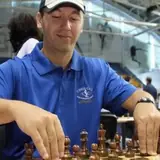
Gata Kamsky is the great American hope who walked away near the top and then came back to do it again. A Tatar boy brought out of the Soviet Union by a father who wanted nothing less than the world title for him, he became the youngest player ever in the world's top ten before he was old enough to vote. At twenty-two he became the first American since Bobby Fischer to play for the world championship. Later that year he withdrew from professional tournaments and spent eight years at university instead. It was remarkable that he came back at all; that he came back to win the World Cup and four more U.S. titles is a second act chess almost never allows.
A Tatar boy and his father
He was born Gata Rustemovich Kamsky in Novokuznetsk, deep in Soviet Siberia, in 1974, into a Tatar family whose name carried weight: his grandfather, Gataullah “Kamsky” Sabirov, founded the Tatar Drama Theater in Kazan. His father Rustam, a former boxer, became his coach and manager.
Kamsky described childhood physical abuse and threats from his father in Chess Gamer, Volume 2: Return (2004–2013), in the recollections following game 11. He wrote: “He kept me in a constant state of fear.” The same account describes the difficulty he later had finding the courage to apologize to Joel Benjamin and Nigel Short for his father's behavior during their games.
His first teacher, Vladimir Zak, offered a different approach. In Chess Gamer, Volume 1: Awakening (1989–1996), in the notes to game 19, Kamsky recalled that coaches at the Pioneers' Palace had initially refused to take him because of his father's demands. Zak proposed a hundred-game trial match, but Kamsky remembered playing probably no more than ten games before being accepted. Zak talked with him about chess and other subjects and gave him children's chess books, which he read repeatedly.
The talent was enormous and early. At twelve Kamsky defeated the veteran grandmaster Mark Taimanov in tournament play and earned the National Master title in the same year. He won the Soviet under-20 championship twice over, in 1987 and again in 1988, while still a boy among young men.
Defection, and the American hope
In 1989 Kamsky and his father left the Soviet Union for the United States, helped to settle by Allen Kaufman of the American Chess Foundation and the businessman James Cayne. America had not had a genuine world-title contender since Fischer, and here, suddenly, was a teenager who might be one.
He recalled an unexpected problem at his first American tournament in Chess Gamer, Volume 1, game 1. The expensive Commodore computer his father had bought in Russia would not work on American electrical power. A local shopkeeper said it belonged in a museum; a power adaptor failed to revive it. Kamsky played the tournament relying on heavy theory books and notebooks full of his games and analysis.
He did not disappoint. FIDE awarded him the grandmaster title in 1990, when he was sixteen, and within weeks of that birthday he had climbed to world No. 8 — the youngest player ever to break into the top ten. In 1991 he won the first of his U.S. Championships. The American chess world, starved of a champion for two decades, had found its standard-bearer.
“I have always hated studying for hours in preparation for a game as it makes chess more like a science than a creative outlet.”
“I decided that I would try my best and, if I was going to lose, I would lose in glory.”
“For the first time in my life I was free to pursue directions of my own choosing.”
“It’s hard to say what would have happened had I won that game, and to this day I sometimes have nightmares, seeing the position and knowing that I missed the win.”
The road to the crown
The mid-1990s were Kamsky's surge. With the title split between the FIDE and PCA cycles, he ran both gauntlets at once. In the PCA Candidates he beat the young Vladimir Kramnik in the 1994 quarterfinal and Nigel Short in the semifinal at Linares, before losing the final to Viswanathan Anand at Las Palmas in 1995 by 4½–6½.
The FIDE road carried him further. He drew his 1994 semifinal with Anand 4–4 and took it on rapid tiebreaks, then crushed Valery Salov 5½–1½ in the 1995 final at Sanghi Nagar. It made him the challenger — the first American since Bobby Fischer to play a match for the championship of the world.
Elista, 1996
The match was held in Elista, the capital of the Russian republic of Kalmykia, with twenty games scheduled against Anatoly Karpov — the reigning FIDE World Champion and one of the greatest players who ever lived. Kamsky struck early, winning the second game with a Greek gift bishop sacrifice on h7.
But Karpov's class told over the distance. The former champion won six games to Kamsky's three, with nine draws, taking the match 10½–7½ after eighteen games. Kamsky had come within reach of the highest title in the game and been turned back by a legend at the peak of his match craft. He was twenty-two years old.
The vanishing — and the long way back
Ranked among the very best players in the world, Kamsky withdrew from professional tournament chess later in 1996. Between 1996 and 2004 he played almost no rated games. He earned a bachelor's degree from Brooklyn College in 1999 and graduated from Touro Law Center before returning to chess in 2004. In the introduction to Chess Gamer, Volume 2, he recalled his interest in intellectual property and cyber law. His withdrawal from tournaments lasted eight years, at the age when most grandmasters are at their strongest.
He had kept playing online. In Chess Gamer, Volume 2, game 1, he recalled hundreds of blitz games and sleepless nights on the Internet Chess Club against young players including Levon Aronian, Hikaru Nakamura, Alexander Grischuk and Shakhriyar Mamedyarov. His two classical games against Alexander Khalifman at the 1999 Las Vegas world championship were an exception to his years away from tournament play.
He came back in June 2004, and the comeback was no nostalgia tour. In 2007 he won the Chess World Cup, seeded eleventh, beating Peter Svidler, Ruslan Ponomariov and a teenage Magnus Carlsen on the way to defeating Alexei Shirov in the final. He lost a hard 2009 Candidates match to Veselin Topalov in Sofia, then in 2011 beat the same Topalov in the Kazan Candidates quarterfinal before falling to Boris Gelfand on tiebreaks. And he made the U.S. Championship his own again — winning in 2010 and 2011 back to back, then 2013 and 2014, five titles spread across twenty-three years. His rating peaked at 2763 in 2013, higher than it had ever been before the long absence.
The World Cup run also began a working friendship. In Chess Gamer, Volume 2, game 10, Kamsky explained that he sought opening help from Emil Sutovsky after the first round in 2007. Sutovsky had been eliminated from the tournament and agreed to help him prepare for the remaining matches. The two became close friends; Kamsky credited Sutovsky with playing a major part in his life between 2007 and 2013.
France, the board, and the camera
A patient positional player who had used the London System since his youth, Kamsky combined maneuvering with tactical play and a practical interest in his opponents' psychology. His later move toward open tournaments also had financial reasons. In the closing reflections of Chess Gamer, Volume 2, game 22, he wrote that invitations to the top elite events had stopped after 2013 and he began playing American opens to make ends meet. In 2025, after thirty-six years representing the United States, he transferred to the French Chess Federation.
Today he lives in France, where he teaches chess to students, and he shares the game with a far wider room than any classroom: he streams and posts his chess on Twitch as igmgatakamsky and on his YouTube channel, bringing the thinking of a former world-championship finalist to anyone who wants to watch a grandmaster work.
Legacy
Kamsky's career is one of the strangest and most dramatic in modern chess: a prodigy who reached a world championship match before he was old enough to rent a car, left for university for eight years, and came back to win the World Cup and keep winning U.S. titles into his forties. He is still the only American between Bobby Fischer and the current generation to play for the world title, and for a generation of American players he showed that the top was reachable from their own country. He now teaches from France, one student and one stream at a time.
Books
Books Gata Kamsky wrote, co-wrote, edited, or contributed to. Translations and reprints are grouped under the same work.