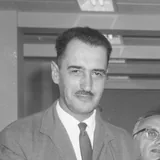
Gedeon Barcza was a Hungarian mathematics teacher, journalist and grandmaster who won the national championship eight times between 1942 and 1966 and played for Hungary in seven Chess Olympiads. He won an individual gold medal at Amsterdam in 1954 and an individual silver at Moscow in 1956, where he beat Vasily Smyslov. His flexible way of opening the game with Nf3 and g3 carries his name as the Barcza System. For two decades he helped edit Hungary's chess magazine, and in retirement he wrote a history of Hungarian chess.
Debrecen
Barcza was born in Kisújszállás on 21 August 1911. In 1916 his family moved to Debrecen, where his father, a teacher of Latin and Hungarian, became head of the Reformed gymnasium. Barcza went to school in Debrecen and studied mathematics and physics at the university there, receiving his diploma as a secondary-school teacher in 1934.
Teacher and national champion
In 1936 he played in the unofficial Olympiad at Munich, where Hungary won the team gold, and that autumn he moved to Budapest. He taught at a boys' school, becoming a regular teacher in 1940 and deputy head in 1943. In 1940 he finished third at the Maróczy jubilee tournament in Budapest behind Max Euwe and Milan Vidmar. He won the Hungarian Championship in 1942 and 1943, and in September 1942 he finished sixth at the first European Championship in Munich, which Alexander Alekhine won.
“Look, I have a wife and children. Who will feed them in the event of my untimely death!”
“Without Bronstein neither Tal nor Fischer would have played such an important role in the history of chess.”
After the war
Barcza won the national title again in 1947. In 1948 he was second at Karlovy Vary behind Jan Foltys and shared second place at Venice behind Miguel Najdorf, and in 1950 he shared second place at Szczawno-Zdrój behind Paul Keres. He took the Hungarian title in 1950 and 1951 and became a grandmaster in 1954. He played in two Interzonals, finishing fifteenth at Saltsjöbaden in 1952 and sharing fourteenth place at Stockholm in 1962.
He won Hungarian titles in 1955 and 1957 and an eighth in 1966. Abroad he won at San Benedetto del Tronto in 1957, was third at Vienna in 1961 and shared third place at Moscow in 1962.
At Zürich in 1959 Barcza drew a 103-move game with the sixteen-year-old Fischer. In My Great Predecessors, Part IV (2004), Kasparov quotes Tal’s recollection that Fischer immediately wanted to analyse the game from the beginning. Barcza replied: “Look, I have a wife and children. Who will feed them in the event of my untimely death!”
Olympiads
Barcza played in seven official Olympiads, from Helsinki 1952 to Lugano 1968. At Amsterdam in 1954 he scored 12½ of 16 on board three, the best result on his board, and at Moscow in 1956 he scored 11½ of 16 on board two, taking the individual silver medal as Hungary won the team bronze. His win over Smyslov came in that Olympiad. At Lugano in 1968, playing as first reserve, he scored 10½ of 14 and won an individual bronze medal.
Journalist, coach and historian
In February 1951 Barcza left teaching to become a journalist. He worked at Magyar Sakkélet, where with László Szabó and Jenő Bán he shaped Hungary's leading chess magazine until he retired on 1 March 1972. He was a master coach from 1952 and became an international master of correspondence chess in 1966. In retirement he edited Magyar Sakktörténet, a history of Hungarian chess whose first two volumes appeared in 1975 and 1977.
Legacy
Barcza died in Budapest on 27 February 1986 and is buried in the Kerepesi Cemetery. White's set-up of Nf3, g3, Bg2 and castling, which leaves the center pawns uncommitted until Black has shown a plan, is known as the Barcza System. In 2012 the Hungarian Chess Federation honored him posthumously as a Knight of Caissa.
Books
Books Gedeon Barcza wrote, co-wrote, edited, or contributed to. Translations and reprints are grouped under the same work.
-
Balogh János és B. G. játszmái az 1941–42. magyar levelezési bajnoki sakkversenyről
Author
-
A sakk
Author
-
Egykor és most: Két győri verseny válogatott játszmái
Author
-
Országos magyar sakkbajnokság 1947
Coauthor — Gedeon Barcza, József Szily
-
Botvinnik győzelme a világbajnoki küzdelemben
Coauthor — Gedeon Barcza, Lajos Asztalos
-
Párosmérkőzés a világbajnokságért: Lasker–Tarrasch 1908
Author
-
A XVIII. szovjet sakkbajnokság
Coauthor — Gedeon Barcza, László Tóth
-
A sakkvilágbajnokjelöltek versenye: Budapest 1950
Author
-
Tanulj sakkozni
Coauthor — Gedeon Barcza, László Tóth
-
A sakkozás világbajnokai / Die Weltmeister des Schachspiels
Coauthor — Gedeon Barcza, László Alföldy, Jenő Kapu
-
Nagymesterverseny Tóth László tiszteletére: Kecskemét 1966
Author
-
Magyar Sakktörténet 1
Coauthor — Gedeon Barcza, Emil Gelenczei, József Hajtun
-
Magyar Sakktörténet 2
Editor — compiler of Géza Maróczy’s books and manuscripts
-
Versenyfutás az aranyérmekért: Máltai Sakkolimpia 1980
Coauthor — Gedeon Barcza, Mária Angyalosiné Porubszky, István Csom; edited by István Bilek
-
Magyar Sakktörténet 3: 1896–1921
Coauthor — Gedeon Barcza, Iván Bottlik, Árpád Földeák