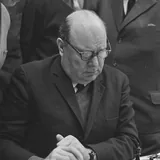
Gideon Stahlberg
Gideon Ståhlberg was nineteen when he shared first place in the Swedish national tournament at Örebro, and barely into his twenties when he won matches against Rudolf Spielmann and then Aron Nimzowitsch — two results that told Europe a serious player had appeared in Sweden. War caught him in Buenos Aires in 1939 and kept him there for nine years. He came home to become one of FIDE's first grandmasters and twice a Candidate for the world title, then spent his last decade on the other side of the board, as the arbiter trusted with five straight world championship matches.
◈The boy from Surte
Anders Gideon Tom Ståhlberg was born in January 1908 in Nödinge parish and grew up in Surte, a village just outside Gothenburg. His father was an office administrator who had been born Alfred Andersson and had changed the family name — first to Stålberg, then to Ståhlberg — trading the commonest surname in Sweden for something with steel in it. His mother was a nurse. There were four children. Gideon helped get the Surte chess club started, took his school-leaving examination in Gothenburg in 1926 and spent a year at the university there. The board won.
In 1927, at nineteen, he tied for first with Gösta Stoltz in the national tournament at Örebro. Two years later he took the Swedish title the way it was then decided — by match — beating Allan Nilsson 3–0 in Gothenburg, and became Nordic champion in the same year. In 1931 Stoltz challenged him and the match finished 3–3, which under the old rules meant the champion kept his title. Ståhlberg held it through the whole of the 1930s regardless of who won the national tournaments, and when the championship finally passed to tournament play in 1939, he won that too.
◈Spielmann, Nimzowitsch, Lasker
In January 1933 in Stockholm he sat down for a match with Rudolf Spielmann, the great Austrian attacker of the previous generation, and beat him +3 −1 =4. Thirteen months later, in Gothenburg, he did the same to Aron Nimzowitsch: +4 −2 =2. Nimzowitsch was taken ill at the end of that year and died the following March, which makes the Gothenburg match one of the last he ever played. Between them the two results did what no Swedish result had done before — they put a Swede into the conversation about the best players alive.
There was a third scalp in that stretch, quieter but sweeter. At Zurich in July 1934, in the fifth round, Ståhlberg played Emanuel Lasker for the first time in either man's career, and won. He finished third at Dresden 1936 behind Alekhine, second at Stockholm 1937 behind Reuben Fine, and in 1938 drew a match with the young Paul Keres, +2 −2 =4. He was by then a settled classical player — Queen's Gambit and French Defence, patient, elegant, very hard to hurt and formidable once the queens came off. Gambits, as one of his biographers put it, really weren't his cup of tea.
◈The Three Musketeers
Sweden in the 1930s had three players good enough to frighten anybody, and the country knew them as the musketeers: Ståhlberg, Gösta Stoltz and Erik Lundin. At the Warsaw Olympiad of 1935 they took Sweden to second place, half a point behind the United States — the high-water mark of Swedish team chess. Ståhlberg was on top board.
He kept turning up for thirty-six years. Thirteen Olympiads between 1928 and 1964, two hundred games — the second-largest total any Swede has played — with a record of +74 =96 −30, a shade over sixty-one percent, most of it against the strongest first-board opposition in the world.
◈Stranded in Buenos Aires
The eighth Olympiad opened in Buenos Aires in August 1939. Its finals began on 1 September, the day Germany invaded Poland, and by the end of it a large part of European chess had decided not to go home. Sweden finished fourth. Ståhlberg stayed nine years. He made a living the way a professional had to: club engagements, teaching, exhibitions, writing. A tournament in Rosario that was meant to last a week kept him there more than a year. He learned Spanish well enough to publish in it — El gambito de dama in 1942, and a study of Capablanca's classic games in 1943 with Paulino Alles Monasterio.
From 1941 the casino at Mar del Plata began underwriting an annual tournament, and Ståhlberg became one of its fixtures, winning that first edition ahead of Miguel Najdorf and Erich Eliskases. He tied with Najdorf at Buenos Aires later the same year. In 1943 he won the Torneo Mayor, then Argentina's national championship, outright — but as a foreigner he could not be crowned, and the title went to Juan Iliesco. He toured Chile twice, in 1946 and early 1947. Argentine chess history also records a simultaneous display he gave at Santos Lugares in 1941: four hundred boards over thirty-six hours, +364 −22 =14.
Najdorf was the one man whose results in those years consistently outran his, and the rivalry shaped South American chess for the better part of a decade. Ståhlberg's last great Argentine result came at the Buenos Aires and La Plata international of 1947, where he finished first ahead of Najdorf, Eliskases and Max Euwe. Argentina called him el león sueco — the Swedish lion — and a good many people there had long since stopped thinking of him as a visitor.
◈Among the first grandmasters
He came back to Sweden in 1948, in time for the Interzonal at Saltsjöbaden, where sixth place made him a Candidate. In 1950 FIDE handed out its first grandmaster titles to twenty-seven players, and Ståhlberg was one of them. At the Budapest Candidates that spring he finished seventh of ten, beating Vasily Smyslov and David Bronstein along the way. He won Trenčianske Teplice in 1949, was third at Amsterdam in 1950 and third at Budapest in 1952, and came fifth at the 1952 Saltsjöbaden Interzonal — a Candidate for the second time.
Zurich 1953 was the hardest room he ever entered: fifteen players, twenty-eight rounds, and a field containing Smyslov, Bronstein, Keres, Reshevsky and Petrosian. He finished last on 8 points and never pretended otherwise. He also took both games from Yuri Averbakh and beat Alexander Kotov, which is more than most of the men above him managed. He was forty-five, he had spent a decade of his prime a hemisphere away from European chess, and he was still in the room.
◈The writer, the arbiter, the man
Away from the board he was excellent company and slightly ungovernable: sociable, fond of a drink, no stranger to the racetrack, the roulette table or a serious game of bridge, and genuinely interested in probability for its own sake. He spoke several languages and had a memory that could produce the birth and death dates of every English king. He was also easily distracted mid-game — he had been known to leave the board to gamble or read — and was chronically short of time. He had a quick temper and a certain swagger, and he did not suffer fools, which occasionally cost him goodwill among officials.
He wrote more than ten books. Schack och schackmästare (1937) became Chess and Chess Masters in Harry Golombek's English translation of 1955 — a gallery of portraits of Lasker, Capablanca, Alekhine, Euwe, Nimzowitsch, Keres and the rest, each carried by annotated games, and a minor classic in the line of Réti's Masters of the Chessboard. I kamp med världseliten (1958) is his own account of a life spent among the world elite; Strövtåg i schackvärlden followed in 1965. He wrote steadily for newspapers and magazines throughout.
From 1951 he served as a FIDE arbiter, and his standing and his popularity made him the obvious man for the biggest chairs in the game. He umpired the five world championship matches played between 1957 and 1963 — Botvinnik against Smyslov twice, Botvinnik against Tal twice, Botvinnik against Petrosian. A book of his on the second Tal–Botvinnik match appeared in 1969, two years after his death.
“My achievements at the 1931 chess olympiad strengthened my confidence. I had more and more switched from open to closed openings and the results in Prague indicated that I was on the right path.”
“A true artist who is not concerned so much with acquiring points as playing beautiful chess.”
“A man who carries in his blue eyes the sympathy that his distant homeland deserves has won the contest. It has been won by a great gentleman of the board and a great gentleman in private life, who honors us by staying in our country.”
◈From the archive
◈Legacy
In May 1967 he travelled to Leningrad for the international tournament marking the fiftieth anniversary of the October Revolution. He died there on 26 May, aged fifty-nine, before he had played a move, and was buried at Surte, the village he came from. What he left is a record no other Swede of his century matched: thirteen Olympiads, two Candidates tournaments, a decade as his country's champion, a place among the twenty-seven men FIDE first called grandmaster, and a shelf of books in two languages. In 2024 Peter Holmgren published the first volume of a 582-page biography, Gideon Ståhlberg – An Epoch in Swedish Chess. It ends exactly where his life turned: a Swede alone in Buenos Aires, and a war starting behind him.