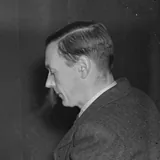
Gösta Stoltz grew up poor on Kungsholmen in Stockholm, left school to work as a delivery boy, and learned chess at fifteen while working as a car mechanic. By 1931 he was established among the world's leading players. He played for Sweden in nine Olympiads, won the individual gold medal on second board at Prague in 1931, and in short matches beat Isaac Kashdan, Rudolf Spielmann and Salo Flohr. His queen sacrifice against Spielmann in 1930 was named by Ruslan Ponomariov, seventy-five years later, as the best game he had ever seen. At Munich in 1941 he finished a point and a half ahead of the World Champion, Alexander Alekhine. Heavy drinking undermined his health, but he won three Swedish championships in a row from 1951 to 1953, and in 1954 FIDE made him a grandmaster.
Kungsholmen
Stoltz was born in Stockholm on 9 May 1904 and grew up on lower Kungsholmen. His father, the writer Axel de la Nietze, left the family two months before he was born and never returned. When his mother married the construction worker Vilhard Stoltz in 1906, Gösta and his older brother took their stepfather's surname; from 1924 to 1929 he went by his mother's name, Hallgren. The brothers had an unsettled childhood of foster homes, stays with relatives and frequent contact with the city's social services.
After elementary school he worked as a bicycle delivery boy for a grocery. He learned chess at fifteen and became a regular in Stockholm's chess cafés while working as a mechanic in a car repair shop. He played his first serious game in 1921, in a sports club's team match, and won it in twelve moves. He made his debut in the Swedish championship tournament at Uppsala in 1923.
The chess patron Ludvig Collijn noticed his talent and encouraged him. Stoltz won the Stockholm championship in 1926 and 1927, and in 1926 he played two games against the young Mikhail Botvinnik in a Stockholm–Leningrad team match, losing one and drawing one. In 1927 he shared first place in the top section of the Swedish championship tournament at Örebro with Gideon Ståhlberg, drew a match for the national title with Allan Nilsson, and played in the first Olympiad, in London. Early in 1928, with Collijn's financial support, he spent several months training with Efim Bogoljubov at Triberg in Germany.
Matches with the masters
His breakthrough came in 1930. He scored ten points from seventeen games at the Hamburg Olympiad, and that autumn Collijn organized an international tournament in Stockholm, where Stoltz shared second place with Bogoljubov, half a point behind Isaac Kashdan. Matches followed. Stoltz beat Kashdan by two wins to one with three draws, and he beat Spielmann by the same score. In the fifth game against Spielmann he gave up his queen with 13...exf3 and won in 28 moves. Spielmann annotated the game in his newspaper column and compared it to Anderssen's Immortal Game.
In 1931 he beat Salo Flohr in a match in Gothenburg, and at the Prague Olympiad he scored 13½ points from 18 games on second board, the best result on that board. Later that year he played the double-round tournament at Bled, which Alekhine won ahead of Bogoljubov and Aron Nimzowitsch, and shared fourth place with Flohr, Kashdan and Milan Vidmar. In the autumn he challenged Ståhlberg for the Swedish title; the match ended 3–3 and Ståhlberg kept the title.
“Stoltz, the first prize-winner, has a particularly fine feel for unexpected chess tactics. This cannot be learned from any book, and it is this “something” which makes a player a grandmaster.”
“The greatest natural talent in chess that we have ever had.”
Hard years
An irregular life and heavy drinking had begun to wear down his health. He was also a heavy smoker, and early in 1932 he suffered severe nicotine poisoning. He still won tournaments that year at Swinemünde and in Stockholm. But the Depression reached chess too: there were fewer tournaments and smaller prizes, and for a time he worked as a fitter for Atlas Copco in Norway. He had married Anna Andersson in 1928, and when she fell ill he could not care for the family alone and had to place his son with foster parents.
In the spring of 1933 he made a deep study of the Tarrasch Defense to the Queen's Gambit. At the Folkestone Olympiad that summer his analysis served the whole Swedish team, and when Siegbert Tarrasch published a "refutation" of it in his own magazine, the players who tried his suggestion were outplayed by the well-prepared Swedes. Sweden took third place. In 1935 the Swedish team led the Warsaw Olympiad for a long time before finishing second to the United States, and Stoltz won the bronze medal on second board. That September Sweden beat Germany 17–15 in a four-player team match at Zoppot, and Stoltz's play contributed much to the win.
The Stockholm Olympiad of 1937 went badly. Stoltz lost his first five games. When the team captain left him out of the line-up for one round, he felt he had been treated unfairly, walked out and did not return to the event. The Swedish federation suspended him from its competitions until 1 September 1938. During the suspension he worked as a laborer on building sites, carrying mortar eight hours a day before going to the chess club. When he came back he won the 1938 Collijn tournament ahead of several of Sweden's best players.
Munich 1941
In September 1941 the Nazi-run Greater German Chess Federation held an unofficial European championship tournament in Munich. With no players from Britain, the United States, the Soviet Union or South America, the field was limited, but it included Alekhine, the reigning World Champion, Bogoljubov and the best players from much of the continent. Stoltz scored 12 points from 15 and finished a point and a half ahead of Alekhine and his countryman Erik Lundin. It was the biggest tournament victory of his career.
Alekhine wrote that Stoltz had played the best chess of the tournament and had "a particularly fine feel for unexpected chess tactics." The success did not continue. At the founding meeting of the German-led European chess federation, at Salzburg in 1942, Alekhine won the tournament and Stoltz did badly, and he did badly again at the Munich European Championship later that year. The Swedish federation's decision to join the new body caused an outcry at home, and it left in the winter of 1943–44.
Champion at last
After the war Stoltz had a run of good results. In 1946 he finished second to Albéric O'Kelly de Galway at Beverwijk and shared second place behind Miguel Najdorf at Prague. In 1947 he tied for first with Eero Böök in the Nordic zonal tournament at Helsinki and drew the play-off match. He played in the first Interzonal, at Saltsjöbaden in 1948, and in the Stockholm Interzonal of 1952, and FIDE gave him the International Master title in 1950.
His health was now failing, but he finally became Swedish Champion in 1951, and he won the title again in 1952 and 1953. He scored five points from ten games at the Helsinki Olympiad of 1952. He was picked again for the Amsterdam Olympiad of 1954 but fell ill on arrival and was taken to hospital; he played only two games, both draws, near the end of the event. At the FIDE congress held there he was named a grandmaster.
Legacy
His last years were marked by illness and poverty. He pawned his three Swedish championship plaques and the statuette he had received for winning at Munich, lived for periods with his mother, and in his last years moved between temporary rooms and hostels. He died in Stockholm on 25 July 1963, at fifty-nine, and is buried at Skogskyrkogården. He was a friendly bohemian with a good sense of humor who played the harmonica and accompanied himself on the lute and guitar. Eero Böök published two books on his games, in 1947 and 1968, and the line 5.e3 Nbd7 6.Qc2 of the Semi-Slav is catalogued in opening references as the Stoltz Variation.
Books
No authored or contributed books are documented in the available sources.