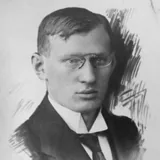
Gyula Breyer won the Hungarian championship at nineteen, and in December 1920 he finished first at Berlin, a point clear of a field that included Efim Bogoljubov, Savielly Tartakower, Richard Réti, Géza Maróczy and Siegbert Tarrasch. In January 1921, in Košice, he played 25 blindfold games at once, a world record at the time. He was a leading pioneer of the hypermodern school. He argued in print that 1.d4 was a better first move than 1.e4, and Réti, his close friend, said that the moderns had all learned from him. He was also an engineer, a problem composer and the editor of a short-lived magazine of chess and puzzles. He died of heart disease in Bratislava in November 1921, at twenty-eight. The Breyer Variation of the Ruy Lopez, 9...Nb8, is still named after him.
Budapest
Breyer was born in Budapest on 30 April 1893, one of five children. At secondary school he stood out in mathematics, and in 1910 he enrolled at the Technical University in Budapest, where he took his engineering diploma in 1918. He joined his first chess club at sixteen. Poor health kept him out of military service in the First World War.
In 1911 he beat the World Champion, Emanuel Lasker, in a simultaneous exhibition in Budapest. Later that year he finished sixth in the main tournament at Cologne.
Hungarian champion
In August 1912, at Temesvár (now Timișoara), Breyer won the Hungarian championship ahead of Lajos Asztalos, Zoltán von Balla, Kornél Havasi and Réti. The same year he played his first international master tournaments, sharing seventh place at Pistyan and eighth at Breslau, and in 1913 he took sixth prize at Scheveningen.
At the German Chess Federation congress in Mannheim in July 1914 he beat Tarrasch and was tied for fourth place, behind Alexander Alekhine, Milan Vidmar and Rudolf Spielmann, when the outbreak of the First World War stopped the tournament.
“Beauty in chess is the unusual.”
“A new Steinitz was all too soon snatched from us.”
“Something prophetic lay in his vision and something feverish in his work.”
“His enquiring mind, stimulated by new chess ideas of any kind, was a source of inspiration to some of his contemporaries, not least to his close friend Réti; and his annotations are refreshingly undogmatic.”
“… fortunately there prevails a stronger oppositional force which first asserted itself in the play of Breyer and Réti, whose premature deaths were a distinct loss to the chess world.”
The war years
Breyer spent the war in Hungary. In 1918 he shared third place in the international tournament at Kassa (now Košice), and in the same year he married Teréz Balikó.
He used those years to rethink the openings. In articles in Hungarian chess magazines he argued that 1.d4 was a better first move than 1.e4; Réti identifies one such article as “A Complicated Position” in Modern Ideas in Chess. Breyer recommended meeting 1.d4 with 1...Nf6 rather than the usual 1...d5. Tartakower later attributed to him the remark that after 1.e4 White's game was already "in the last throes"; the chess historian Edward Winter found no documentary evidence that Breyer ever wrote it. He also proposed a mathematical rating system for chess players, about fifty years before the Elo system.
Berlin 1920
After the war Breyer went to Vienna, where he wrote the chess column of the Hungarian-language newspaper Bécsi Magyar Újság, and in 1920 he settled in Bratislava and opened an engineering office with a partner. The office made little money, and he lived mostly on prize money, simultaneous exhibitions and his column.
He did poorly at Gothenburg in August 1920. In December, at Berlin, he scored 6½ points from nine games and won the tournament by a point, beating Bogoljubov, Réti, Maróczy, Tarrasch, Paul Saladin Leonhardt and Spielmann. It was the best result of his career.
Blindfold games, puzzles and the last year
In Bratislava he edited Szellemi Sport, a magazine of chess and puzzles that stopped after five issues. Réti described it in Modern Ideas in Chess: one issue printed a love letter that could be read backwards letter by letter, and another a chess position in which it could be proved that no piece had been taken and no pawn moved in the last fifty moves, so that the game was a draw. Breyer composed mate problems and retrograde analysis studies.
He also published detailed analyses of the Lasker–Capablanca world championship match in 1921 in Hungarian newspapers. In Modern Ideas in Chess, Réti reproduces one of his suggested improvements to Lasker's play. Kasparov credits the same suggestion to Breyer in My Great Predecessors, Part I.
In January 1921, in Košice, he played 25 games blindfold at the same time, winning fifteen, drawing seven and losing three, a world record at the time. In May he took third place at Vienna, his last tournament, where he beat Max Euwe. His daughter was born in April 1921. He died of heart disease in Bratislava on 9 November 1921, at twenty-eight.
Legacy
Breyer was buried in Bratislava. In 1987 his remains were moved to the Kerepesi Cemetery in Budapest. Several opening lines carry his name: the Breyer Variation of the Ruy Lopez, 9...Nb8, which became popular in the 1960s and was a favorite of Boris Spassky; the Breyer Gambit of the King's Gambit, 1.e4 e5 2.f4 exf4 3.Qf3; and the Breyer Variation of the Vienna Gambit. Leonard Barden wrote that Breyer recommended 9...Nb8 as early as 1911, although no game of his with the move has been found. In My Great Predecessors, Part V, Kasparov also names Breyer, Réti and Nimzowitsch among the early-1920s practitioners of 1.d4 e6 2.c4 b6, later known as the English Defence. Chessmetrics' retrospective ratings place him ninth in the world in late 1917.
Books
Books Gyula Breyer wrote, co-wrote, edited, or contributed to. Translations and reprints are grouped under the same work.
-
Gyula Breyer: The Chess Revolutionary
Contributor — collected writings and own game annotations; edited by Jimmy Adams