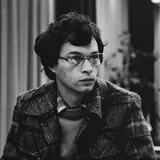
Gyula Sax was a Hungarian grandmaster and an attacking player who won the European Junior Championship, the Hungarian championship in 1976 and 1977, and tournaments at Rovinj–Zagreb, Vinkovci, Las Palmas, Amsterdam and Wijk aan Zee. In the last round of the 1978 Olympiad in Buenos Aires he beat Aleksandar Matanović, and Hungary won the gold medal ahead of the Soviet Union. He played in ten Olympiads, shared first place at the Subotica Interzonal of 1987 and twice reached the Candidates matches. He beat the former World Champions Vasily Smyslov and Boris Spassky, and he kept playing and winning tournaments until the last year of his life.
Budapest and the junior title
Sax was born in Budapest on 18 June 1951. He won the Hungarian Junior Championship in 1970, and in 1971/72 he won the European Junior Championship at Groningen, sharing first place with René Borngässer and taking the title on tiebreak. FIDE made him an International Master in 1972 and a grandmaster in 1974.
He won the Hungarian championship outright in 1976 and shared it with Zoltán Ribli in 1977. His first major international wins came at Rovinj–Zagreb in 1975 and Vinkovci in 1976, followed by Las Palmas in 1978, shared with Vladimir Tukmakov, the Canadian Open of 1978 and the IBM tournament in Amsterdam in 1979, shared with Vlastimil Hort.
Buenos Aires, 1978
Sax played for Hungary in ten Olympiads between 1972 and 2000. In Buenos Aires in 1978 he played board three, scored 8½ out of 12 without a loss and won the individual bronze medal for his board. Before the last round only Hungary, the Soviet Union and the United States could still take the gold. Hungary beat Yugoslavia 3–1, and Sax's win over Aleksandar Matanović settled the result. It was the only Olympiad between 1952 and 1990 in which the Soviet Union took part and did not finish first.
Hungary also won the silver medal at the Olympiads of 1972 and 1980; in 1980 it finished level with the Soviet Union and lost on tiebreak. At the World Team Championship of 1985 Hungary took second place and Sax had the best result on board three.
“Gyula Sax was one of the greatest chess players of Hungary. He was the first GM who treated me as a fellow chess player when I was only 9 years old. He was ready to analyze positions with me, and shared ideas and by doing so he gave me a lot of self-confidence.”
“I can't play against him; he also looks so intelligent.”
Two Candidates cycles
Sax first reached an Interzonal in 1979 at Rio de Janeiro, where he shared seventh place. At the Moscow Interzonal of 1982 he finished eighth but beat Alexander Beliavsky, who qualified behind Garry Kasparov.
Sax began Linares in February 1983 with two wins. In My Great Predecessors, Part V, Kasparov reproduces Karpov's explanation for choosing the Keres Attack against him: ‘An attempt had to be made to stop him,’ he wrote. Karpov won their game, and Sax finished on 5½/10, sharing fourth place with Tony Miles and Artur Yusupov.
In 1987 at Subotica he shared first place with Nigel Short and Jonathan Speelman on 10½ points, and all three qualified for the Candidates. In the first round of the Candidates in 1988 Short beat him with two wins and three draws.
He qualified again at the Manila Interzonal of 1990. His Candidates match against Viktor Korchnoi was played at Wijk aan Zee in 1991 and finished 4–4 with one win each. Korchnoi won the rapid tiebreak 1½–½. Sax's highest rating was 2610, reached in January 1988 and again in January 1989, when he shared twelfth place on the world list. In January 1989 he also shared first place at Wijk aan Zee with Viswanathan Anand, Zoltán Ribli and Predrag Nikolić.
The later years
Sax became an International Arbiter in 1995. He played in the German Bundesliga in the 1990s and for many seasons in the Hungarian league, where his club Zalaegerszeg won the national team title six times between 2002 and 2008. He won open tournaments across Europe into his fifties, and his last tournament win came in May 2013 in a grandmaster round-robin at Kecskemét.
In his last two decades he reportedly lived in seclusion, although he kept playing in team matches and smaller tournaments. He died of a heart attack on 25 January 2014, at sixty-two, and his funeral was held in Kecskemét on 7 February 2014.
Legacy
Sax won a European junior title, two Hungarian championships and a share of an Interzonal, and he played in two Candidates cycles. In Buenos Aires in 1978 his last-round win decided the only Olympiad of that era that the Soviet team entered and did not win. Judit Polgar remembered him as the first grandmaster who treated her as a fellow player when she was nine.
Books
Books Gyula Sax wrote, co-wrote, edited, or contributed to. Translations and reprints are grouped under the same work.
-
Versenyfutás az aranyérmekért: Máltai Sakkolimpia 1980
Contributor — own game annotations