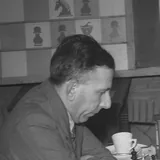
Harry Golombek won the British Championship three times, played for England in nine Olympiads and was the first British player to qualify for an Interzonal. During the Second World War he worked on the German naval Enigma at Bletchley Park. For forty years he was the chess correspondent of The Times, and he served as an arbiter at World Championship matches, translated Russian chess books and wrote more than thirty of his own, among them the collections of Capablanca's and Réti's best games and the Penguin primer The Game of Chess. In 1966 he became the first person appointed OBE for services to chess.
London
Golombek was born in London on 1 March 1911 to Polish-Jewish parents. He went to Wilson's Grammar School in Camberwell and studied philology at King's College London. In 1929 he won the London Boys' Championship, and two years later he won the Major, the top section of the London Congress. From 1938 to 1940 he edited the British Chess Magazine.
As a boy he read Richard Réti's Modern Ideas in Chess and found that it changed the way he thought about the game. When he wrote a foreword for its reissue, dated December 1942, he remembered the possibilities that the book had opened for him. He later devoted a games collection of his own to Réti.
He was champion of the University of London from 1930 to 1933. He first played for England at the Warsaw Olympiad of 1935, where he beat Israel Albert Horowitz, and at Margate in 1938 he beat the Women's World Champion Vera Menchik. At the British Championship at Brighton that year he shared second place with E. G. Sergeant, half a point behind C. H. O'D. Alexander. At Margate in 1939 Miguel Najdorf finished with only four points, “partly owing to my having beaten him (I had 3½),” Golombek wrote in Chess: A History (1976).
Bletchley Park
When the Second World War broke out in September 1939, Golombek was in Buenos Aires, playing in the Olympiad with C. H. O'D. Alexander and Stuart Milner-Barry. After the Olympiad he played in a tournament at Montevideo won by the World Champion Alexander Alekhine; the Enciclopedia del ajedrez (1980), which Golombek edited, places him second. Back in Britain he served in the Royal Artillery in 1940 and 1941. Writing about the cannon of Chinese chess in Chess: A History, he said that as “one who received his early training in the artillery in the last war,” he could “testify to its being a most subtle and civilized arm of warfare.” He was then posted to Bletchley Park, where Alexander and Milner-Barry were also working. Golombek worked in Hut 8, the section that broke the German naval Enigma, and moved to another section late in 1942.
“It is one of the many delights of chess that it is a literate game for literate people, …”
“It so happens that this was my first international tournament too and I well remember with what delight I watched the games played by the young Estonian genius.”
“As translator I had of necessity to study the authors’ texts with great care and attention, and I must confess that I myself felt the benefit of them as a chess-player.”
“I well remember what a revelation the book was to me when I read it as a boy—what new horizons and fresh ways of thought on the game were disclosed to me.”
“I think it is fair to say of the chessmasters of our time (the last hundred years or so), ‘Scratch a chessmaster and you will find a philosopher’.”
“From 1954 until 1972, a world championship match without Golombek as one of the arbiters was almost unthinkable.”
British Champion
In 1947 at Harrogate Golombek tied for first with Reginald Broadbent on 8/11, and he won the play-off match 4–2 to take the title. He won again at Felixstowe in 1949 and at Aberystwyth in 1955, each time with 8½/11, and finished second in 1948. He also took first prizes at Antwerp 1938, Leeuwarden 1947 and Berne 1948. In 1951 he won the first Paignton tournament with 6½/7, half a point ahead of the former World Champion Max Euwe, whom he beat.
FIDE made him an International Master in 1950, the year the title was introduced. Through the Bad Pyrmont zonal of 1951 he became the first British player to qualify for an Interzonal, at Saltsjöbaden in 1952. At the Maróczy Memorial in Budapest in 1952 he shared a brilliancy prize with Efim Geller for their draw, in which, he wrote, he “sacrificed two Rooks and a Knight.” He played in nine Olympiads between 1935 and 1962.
Arbiter and writer
Golombek became an International Arbiter in 1954. He was chief arbiter at the Portorož Interzonal of 1958, where, he wrote, the lights “gave continuous trouble by failing at vital moments,” and at the Candidates' Tournament in Yugoslavia in 1959, and he got to know the young Bobby Fischer at both. He was an arbiter at six world title matches, among them the 1963 match between Mikhail Botvinnik and Tigran Petrosian, and was a founding member of FIDE's Rules Commission, on which he sat for thirty years. In Chess: A History he wrote that he represented FIDE for most of the 1972 match between Boris Spassky and Fischer in Reykjavik, after the FIDE president Max Euwe went home. “In that capacity I received letters from all over the world,” he wrote, among them, to his surprise, many from the Soviet Union in support of Fischer.
He was chess correspondent of The Times from 1945 to 1985 and wrote a weekly column for The Observer from 1955 to 1979. Among his books are Capablanca's Hundred Best Games of Chess (1947), Réti's Best Games of Chess (1954), the Penguin The Game of Chess, Chess: A History (1976) and Golombek's Encyclopedia of Chess (1977), which he edited. He also contributed a chapter on the developments up to 1963 to H. J. R. Murray's A Short History of Chess.
He also translated and edited Paul Keres's Grandmaster of Chess: The Early Games of Paul Keres, first published in English in 1964. In his translator's preface, Golombek recalled watching Keres at Warsaw in 1935, which had been the first international tournament for both of them. He wanted the English reader to see the thoughts behind the games and to share the pleasure he had found in translating the book. In April 1975, as president of FIDE's Zone One, he attended the ceremony in Moscow for the new World Champion Anatoly Karpov. It was the last time he saw Keres, “of whom I had the honour of being a friend for some forty years.”
Teaching the middlegame
For the English edition of Paul Keres and Alexander Kotov's The Art of the Middle Game (1964), Golombek added his own chapter on planning. He drew its examples from his match and tournament games so that he could explain what he had been thinking at the board. In the editorial foreword he criticized chess writing that hid a lack of ideas behind jargon, and said that the close study required by translation had improved his own play.
His planning chapter warned against learning an opening variation without understanding the positions that followed. The opening, middlegame and ending had to be considered together. He pictured a young player memorizing a line that ended with an advantage for White, expecting the remaining moves to take care of themselves, and watching that advantage turn into a loss.
Legacy
In 1985 FIDE awarded Golombek the grandmaster title, which he insisted was not honorary but a belated recognition of his play in the 1940s. He shared first place in the British Veterans' Championships of 1984 and 1985, and he died on 7 January 1995, at eighty-three. William Hartston wrote that through The Game of Chess Golombek could justifiably have claimed to have taught the game to more people than anyone else.
Books
Books Harry Golombek wrote, co-wrote, edited, or contributed to. Translations and reprints are grouped under the same work.
-
Capablanca’s Hundred Best Games of Chess
Author
-
Fifty Great Games of Modern Chess
Author
-
The World Chess Championship 1948
Author
-
Richard Réti’s Best Games of Chess
Author
-
The Game of Chess
Author
-
The World Chess Championship 1954
Author
-
The World Chess Championship 1957
Author
-
Instructions to Young Chess Players / Improve Your Chess
Author
-
The World Chess Championship 1958
Author
-
Modern Opening Chess Strategy
Author
-
Fourth Candidates’ Tournament, 1959: Bled–Zagreb–Belgrade
Author
-
Mikhail Tal
Coauthor — collective book on Mikhail Tal
-
The Art of the Middle Game
Contributor — English translation of Paul Keres and Alexander Kotov’s book
-
Petrosian v Spassky
Coauthor — Harry Golombek, Peter H. Clarke
-
The World Chess Championship 1972: Fischer–Spassky / Reykjavik 1972
Author
-
The World’s Chess Championship, 1937
Editor — Alexander Alekhine’s match book, with annotations by Max Euwe
-
Chess: A History
Author
-
The Best Games of C. H. O’D. Alexander
Coauthor — Harry Golombek, William Hartston
-
The Encyclopedia of Chess / The Penguin Encyclopedia of Chess
Editor
-
Beginning Chess
Author
-
Modern End-Game Studies for the Chess Player
Contributor — English translation of Hans Bouwmeester’s book
-
Southsea Chess Tournament1949
Author/compiler and principal annotator