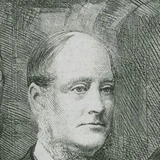
Henry Bird learned chess in 1844 after watching the players in a London coffee house, and he was still playing in international tournaments at almost seventy. He was a railway accountant by profession, never a professional player, yet he played Morphy, and he beat Anderssen, Steinitz, Zukertort, Chigorin and Lasker. He played in the first international tournament, London 1851, and won a brilliancy prize, at New York in 1876. His name is on the opening 1.f4, which he played for half a century, and on a defence to the Ruy Lopez. He wrote of himself that if he was not original in chess he was nothing.
The coffee house and the Divan
Bird was born at Portsea, Hampshire, on 14 July 1829. In Chess History and Reminiscences (1893), he recalled watching games for about three months in 1844 at Raymond's Coffee House near the City Road Gate before learning the moves. A cup of coffee was the usual stake. His first opponents gave him queen odds, and he was astonished to learn that the man conceding those odds was not, as he had supposed, the world champion. He first visited Simpson's Divan in 1846. In 1848 Henry Thomas Buckle gave him the odds of pawn and move in a match of seven games at the Divan. Bird won all seven and, he wrote in Bird's Modern Chess (1884), "have not accepted odds since."
In the same book he remembered worrying, during his first game at Simpson's, that he might break the large mirror behind him. John reassured him that the glass was thicker than his head and much less likely to crack.
At twenty-one he was invited to London 1851, the first international tournament, organised as a series of knockout mini-matches. Bernhard Horwitz eliminated him in the first round.
The accountant
After 1851 Bird had to set chess aside for his profession. He worked his way up from clerk to partner in a firm of London accountants, and in 1860 he was in Canada as a junior partner of Coleman, Turquand, Young & Co., working on the accounts of the Great Western Railroad. In 1866 he published An Analysis of Railways in the United Kingdom. His obituary in the British Chess Magazine said that as an authority on the details of railway accounts there was hardly a man in England his equal.
By his own account Bird had retired from chess when Paul Morphy came to England in 1858. He recalled in Bird's Modern Chess that on his return to London he met Morphy at Simpson's and fared badly there and at a second meeting, but later "won and drew two very fine games" at the St. George's Chess Club that, as far as he knew, were never recorded. Soon after Wilhelm Steinitz came to London in 1862, Staunton, Boden and Duffy called on Bird in the City and asked him to meet a remarkable player newly arrived from abroad. In Steinitz & Lasker Match (1894) Bird wrote that he went to Purssell's and "we had sixteen off-hand games with even results."
In the autumn of 1866 he played a match with Steinitz at the Westminster Chess Club for a small stake, the first to win eleven games to take it, playing in the evenings after a full day's work. While the seventeenth game was in progress, a telegram called him to America on his firm's business. He began an eighteenth game to oblige Steinitz but could not finish it, and the stakes were forfeited. The match was left unfinished with Steinitz ahead by only +7 −5 =5; Bird's own index of the games counted six wins to Steinitz, five to himself and six draws, with the eighteenth adjourned. From then on Bird was recognised as an amateur of master strength.
“if, however, I have had less success than some other players, I have derived more amusement and real pleasure from the combinations of the game, besides which if I am not original in Chess I am nothing.”
“I have however consistently adopted moves in some of the Openings which have been more or less condemned by the authorities.”
“Concerning the innovations and novelties dealt with herein, the value of them should be estimated rather by the kind of game they lead to than the result of them, however favourable it has been, …”
“The writer is not enamoured of blindfold play, preferring not to attempt to do that without his eyes, which he can do better with.”
“I sometimes play this, but not always; it depends upon the state of mind I am in, and whether I want a lively and critical game or a steady contest—one, in fact, in which my adversary considers that I treat him with becoming respect.”
“If there is genius in chess, Bird of all players had it, I think, in greatest abundance.”
“Always alternating between being dangerously ill and dangerously well.”
“Your games always delight me, as they seem in my humble judgment specimens of Chess skill remarkable for originality and vivacity.”
“Bird is always ready and eager for the fray, even when the stake is only empty glory.”
The brilliancy prize
In 1876 Bird was in the United States again, and in the Clipper tournament in New York he beat James Mason in a game that won the silver cup for brilliancy. He called it "one of my best games" and noted that the judges had placed it first unanimously. He played in the great international tournaments of the following decades: Vienna 1873, Paris 1878, Vienna 1882, London 1883, Hamburg 1885, Hastings 1895 and London 1899.
His results were uneven, and he rarely finished near the top of the table. Zukertort remarked, as Bird recorded in Bird's Modern Chess, that he might have finished higher if he had been less experimental and less hazardous. Bird offered another explanation in Chess History and Reminiscences: he found the clocks more troublesome than the chess and felt they handicapped him in tournaments. At Vienna in 1882 he fell ill, and several of his games, the one against Zukertort among them, were declared forfeited while he could not leave the hospital. He played the last round against Steinitz at the request of the committee and the leading prize-winners, "being in a lamentable state of health at the time." But in any single game he was dangerous to anyone. Among the players he beat were Anderssen, Steinitz, Zukertort, Blackburne, Chigorin, Winawer, Burn, Janowski and, in 1890 and 1892, the young Emanuel Lasker.
1.f4
Bird liked unusual experiments. He tried 1.f4 against Ernst Falkbeer in 1856, with poor results at first, and kept returning to it for the rest of his career. He gave up chess after the 1866 match with Steinitz, but early in 1873 Löwenthal and Boden introduced him to John Wisker, holder of the British Chess Association Challenge Cup, and suggested a friendly match. "Having forgotten familiar openings, I commenced adopting KBP for first move," Bird wrote in Bird's Modern Chess, and he became partial to it. Over four matches and 47 games he finished three games ahead of Wisker. In Chess Novelties (1895), he credited the Hereford Times with calling it Bird's Opening in 1885, after his successful and unusual games with it. He also gave his name to Bird's Defence to the Ruy Lopez, 3...Nd4, and he was one of the few masters of his time who kept faith with the Sicilian Defence. A note in his Chess Masterpieces (1875) admitted that the defence had been "generally condemned", but argued that "the move has the rare advantage of not having been analyzed to any great extent."
He recalled in Chess Novelties that, an hour before play began at Manchester in 1890, friends advised him to avoid the Philidor and especially the Sicilian, which they said the German school had analysed and found wanting. Bird rejected that verdict. His first game was a Sicilian against Isidor Gunsberg, and he won.
In 1874 he proposed a chess variant on an 8×10 board with two new pieces, the guard, which moved as rook and knight, and the equerry, which moved as bishop and knight. Capablanca's own variant, Capablanca Chess, later differed from it only in the starting position.
The writer
Bird's books included Chess Masterpieces (1875), The Chess Openings, Considered Critically and Practically (1877), Chess Practice (1882), Bird's Modern Chess (issued in parts from 1884 and collected as Modern Chess and Chess Masterpieces in 1887), Chess History and Reminiscences (1893), Steinitz & Lasker Match (1894) and Chess Novelties (1895).
Chess Masterpieces grew, he wrote in its preface, out of off-hand games with Samuel Boden, "played at a rapid pace, and for amusement only." He dedicated it to Ignatz Kolisch, who had promoted the Vienna tournament of 1873. In the same preface he complained that "match play is entirely stopped through the largeness of the stakes demanded." Reviewing the Steinitz–Lasker match in 1894, he admitted that "the writer's instinctive and rapid chess proclivities scarcely qualify him to express the soundest opinions upon the long-thought games of two such masters."
In the introduction to The Chess Openings, Bird traced the decision to write the treatise to his visit to Montreal in the winter of 1876–77. Encouragement from members of the Montreal Chess Club, together with support from players in New York and Brooklyn, persuaded him to assemble it. He dedicated the book to the Montreal club and two of its supporters.
In old age he suffered badly from gout. At Hastings in 1895 and London in 1899, in his late sixties, he was still playing the leading masters of the day. His last public appearance was on 22 June 1901, in a bath chair, at a chess club garden party.
Legacy
Bird died in London on 11 April 1908. His competitive life ran from the chess rooms of the 1840s to London 1899, and it took in Morphy, Anderssen, Steinitz and Lasker. W.E. Napier, who saw him play at Simpson's Divan, remembered "fulminating chess, of hearty laughter and liberty", and wrote that England would not know his like again. 1.f4 is still called Bird's Opening, and Hans Renette's biography H.E. Bird: A Chess Biography appeared in 2016.
Books
Books Henry Bird wrote, co-wrote, edited, or contributed to. Translations and reprints are grouped under the same work.
-
Chess History and Reminiscences
Author
-
Chess Masterpieces
Author
-
Chess Novelties and Their Latest Developments
Author
-
Chess Practice
Author
-
Steinitz and Lasker Match
Author
-
The Chess Openings
Author