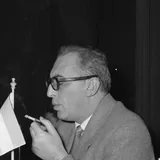
Herman Pilnik was born in Stuttgart and moved to Buenos Aires with his family at sixteen. He won the Argentine championship three times, played on five Olympiad teams for Argentina and qualified for the 1956 Candidates Tournament. In the early 1950s he spent years on the road in Europe, winning tournaments in Beverwijk, Vienna and Belgrade, and he beat three World Champions: Max Euwe, Vasily Smyslov and Tigran Petrosian. Miguel Najdorf described him as a globetrotter and a bohemian, and a romantic, combinative player. He spent his last years in Caracas, where he taught chess and coached the Venezuelan team.
Stuttgart and Buenos Aires
Pilnik was born in Stuttgart on 8 January 1914. He learned chess at twelve and was champion of his home city at fifteen. In 1930, when he was sixteen, his family moved to Buenos Aires, where the young player was known as "El alemancito," the little German. His name was Hermann in German; the Argentine press always spelled it Herman. By 1933 the Argentine magazine El Ajedrez Americano was listing him among the new players and publishing his games.
The 1939 Olympiad in Buenos Aires ended as the Second World War began, and several strong masters stayed on in Argentina, among them Gideon Ståhlberg, Moshe Czerniak, Miguel Najdorf and Erich Eliskases. Zenón Franco later wrote that Pilnik played these masters for money and lost, and that he learned from them. He won the Argentine championship in 1942. The 1945 title was settled by a match with Héctor Rossetto, which Pilnik won 5–3, and he won the championship a third time in 1958.
Mar del Plata and New York
His international career began at Mar del Plata. In 1942 he finished joint second with Ståhlberg, half a point behind Najdorf, and his win against Najdorf was the winner's only loss; Fred Reinfeld later included the game in Great Brilliancy Prize Games of the Chess Masters. In 1944 he tied for first place with Najdorf. In the summer of 1945 he finished third at the Pan-American Championship in Hollywood, which Samuel Reshevsky won.
In a 1947 magazine interview he said that his strength was calculation: he could see a great number of combinations at every move, but he was weaker than the leading masters in long-range planning and technique. He added that he feared weak opponents, because he could not concentrate against them. At New York 1948/49 he shared third place with Max Euwe, behind Reuben Fine and Najdorf.
“Against a grandmaster I feel at ease. I am not a player of deep knowledge or of a refined strategic style; my strength lies in the mental vision of the moves. I see, as if they were in front of my eyes, an immense number of possible combinations at every move.”
“And if I played badly, why did I win?”
“Globetrotter, bohemian, eternally optimistic, intelligent and cultured, with a command of several languages, Herman led a novelistic life given over entirely to his great passion: chess. … His style? A romantic, a formidable and deep combinative player.”
Five years on the road
After New York, by his own account, Pilnik began a tour that lasted about five years. At Bled in 1950 he finished second to Najdorf, and he shared first place with Euwe at Lucerne in 1950/51. He won the Hoogovens tournament at Beverwijk in 1951, drew a match with Efim Bogoljubov 3–3 late that year, and won at Vienna in 1951/52 and Belgrade in 1952. At the Maróczy Memorial in Budapest in 1952, won by Paul Keres, he beat both Smyslov and Petrosian. In 1954 he won a tournament in his native Stuttgart. FIDE made him an International Master in 1950 and a Grandmaster in 1952.
He played for Argentina at five consecutive Olympiads from 1950 to 1958. At Dubrovnik in 1950 he scored +6 −1 =3 as first reserve and won the individual gold medal, and Argentina took team silver there, at Helsinki in 1952 and at Amsterdam in 1954. At Munich in 1958 he played first board and the team won bronze.
Candidate
Pilnik played the Interzonal tournaments of 1952 at Saltsjöbaden and 1955 at Gothenburg. At Gothenburg he shared seventh to ninth places with Boris Spassky and Miroslav Filip, which qualified him for the Candidates Tournament in Amsterdam in 1956. There he finished tenth and last with 5 points from 18 games; his one win was against László Szabó.
On his way back from Gothenburg he played a six-game match in Reykjavík against the young Icelander Friðrik Ólafsson in late 1955 and lost it 1–5. In Reykjavík he also met Anna Erla Magnúsdóttir, who left Iceland with him that December. Their rematch in Reykjavík in March and April 1957 was closer: Pilnik won three of the first six games, and Ólafsson took the match 4½–3½.
Chile, Buenos Aires and Caracas
In the 1960s Pilnik lived for some years in Chile and finished second in the Chilean championship of 1961. He still played in Europe: at Hoogovens in 1963, won by Jan Hein Donner ahead of David Bronstein, he shared third place with Bruno Parma and Borislav Ivkov. At Mar del Plata in 1966 he beat Leonid Stein and Lajos Portisch.
Back in Buenos Aires he won the 1972 Joker tournament at the Club Argentino with 9 points from 11, a point ahead of Najdorf, and beat Najdorf at the same event a year later. His highest FIDE rating was 2450, in July 1972. He then moved to Venezuela, where he taught chess at the Military Academy in Caracas, wrote a weekly column for the newspaper El Nacional and coached the Venezuelan team at the 1976 Olympiad in Haifa.
Legacy
Pilnik died in Caracas on 12 November 1981, at sixty-seven, and was buried in the city's Cementerio General del Sur. The Pilnik Variation of the Ruy Lopez is named after him. In 2025 he was elected to the Hall of Fame of Chess of the Americas. He had lived in Germany, Argentina, Chile and Venezuela and spent years on tour in Europe, and he played on all four Argentine teams that won Olympiad medals in the 1950s.
Books
No authored or contributed books are documented in the available sources.