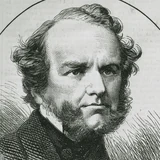
Howard Staunton
Howard Staunton beat Saint-Amant in Paris in 1843 and was, by common consent, the best player in the world for the next several years. But his real monument is organisational: he convened London 1851, the first international tournament ever held, and he lent his name to the pattern of chess pieces that every tournament on earth still uses. He was also a Shakespeare scholar of standing, and — in the one episode that has followed him ever since — the man who never played Paul Morphy.
◈Paris, 1843
Staunton came late to serious chess and rose fast. In late 1843 he travelled to Paris to meet Pierre Charles Fournier de Saint-Amant, the leading French player, and won the match decisively — eleven wins to six with four draws. With La Bourdonnais and McDonnell both dead, that result made him the strongest player in the world in the eyes of the chess public.
He consolidated it in print. The Chess Player's Chronicle, which he founded in 1841, was the first enduring English chess magazine, and The Chess-Player's Handbook of 1847 became the standard English manual for decades.
◈London 1851
His largest contribution was to conceive and organise the London 1851 tournament, held alongside the Great Exhibition — the first international chess tournament ever staged. It brought the leading players of Europe together for the first time and was won by Adolf Anderssen, who beat Staunton along the way.
In 1849 the firm of Jaques of London registered a new pattern of pieces, designed for stability and instant legibility, and Staunton endorsed it and lent it his name. The Staunton pattern is now the only design permitted in serious competition anywhere in the world.
◈Morphy, and Shakespeare
In 1858 Paul Morphy came to Europe expressly to play him. The match never happened. Staunton, by then past his best and deep in editorial work, put it off in a series of postponements and evasions that were read at the time — and have been read ever since — as an unwillingness to risk his reputation. It is the thing most people know about him.
What occupied him instead was Shakespeare. His annotated edition of the complete works, issued in parts between 1857 and 1860, was a respected piece of scholarship in its own right, and he went on writing on the subject for the rest of his life. He died in London on 22 June 1874.
“The late Mr. Howard Staunton.”
◈Legacy
Staunton's reputation has never quite recovered from the Morphy affair, which is a poor way to measure him. He was the best player in the world in the 1840s, the first English writer to make chess literature respectable, and the man who invented the international tournament — the format the entire competitive game has used ever since. And every set of pieces used in every serious game played today is named after him.