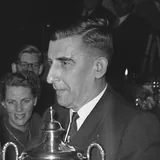
Igor Bondarevsky came out of the Don Cossack country a tactician, and in the autumn of 1940 he shared the Soviet Championship with Andor Lilienthal — ahead of Smyslov, ahead of Keres, ahead of Botvinnik, whom he had beaten on the opening day. He was among the first grandmasters FIDE ever named, and later a grandmaster of correspondence chess as well. But the work that outlived him was done off the board. From 1961 he took a gifted, unserious young Leningrader named Boris Spassky and, over eight years, made him world champion.
A teacher before a champion
Igor Zakharovich Bondarevsky was born on 12 May 1913 at khutor Samsonov, a farmstead attached to the Cossack stanitsa of Novonikolayevskaya in the Don Host Oblast, and grew up in Rostov-on-Don. He learnt the rules at nine; at twelve, during the chess excitement of the 1925 Moscow tournament, he began studying Capablanca's Chess Fundamentals. He became champion of Rostov, and in 1936, aged twenty-three, was invited to teach in the newly opened chess section at the Palace of Pioneers. He qualified as an engineer-economist and became a Master of Sport in 1937.
The breakthrough was an all-Union first-category tournament in Leningrad in 1936, which he won with 11½ from 14 and no losses. Within a year he was in the final of the 10th USSR Championship at Tbilisi and in the international tournament staged in Moscow around Reuben Fine's visit — his first foreign opposition, where he finished near the bottom of the table but took the brilliancy prize for his win over Andor Lilienthal.
Moscow, September 1940
The 12th USSR Championship opened in Moscow on 5 September 1940 with twenty masters — Botvinnik, Smyslov, Boleslavsky, Lilienthal and Paul Keres making his Soviet debut — in what was, with the world at war, effectively the strongest tournament anywhere. On the first day Bondarevsky beat Botvinnik. He did not let go: ten wins, two losses, seven draws, 13½ from 19, level at the top with Lilienthal, with Smyslov third, Keres fourth and Botvinnik back in a share of fifth. Both leaders were declared champions of the Soviet Union. Bondarevsky was twenty-seven.
The tie settled nothing about who should challenge Alexander Alekhine for the world title, so the authorities staged a match-tournament in the spring of 1941 for the title of Absolute Champion of the USSR — the top six, four games each, across Leningrad and Moscow. Botvinnik won it outright. Bondarevsky finished last of the six with 8 from 20, though in the opening rounds, on 27 March, he beat Botvinnik once more. Two months after the last move, Germany invaded.
“If you don't work, you'll lose the match.”
“Some day you will probably become a world champion.”
“We were then planning a distant, stage-by-stage journey towards the world championship, overcoming all barriers”
“Vladimir Zak gave me a weapon, Alexander Tolush sharpened it, Bondarevsky hardened it.”
“An epitome of wisdom, determination, clarity and work ethic.”
The war, and the Candidates he never played
The war took the middle of his career. A training match against Isaak Boleslavsky at Rostov was broken off when the fighting reached the Don. In occupied Rostov he played the Romanian army doctor Octaviu Troianescu, escaping a piece-down ending with a draw. Dmitry Kryakvin's account for the Russian Chess Federation, drawing on Vladimir Neishtadt's research and archival work, places the encounter there. After the city's liberation Bondarevsky joined the Red Army. He reappeared in tournaments in 1944, then shared fourth place in the 1945 USSR Championship.
His best postwar championship came at Leningrad in 1947: 12 from 19 and a share of third place. The following year he played the first Interzonal, at Saltsjöbaden, scored 10½ from 19 and finished in a share of sixth — enough to qualify for the Candidates Tournament at Budapest in 1950. He never played it. Illness is the conventional explanation; Yuri Averbakh later gave a political one, reported by Kryakvin: Bondarevsky was excluded to prevent a Yugoslav reserve from entering during the Stalin–Tito split. His chance to contest the title went with that absence. FIDE named him an International Grandmaster in 1950 all the same, one of the twenty-seven on the inaugural list.
A grandmaster twice over
He never recovered the form of 1940 over the board — 12th at the 18th Soviet Championship, 12th again at the 19th — though as late as Hastings 1960/61 he took second place behind Svetozar Gligorić with 6 from 9, unbeaten. By then he had built an entire second career out of a slower game. On board one for the USSR in the third Correspondence Olympiad (1958–61) he scored 7 from 9; on board one in the fourth (1962–64) he scored 6½ from 8. The Soviet team won both. The ICCF made him a correspondence grandmaster in 1961, and he became one of the few men to hold the grandmaster title both over the board and by post. He had been an International Arbiter since 1954.
His name is fixed in opening theory as well. The Tartakower–Makogonov–Bondarevsky system of the Queen's Gambit Declined — Black playing ...h6 and then ...b6, freeing the cramped light-squared bishop to the long diagonal — remains one of the most reliable defences in the whole of 1.d4, still played at the top level eighty years on.
Before Spassky
Other players had been leaning on him for years, including Paul Keres and Efim Geller. As Geller's second in the 1955 Soviet championship play-off against Smyslov, Bondarevsky helped choose an unexpectedly quiet strategy. Geller would offer fewer weaknesses and wait for Smyslov's reaction. Six draws followed; Geller won the seventh game and the title. Bondarevsky then served as Smyslov's official second in the world-title matches of 1957 and 1958, with Simagin and Makogonov also helping the team.
The making of Boris Spassky
He began working with Boris Spassky in early 1961. The twenty-four-year-old had already missed one Candidates cycle and been dropped from the national team after losing to William Lombardy at the 1960 Student Olympiad. Another qualifying chance slipped away in the January Soviet championship. Bondarevsky's answer was work. He set middlegame positions to be solved on the clock without touching the pieces, and stressed planning in the middlegame and endgame. Spassky called him Fater — Father. During Spassky's divorce he also offered him a place in his Leningrad flat. At the end of that first year Spassky won the Soviet Championship.
In 1963 they planned to qualify quietly at Kharkov: no losses, with five wins expected to be enough for the championship final. The plan nearly collapsed on the first day. Anatoly Lutikov obtained a winning position, but failed to convert the ending; Spassky escaped with a draw. Bondarevsky recalled the scare as the beginning of a long campaign. Spassky went through both semifinal and final undefeated.
What followed was one of the great sustained partnerships in chess: the Amsterdam Interzonal of 1964; Candidates matches against Keres, Geller and Tal in 1965; a first world championship match against Tigran Petrosian in 1966, lost; Geller, Larsen and Korchnoi in 1968; and in 1969 the rematch with Petrosian, won 12½–10½. Bondarevsky was his second throughout, and annotated the games for the Soviet press as they were played. He was made an Honoured Trainer of the USSR in 1966, and wrote the story down twice — in Boris Spassky Storms Olympus (1966) and, with Isaak Boleslavsky, in the match book Petrosian – Spassky 1969.
The match he left
For the projected 1972 match with Fischer, Bondarevsky drew up a plan combining psychological, physical and chess preparation. It called for a study of both players' strengths and weaknesses, practice in tactics and technique, and a deliberately uncomfortable exercise: look at Spassky's games from Fischer's point of view. The plan treated the opponent's judgment as part of the work.
The break came on 1 February 1972, five months before Reykjavík. Bondarevsky handed his resignation to the Sports Committee; Spassky, the same day, wrote asking for his removal, saying his trainer had fallen behind in theory and practice and no longer believed in their work. Nikolai Krogius, who was inside the camp, blamed much of it on Geller and judged the dismissal a grave mistake. Viktor Baturinsky recalled Bondarevsky saying Spassky was not preparing seriously and he did not want responsibility for the outcome. Spassky later defended the separation: he wanted to make his own decisions. Bondarevsky had warned him that insufficient work would cost him the match.
They resumed work after Spassky's victory in the 1973 Soviet Championship, and Bondarevsky was his second against Karpov in 1974 and Korchnoi in the 1977/78 Candidates final. His knowledge of Fischer also reached another team. Unable to attend Karpov's 1975 training sessions for the projected title match, he supplied a written assessment of the American champion; Polugayevsky supplied one as well.
Pyatigorsk
From 1966 he lived and worked in Pyatigorsk, in the spa country of the northern Caucasus. He married the chess player Valentina Kozlovskaya, and he kept writing: Combinations in the Middlegame (1960) and Attack on the King (1962) had already gone through several printings, and his tournament books ran from twenty games of the 1940 championship, published in Rostov in 1941, to the Gothenburg Interzonal of 1955. He also edited the 1952 first edition of The Chess Creativity of N. D. Grigoriev, compiled by Ilia Kan, and his notes were kept in the enlarged second edition of 1954. He had held the Order of the Badge of Honour since 1957.
In Combinations in the Middlegame, he began with threats and exchanges before introducing combinations. His practical advice was to take positions from annotated games, make diagrams, and find the combinations and all their variations mentally, without moving the pieces. Write the variations down, then build a card index arranged by tactical motifs and, within each group, by the ideas used to exploit them. Beginners could first work through the moves on a board; the aim was to learn to calculate them in the mind.
He died in Pyatigorsk on 14 June 1979, aged sixty-six. The magazine 64 carried the obituary that summer under the title In Memory of a Grandmaster. His teaching book outlived him in a more personal way. The editors of the revised 1982 Combinations in the Middlegame recorded that he had died while it was being prepared, and that Kozlovskaya — his widow and pupil, herself an international grandmaster — completed the work.
Legacy
What Bondarevsky built lasted longer than what he won. The Tartakower–Makogonov–Bondarevsky system is still a main-line defense to the Queen's Gambit, and his training methods passed through Spassky into the normal routine of preparing a world champion: solving timed positions without moving the pieces, planning before calculating variations, and physical training alongside chess work. Rostov-on-Don, where he taught at the Palace of Pioneers, holds a memorial tournament in his honor. But the tribute that matters most is a sentence Spassky repeated for the rest of his life: Zak gave him the weapon, Tolush sharpened it, and Bondarevsky, the hard, blunt, immovable Cossack from the Don, tempered it.
Books
Books Igor Bondarevsky wrote, co-wrote, edited, or contributed to. Translations and reprints are grouped under the same work.
-
Борис Спасский штурмует Олимп
Author
-
Combinations in the Middle Game
Author
-
Петросян — Спасский, 1969
Coauthor — Isaac Boleslavsky, Igor Bondarevsky
-
Шахматное творчество Н.Д. Григорьева: Анализы, теоретические работы, этюды, избранные партии
Retained first-editionannotator