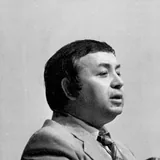
Some players are remembered for the crowns they wore. Igor Zaitsev is remembered for a move. Nine moves into the Closed Ruy Lopez the black bishop slides to b7, leans on White's pawn on e4, and a line the world's champions have been arguing over ever since carries his name. He was a fine player in his own right — a combinative attacker who beat Boris Spassky at twenty-two and Mikhail Tal at thirty, Moscow champion at thirty-one, grandmaster at thirty-eight. But he gave the larger part of his life to other men's titles: thirteen years in Anatoly Karpov's back room, from 1978 to 1991, thinking thoughts that would appear on the world's boards under somebody else's name. David Bronstein warned him exactly what that choice would cost. He made it anyway, and he has never stopped analysing since.
The boy from Ramenskoye
Igor Arkadyevich Zaitsev was born on 27 May 1938 in Ramenskoye, a factory town on the eastern edge of the Moscow region. His father, Arkady Gevorgovich Aghaian, was an Armenian and the deputy commander of a warship; his mother, Anna Fyodorovna Zaitseva, worked at the Red Banner textile factory. It is her surname he carries, and it is the world of Soviet working Moscow — not a chess dynasty — that produced him.
He finished school with honours and went to the Moscow Institute of Transport Engineers, the ordinary technical path of a bright Soviet boy. Chess pulled him off it. In 1963 he moved into Moscow proper and into the chess press, working with Moscow Chess, Chess in the USSR and the weekly 64 — a life spent, from the beginning, as much in the analysis of the game as in the playing of it. The earliest game preserved in this archive is a win in Moscow in 1956, when he was eighteen years old. The latest is from 2011. Between those two dates lie fifty-five years of a man refusing to put the pieces down.
A combinative player
Before he was anybody's second he was a genuinely dangerous opponent, and his own federation's summary of him is blunt about the style: attractive, combinative chess, and world champions among the casualties. In August 1960, a twenty-two-year-old playing a semifinal of the 28th Soviet Championship, he beat Boris Spassky. Eight years later, in December 1968, he took the black side of a Ruy Lopez against Mikhail Tal in the Soviet team cup and won that too. Spassky would hold the world title within two years of their game; Tal had held it already.
He reached six Soviet Championship finals, in 1962, 1967, 1968–69, 1969, 1970 and, remarkably, again in 1991. In 1969 he became Moscow champion, beating Yakov Estrin for the title. He became an International Master in 1970, the year he took second place at Polanica-Zdrój; on the very first FIDE rating list, in July 1971, he was rated 2520, joint fifty-fifth in the world. The grandmaster title followed in 1976. Over his career he won more than thirty all-Union and Russian competitions, took silver in the 1973 Russian championship, and won grandmaster round robins at Moscow, Quito, Dubna, Bucharest and Orel.
One correction the record still needs. Over the New Year of 1968–69, at the 36th Soviet Championship in Alma-Ata, a Zaitsev tied for first with Lev Polugaevsky and lost the play-off — but that was Alexander Zaitsev, a different player who happened to share the surname. Igor Zaitsev was in the same twenty-man field, and finished on 8½ points in fifteenth to seventeenth place. Reference works have merged the two men for decades. They were never the same person, and Igor Zaitsev's claim on chess history never depended on that result.
Kasparov recalled their Baku 1980 encounter in his foreword to Attacking the Strongpoint (pp. 5–7). Zaitsev sacrificed a pawn and found counterplay against the white king. He later erred with little time left, but Kasparov remembered the game as a lesson in the limits of his youthful opening preparation.
“I was trying to resuscitate it with the idea of a strategic breakthrough.”
“He was able to see what no one else noticed.”
“A legendary analyst and pioneer of many trails in chess openings.”
Nine moves, and a name
He is remembered above all for opening theory. In the Closed Ruy Lopez, after 1.e4 e5 2.Nf3 Nc6 3.Bb5 a6 4.Ba4 Nf6 5.0-0 Be7 6.Re1 b5 7.Bb3 d6 8.c3 0-0 9.h3, everything turns on Black's ninth move. 9...Bb7 puts the bishop on the long diagonal aimed at White's e4 pawn, and after 10.d4 Re8 the pressure becomes part of the structure. The line is classified as C92 and known as the Zaitsev, or the Flohr–Zaitsev. Karpov played it at the very top, including in his world championship matches with Garry Kasparov, and it is still one of the most important variations of the oldest opening in serious chess.
The really original idea wasn't the bishop but the rook. The Zaitsev's trademark is sending a developed rook back again, 11.Ng5 Rf8, after which White may repeat with 12.Nf3, an idea so counterintuitive that, as FIDE noted on his eighty-fifth birthday, the world's strongest players had missed it for more than half a century. Zaitsev saw it. He also left variations of his own in the Sicilian, the King's Indian and the Caro-Kann. Emil Sutovsky, writing for FIDE, called him “a legendary analyst and pioneer of many trails in chess openings”, which if anything understates it.
In the shadows
From 1971 to 1977 he worked with Tigran Petrosian and with Lev Polugaevsky through their Candidates campaigns — the ninth world champion and one of the hardest men in Soviet chess, both of them wanting his discoveries in their own hands before anyone else could find them. Then, in March 1978, Semyon Furman died, and Anatoly Karpov needed a mind for his openings. Zaitsev took the chair and did not leave it for thirteen years. From 1978 to 1991 he was Karpov's ever-present second: Baguio in 1978, after which came the title of Honoured Coach of the USSR; the Order of the Friendship of Peoples in 1981; and then the long war with Garry Kasparov, match after match from 1984 to 1990, with Zaitsev in the room behind the stage every time.
The work could be painstakingly practical. In his recollection reproduced in My Great Predecessors, Part V, Zaitsev describes missing the Soviet delegation’s excursion to Venice during the 1981 Merano match so that he could decipher Geller and Razuvaev’s handwritten analysis and prepare it for Karpov. Their Ruy Lopez discovery appeared in the fourteenth game.
It is work that leaves almost no trace. The novelties are published under the champion's name; the ideas prepared and never needed simply disappear, and FIDE has noted how much of what Zaitsev gave Karpov the world never got to see. Zaitsev recalled Bronstein warning him that choosing the analyst's life meant remaining in the shadows, his recognition dependent on the players he helped. It was a warning. Zaitsev accepted it.
Dvoretsky kept a separate folder of Zaitsev's articles. In his preface to Attacking the Strongpoint (p. 11), he said students who needed to develop imagination, creativity and concrete analysis would be given access to it.
The analyst who never stopped
He stepped away from elite competition around the turn of the century, but not from the board and never from the analysis. He kept publishing. He kept calculating — and, in an age when the machines had supposedly settled everything, he made a habit of refuting computer analysis, which is a sentence very few players of any generation have earned. He wrote poems for his colleagues and friends. He became a FIDE Senior Trainer in 2006, and he still works at the Botvinnik Central Chess Club in Moscow.
He also kept playing, long after there was any need to. In August 2011, aged seventy-three, he turned up at the Botvinnik Memorial senior tournament and beat both Mark Taimanov and Borislav Ivkov, men who had been near the top of world chess when he was a young master working his way through the Moscow semifinals.
His book Attacking the Strongpoint: The Philosophy of Chess appeared in English in 2020, translated by Jim Marfia and Boris Gleizerov and expanded from the Russian edition published by Sovetsky Sport in 2004. It includes Kasparov's foreword and contributions from Karpov and Mark Dvoretsky. Zaitsev argues that a useful target can be the square an opponent has worked hardest to defend. His defence of older games also distinguishes analytical improvements from artistic achievement: correcting a move need not make a later version more valuable than the original.
His examples include his own French Defence research in the 1960s (p. 106). He tried to revive an old line through a pawn breakthrough, drawing on positions he repeatedly reached as a regular 1.e4 player.
Legacy
In May 2026 Igor Zaitsev turned eighty-eight, and he is still at his desk at the Botvinnik Central Chess Club in Moscow, the club's resident analyst, seven decades after his first recorded win. His wife Tamara is a master of sport and an ICCF grandmaster; their daughter Olga is a lawyer and historian. He never played a world championship match himself, and the title was never within reach; what he left is a variation, and the rare distinction of showing the world's best players something about their oldest opening that fifty years of masters had missed. Every time a Ruy Lopez reaches move nine and the bishop goes to b7, in a world championship, a club game or an engine's opening book, his name comes up. Bronstein was right that the light would be reflected. He was wrong that it would be dim.
Books
Books Igor Zaitsev wrote, co-wrote, edited, or contributed to. Translations and reprints are grouped under the same work.