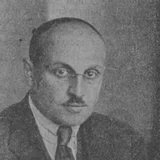
Ilya Rabinovich was one of the leading masters of Petrograd and Leningrad between the world wars and shared the 1934/35 USSR Championship with Grigory Levenfish. Interned in Germany at the start of World War I, he won the 1916 Triberg tournament of Russian internees, and in 1925 he became the first Soviet player to compete abroad, finishing seventh at Baden-Baden. His 1927 book The Endgame was the first original Russian book on the endgame, and both Capablanca and Alekhine called it excellent. A mathematics lecturer by profession, he stayed in besieged Leningrad in 1941 and died after his evacuation in April 1942.
From St Petersburg to Triberg
Rabinovich was born in Saint Petersburg in 1891. Levitov Chess writes that he grew up in a German-speaking milieu, excelled at mathematics at his gymnasium, and took to chess seriously only after watching the St Petersburg international tournament of 1909. He trained as a mathematician and later taught the subject. In 1911 he shared first place in the side tournament of the All-Russian Amateur Tournament in St Petersburg.
In July 1914 he played in the Hauptturnier A at the German Chess Federation congress in Mannheim. He had 7½ points from 10 games when the outbreak of war stopped play; Russian sources say he was leading and that he received the master title for the result. With the other players from the Russian Empire he was interned by the German authorities. Kasparov, in My Great Predecessors, Part I, records that Alekhine shared a prison cell with Bogoljubov, Ilya Rabinovich and Samuil Vainstein.
Alekhine and three others were soon released, but Rabinovich spent the next years in Germany and played in the series of tournaments the internees held at Triberg in the Black Forest. He finished second to Bogoljubov in three of them, won the 1916 event ahead of Bogoljubov and Alexey Selezniev, and shared first place with Selezniev in 1917.
Leader of Petrograd chess
Back in Petrograd, in 1919 he beat Peter Romanovsky in a match by 5½–1½. In 1920 he won the first Petrograd championship with 10 points from 11 games and took fourth place, with 9½ out of 15, in the All-Russian Olympiad in Moscow, later counted as the first Soviet championship, behind Alekhine, Romanovsky and Levenfish. With Levenfish and Romanovsky he formed what the Russian Chess Federation calls the Leningrad trio.
On 20 July 1924 he and Romanovsky played a game of living chess on Palace Square in Leningrad, with soldiers and sailors as the pieces, before 8,000 spectators; it was drawn on move 67. In 1925 he shared first place in the Leningrad championship and was third in the 4th USSR Championship.
The same year he became the first Soviet player to compete outside the country. At Baden-Baden 1925 he finished seventh with 12 points from 20 games, and beat Efim Bogoljubov and Siegbert Tarrasch. At the first Moscow international tournament that November he finished 16th, but he drew with Emanuel Lasker and José Raúl Capablanca and beat Akiba Rubinstein.
“The queen does not always win against a pawn. A pawn which has advanced to the seventh rank often forces the draw.”
“This ending was so thoroughly examined in the mid-nineteenth century (1847-1856) by L. Centurini, that these days we need only to flesh out his analysis a bit.”
“The example we have presented demonstrates the power of the king in front of the pawn, as well as the great significance of the length of the shorter diagonal.”
“There is also an excellent work on the subject by Rabinovich, unfortunately available only in Russian.”
“the manuals devoted to the end-game—even the most up-to-date, such as the recent edition of E. Rabinovitsch's excellent work—do not give any convincing examples.”
“Euwe had looked at it in his preparations and was familiar with Becker's analysis, refuting an idea suggested by Ilya Rabinovich, which, to his misfortune, Alekhine employed.”
“Ilya Rabinovich (1891-1942) has a rare, probably unique, distinction: he wrote a book, Endshpil (two editions, published in 1927 and 1938), which was hailed as 'excellent' by both Capablanca and Alekhine.”
The Endgame
Rabinovich was also a chess writer and journalist, and ran the chess column of the newspaper Leningradskaya Pravda. He published a book on the modern chess game in 1925 and edited the Russian translation of Tartakower's book on the Debrecen tournament in 1926. In 1927 he published Endshpil (The Endgame), the first original book on the endgame in Russian; a revised second edition followed in 1938, and his book on the opening, Debyut, in 1931.
Capablanca, in his Last Chess Lectures, and Alekhine, in his notes to a game against Vidmar, both called the endgame book excellent. Botvinnik later wrote that Rabinovich approached chess like a scientist and studied it systematically, and that the textbook gave invaluable help to the young Soviet players of the 1920s. In 2012 Mongoose Press published an English edition of the 1938 text, translated by James Marfia, as The Russian Endgame Handbook.
His opening work also reached a world championship match. Kasparov writes that after the 1934 Leningrad tournament Rabinovich suggested an improvement for White in the Cambridge Springs Defense. Alekhine adopted it in the 25th game of his 1935 match with Max Euwe and lost: Euwe knew Becker's analysis refuting it.
Champion of the Soviet Union
In 1928 Rabinovich won the Leningrad championship. In 1929 he publicly criticized the Leningrad regional council of trade unions, accusing it of bureaucracy, favoritism and stifling chess organizations, and was excluded from the city's chess organizations; his next tournament came in 1932. He shared third to fifth place in the 1933 USSR Championship.
In August 1934 Leningrad held a tournament with the visiting masters Max Euwe and Hans Kmoch. Rabinovich beat Euwe with Black and finished fourth with 6½ out of 11, ahead of Euwe; Botvinnik won. Botvinnik later wrote that understanding, not concrete calculation, was Rabinovich's strength, and that when the two came together he could crush any resistance, as he did against Euwe in that event.
The 9th USSR Championship was played in Leningrad from 7 December 1934 to 2 January 1935, with Botvinnik away at Hastings. Rabinovich scored 12 out of 19, winning his last-round game against Alexander Ilyin-Zhenevsky, and shared first place with Levenfish, half a point ahead of Fedir Bohatyrchuk and Nikolai Riumin.
At the second Moscow international tournament in 1935 he shared 11th to 14th place. He again drew with Lasker and Capablanca and beat Rudolf Spielmann, Vera Menchik and Levenfish. In the last round he drew with Botvinnik, who shared first place with Salo Flohr; Kasparov tells how Botvinnik refused any suggestion that Rabinovich might lose to him on purpose. Rabinovich played a training match with Botvinnik in 1937 that chessgames.com records as two wins each and a draw, beat him with Black in the 1938 USSR Championship semifinal, and won the Leningrad championship for the last time in 1940.
The siege of Leningrad
In June 1941 Rabinovich was playing in a USSR Championship semifinal in Rostov-on-Don when the German invasion stopped the event. His wife and daughter were evacuated from Leningrad, but he refused to leave with his institute; the Russian Chess Federation quotes his reply that, having been Leningrad champion more than once, he could not abandon his city at such a moment.
During the siege he worked for Leningrad radio, commenting on front-line news in German, which he spoke without an accent, and gave simultaneous exhibitions in hospitals. Weakened by hunger, he was taken out of the city across Lake Ladoga by the Road of Life, but his health had failed. He died of exhaustion in a hospital in Kirov on 23 April 1942, at the age of 50. The Russian Chess Federation and the Jewish Encyclopedia of Russia give Kirov as the place of his death. Some English-language references give Perm, then called Molotov, where Botvinnik recalled that Rabinovich's wife and daughter stopped during their evacuation.
Legacy
Rabinovich's The Endgame, first published in 1927 and revised in 1938, was the first original Russian book on the endgame, and Botvinnik credited it with helping the young Soviet players of the 1920s; an English edition appeared in 2012. He won or shared the Petrograd and Leningrad championship four times between 1920 and 1940, was the first Soviet player to compete abroad, and shared the 1934/35 USSR Championship. He died in April 1942 after his evacuation from besieged Leningrad.
Books
Books Ilya Rabinovich wrote, co-wrote, edited, or contributed to. Translations and reprints are grouped under the same work.
-
Современная шахматная партия (The Modern Chess Game)
Author
-
Освобожденные шахматы (Liberated Chess), by S. G. Tartakower
Editor — Russian translation by A. M. Gorfinkel and M. N. Gurvich
-
Эндшпиль: заключительная стадия шахматной партии (The Endgame: The Final Stage of the Chess Game; in English as The Russian Endgame Handbook)
Author
-
Дебют: начало шахматной партии (The Opening: The Beginning of the Chess Game)
Author