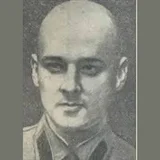
Iosif Rudakovsky
Iosif Rudakovsky came out of Voronezh with an engineering degree and a chessboard, and he had about a decade of serious chess before tuberculosis took him at thirty-two. In that decade he beat Paul Keres from the bottom of the table, shared first place in a Soviet Championship semi-final with Alexander Kotov, and in the summer of 1945 put together the best month of his life against the strongest field his country could assemble. A single identified 1940 portrait survives in the Archiv Lemanczyk collection. The games tell the rest.
◈The engineer from Voronezh
He was born in Voronezh on 24 December 1914 and won the city championship there as a teenager, in 1932. Chess was never his living: he went through the Voronezh Engineering and Construction Institute and worked as a civil engineer, and the tournaments were fitted around that. By nineteen he was already in the RSFSR Championship cycle, taking 6½/9 and a share of third in the Voronezh semi-final of 1934, then 4½/9 in a preliminary group in Moscow.
January 1936 brought him back to Moscow for the final of the fourth Trade Unions Championship, where he made 10/18 for eighth place and left behind the earliest games that survive under his name — a Nimzo-Indian win over Evgeny Zagoriansky among them. Results in the all-Union first-category tournaments at Rostov-on-Don in 1937 and Gorky in 1938 earned him candidate-master rank; in 1937 he won both the Voronezh city title and the Voronezh region title. In 1939, back at Rostov-on-Don, he won his group of the all-Union candidate masters' tournament with 9½/13 and was made a Master of Sport of the USSR. He was twenty-four.
◈Twentieth of twenty
1940 gave him his breakthrough and his humbling in the same year. He came through the Kiev semi-final with 9½/16 and a share of fourth to seventh, enough to qualify; in the same city he took third–fourth in the 12th Ukrainian SSR Championship with 10½/17. Then came the 12th USSR Championship in Moscow, 5 September to 3 October — twenty players, with Lilienthal, Bondarevsky, Smyslov, Keres, Boleslavsky and Botvinnik all in the field. Rudakovsky scored 5½ from 19 and finished last.
In round thirteen, on 21 September, he beat Paul Keres. Keres would finish fourth. Rudakovsky, Black in a Queen's Gambit Declined, answered him with nothing more exotic than accurate defence, took the d4 pawn on move nineteen, and then refused to let go for another fifty-nine moves — the game ends with his king walking in to capture the last white bishop on move 78. It remains the longest game in his archive and, on paper, the largest scalp of his career.
◈The interrupted years
In June 1941 he was at Rostov-on-Don, two points from three games in the fourth group of the 13th USSR Championship semi-final, when the tournament stopped: Germany had invaded. Russian-language accounts of his life record that he came out of the war with the rank of major. Chess did not disappear altogether — he won the Krasnodar Krai championship in 1944 and again in 1945 — but the years that should have been his strongest as a player went elsewhere. He was twenty-six when the semi-final was abandoned and thirty when the next one began.
◈Moscow, June 1945
In March 1945 he travelled to Baku for a semi-final of the 14th USSR Championship and finished level on 10½/15 with Alexander Kotov and Alexander Konstantinopolsky, the three of them sharing first place. It was the best result of his life, and it put him into the final.
That final ran in Moscow from 1 June to 3 July, eighteen players, the first Soviet Championship held after the fighting in Europe stopped. Botvinnik won it with 15/17. Rudakovsky finished on 9 points, tied seventh to ninth with Andor Lilienthal and Vyacheslav Ragozin — and he had beaten both of the men he tied with, along with Kotov, Konstantinopolsky, Alexander Tolush and Ilya Kan. Seven of the sixteen games in this archive come from those seventeen rounds, and they are not quiet ones: the win over Kotov is a Meran in which he tears open the black king with a knight on h6 and a pawn to g6. That September he was named a reserve for the Soviet team in the USSR–USA radio match of 1–4 September, the celebrated first meeting of the two chess countries after the war.
◈The game the world remembers
The most widely reproduced game of Rudakovsky's life is one he lost, in that same 1945 championship, to Vasily Smyslov. He had the Black side of a Scheveningen Sicilian — his own defence, the one he had used in Kiev five years earlier to survive a queen sacrifice from Konstantinopolsky and win a fifty-six-move endgame. Against Smyslov it went the other way. On move eleven he recaptured with 11...e5, gaining a tempo on the bishop and conceding the d5 square for good.
Smyslov stepped the bishop back, played 13.f5 to clamp the light squares, traded off Black's light-squared bishop with 14.Bxc4, removed the knight that guarded d5 with 16.Bxf6, and on move seventeen installed a knight on d5 that was never going to leave. Rudakovsky was left with a bishop that had nothing to bite on and a hole he could not fill; it was finished on move 28. The game became a standard classroom illustration of the good knight against the bad bishop, and coaches have been showing it ever since. For most people who know Rudakovsky's name at all, this is why.
◈From the archive
◈Legacy
After the war he lived for a time in Yeysk, then moved west to Chernivtsi — a city that had been Romanian Cernăuți until 1940 and was only newly Soviet again — where he ran the chess club and won the city championship in 1946. He died there the following year, of tuberculosis, at thirty-two. His surviving record is spare: one identified portrait dated 1940, a reference-book entry a few lines long, a scatter of city and regional titles, one famous defeat that outlived him, and sixteen wins — among them Keres, Kotov, Lilienthal, Ragozin, Konstantinopolsky and Tolush. For a master who was never given the time to become anything more, that is not a small record.