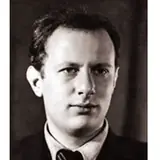
Isaac Boleslavsky never won the world title, and he never seemed to want the attention that came with it. Yet few players have changed so deeply how the game is played. While the champions fought it out in public, this gentle, bookish man from the banks of the Dnieper sat with his board and his library and quietly rewrote the rules of the opening: he taught the Sicilian to push its e-pawn into the center and accept a weakness no master before him had dared to, and he helped turn the King's Indian from a dubious experiment into one of the great defenses of modern chess. He came within a single playoff of a world title match, then spent his best years helping other players chase the title instead.
A boy from the Dnieper
He was born in 1919 in Zolotonosha, a small town in the Ukrainian SSR, to a Jewish family, and he came to chess the way he would come to everything — through reading. He taught himself the moves at nine, and the books did the rest. By 1933 he was schoolboy champion of Dnipropetrovsk; in 1936 he took third prize in the All-Union Junior Championship at Leningrad; and in 1938, still only nineteen, he won the championship of Ukraine.
David Bronstein watched that tournament in Kiev from the audience, and in The Sorcerer's Apprentice he remembered the sensation the young student from Dnepropetrovsk created there. Boleslavsky won the Ukrainian title twice more; Bronstein played in the next championship himself, and the two became friends who, he wrote, "did not keep any secrets from each other in the openings."
The next year he qualified for the USSR Championship, the strongest national tournament in the world, and in the 1940 final he tied for fifth and sixth with Mikhail Botvinnik himself. In the spring of 1941 he was one of the six players in the match-tournament for the title of Absolute USSR Champion, and finished fourth with 9 points out of 20, behind Botvinnik, Paul Keres and Vasily Smyslov. In barely five years, a self-taught provincial player had reached the front rank of Soviet chess.
The quiet revolution
Boleslavsky is remembered for an idea more than a trophy. In the Sicilian Defense he recommended meeting White's centralized knight with ...e5, putting Black's own pawn in the center at the cost of a backward pawn on d6 and a permanent hole on d5. For generations such concessions had been considered simply bad. Boleslavsky showed that what Black got in return, active pieces, open lines and the initiative, was worth far more than the static weakness. The structure became known as the Boleslavsky Variation, and the d5 square it gives up is still called the Boleslavsky hole; the analyst Hans Kmoch named a related pawn formation the Boleslavsky Wall in his classic Pawn Power in Chess. At Zürich 1953, Bronstein noted in his tournament book, the former world champion Max Euwe played "the Boleslavsky Variation against its inventor."
Bronstein recalled that before one USSR Championship game against Lev Aronin, Boleslavsky told him that he would bring out his bishop in the old Italian style, how he would push his pawns forward and on which square he would sacrifice a knight, "and this is exactly what happened." In My Great Predecessors Garry Kasparov calls Boleslavsky–Aronin from the 1949 championship a well-known game, which the young Bobby Fischer followed in 1957.
He did the same service for the King's Indian Defence. Together with his fellow Ukrainians David Bronstein, Efim Geller and Alexander Konstantinopolsky, Boleslavsky took a defence that respectable opinion held to be unsound and turned it into one of the most popular and combative answers to 1.d4 in the game. Kasparov calls Bronstein and Boleslavsky "the acknowledged leaders of this bold opening," and when Botvinnik was unhappy with the young Kasparov's openings in 1975, he told him to collect the best King's Indian games of Bronstein, Boleslavsky, Geller, Petrosian, Gligorić and Stein. Lev Polugaevsky, no easy man to impress, wrote that any player — even the very strongest — could and should learn from Boleslavsky's games, especially his Sicilians, praising his virtuoso feeling for the dynamics of the opening.
“‘Like us when we are Black,’ the chess pieces ask, ‘when we are White everyone likes us!’”
“I played the move which met the needs of the position.”
“A picturesque position. Black is helpless, despite the fact that he is two exchanges to the good. The knight at a5 is a passive witness to the destruction of its army.”
“Fischer sat down at the board almost straight from the plane and was literally knocked out.”
“I am convinced that any player, even the very strongest, can and should learn from his games — especially the Sicilians!”
“Boleslavsky was a man of exceptional modesty and great culture. If it is difficult to imagine Boleslavsky without chess, it is simply impossible to imagine him without books.”
“The tournament hall was overcrowded with spectators who followed with great interest the very lovely style of this young candidate master. He played with fantastic speed and was winning almost every game.”
“Such melding of logic and combinative powers is the hallmark of Boleslavsky.”
Close to a title match
His own assault on the title peaked in a single, cruel cycle. In 1945 he finished second in the 14th USSR Championship and was awarded the Soviet Grandmaster title; that same year, in the famous USSR–USA radio match, he beat the great American Reuben Fine 1½–½ on board three. In 1947 he was runner-up in the national championship again, yet he was left out of the 1948 match-tournament for the vacant world title. "Isaak never complained to me," Bronstein is quoted in Kasparov's My Great Predecessors. When FIDE handed out its first International Grandmaster titles in 1950, Boleslavsky's name was among them.
Then came the 1950 Candidates Tournament in Budapest — the event that would decide Botvinnik's first post-war challenger. Boleslavsky was the only player to go through it undefeated, and with two rounds left he led Bronstein by a point. Bronstein won both of his last games, the second against Keres, and caught him on 12 points out of 18. In The Sorcerer's Apprentice Bronstein gave his own account of the finish. Boleslavsky, who had lost seven games to Botvinnik without winning one, believed a fight against the champion was hopeless, and after a talk with the federation chief Boris Vainstein he slowed down to let Bronstein tie; Vainstein meant to arrange a three-man tournament for the title with Botvinnik. It never came about, and the two friends met in a playoff in Moscow instead.
After twelve games the score was 6–6. In the fourteenth Boleslavsky repeated a two-pawn sacrifice from the twelfth, and Bronstein had found a refutation at home; he won the match by a single point, +3 −2 =9, and went on to draw his title match with Botvinnik. Years later Bronstein wrote that in winning he had most likely saved his friend "from a certain defeat, possibly even humiliation." It was the closest Boleslavsky would ever come. At Zürich 1953, the next Candidates, he scored 13½ out of 28 and shared tenth and eleventh places with Yuri Averbakh among fifteen players.
The man behind the champions
What he did next defined him as much as his own games. The very rival who had denied him in Budapest, David Bronstein, married Boleslavsky's daughter Tatiana — and Boleslavsky worked on Bronstein's team in the 1951 World Championship match against Botvinnik, which Bronstein drew 12–12. Kasparov names Alexander Konstantinopolsky as the official second, with Boleslavsky and Semyon Furman as helpers. The Dynamo sports society chose them, and Bronstein later complained: "Individually they were good analysts, but together they could not even agree with what to begin the analysis!" Having moved to Minsk in 1951, he became a fixture of Belarusian chess, winning the republic's championship and representing the USSR at the 1952 Helsinki Olympiad, where he scored seven points from eight games. At the 1962 Varna Olympiad he was one of the Soviet team's trainers, and Tal remembered how he, Boleslavsky and Spassky set up Botvinnik's adjourned game against Fischer in their room and analysed it "for almost the whole of the night."
From 1963 to 1969 he was the trusted assistant of Tigran Petrosian, helping prepare the openings that carried Iron Tigran to the world title against Botvinnik and to its defence against Spassky. Kasparov counts "the Petrosian-Boleslavsky tandem" among the rare trainer partnerships that were both fruitful and long. In both title matches with Spassky, Boleslavsky was Petrosian's second and Igor Bondarevsky was Spassky's; in 1966 the two seconds named Petrosian's win in the tenth game the best game of the match, and after 1969 they wrote a book on the match that Kasparov received as a present in his childhood. Boleslavsky also trained Lev Polugaevsky, who remembered how he and "my trainer, grandmaster Boleslavsky" prepared for a Sicilian against Fischer at Palma de Mallorca in 1970, only to find Fischer opening with 1 c4. In the summer of 1971 he joined a training session on Fischer's games whose 26-page report was handed to Petrosian and Spassky. In 1968 he captained the Soviet students' team to the world championship. The man who came one game short of a title shot of his own spent his prime making world champions of others — and did it without a trace of bitterness.
Books and the board
Those who knew him remembered the character before the chess. "Boleslavsky was a man of exceptional modesty and great culture," wrote the grandmaster Alexey Suetin. "If it is difficult to imagine Boleslavsky without chess, it is simply impossible to imagine him without books." He knew history, classical literature and poetry, and he poured the same scholarly patience into the chessboard that he poured into a library shelf.
It made him one of the most respected analysts and opening theorists of his time, a writer and teacher whose authority came from the depth and honesty of his work, not from titles. He was a real chess scholar, who studied the game less to beat people than to understand it. Kasparov recalls that in the 1970s his trainer Alexander Shakarov found "holes" in Boleslavsky's popular opening analyses at a time when "everyone believed the books."
He could also calculate. Writing about Zürich 1953, Bronstein ranked him with Samuel Reshevsky, Efim Geller and Mark Taimanov as the best calculating players in the world at that time. In tournaments, Bronstein wrote in The Sorcerer's Apprentice, the two friends always tried to use their fantasy; their technical chess they kept for time trouble and for "thousands and thousands of blitz games which we played for our own pleasure."
Legacy
Boleslavsky died in Minsk on February 15, 1977, aged fifty-seven, after a fall on an icy street broke his hip and a hospital infection followed. He left a body of theory still debated at the highest level: every "Boleslavsky Variation" and "Boleslavsky Wall" in a modern openings book carries his name into games he never saw. He was, to the end, what Suetin called him, a man impossible to imagine without his books, and the English edition of his Selected Games was named the British Chess Federation's book of the year in 1990. He never got a title match, but his ideas about the opening are still the ones players use.
Books
Books Isaac Boleslavsky wrote, co-wrote, edited, or contributed to. Translations and reprints are grouped under the same work.
-
Isaac Boleslavsky: Selected Games
Contributor — own game annotations; later English collection edited by Jimmy Adams
-
Руководство по шахматам
Coauthor — Isaac Boleslavsky, Vladimir Alatortsev, Yakov Rokhlin
-
Актуальные проблемы сицилианской зашиты
Author
-
Актуальные проблемы системы с развитием слона на g2 в староиндийской защите
Author
-
Индийская защита
Author
-
Петросян — Спасский, 1969
Coauthor — Isaac Boleslavsky, Igor Bondarevsky