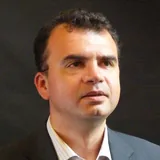
Ivan Sokolov learned chess from his father in Bosnia at the age of six, became a grandmaster in 1987 and won the Yugoslav Championship in 1988. During the war in Bosnia he settled in the Netherlands, where he won the Dutch Championship in 1995 and 1998. He played 12 Olympiads for Yugoslavia, Bosnia and Herzegovina and the Netherlands, winning team silver with Bosnia at Moscow in 1994, and at Wijk aan Zee in 1999 he beat the World Champion Garry Kasparov. His rating peaked at 2706 in January 2004, 16th in the world. He has written books on pawn structure and the middlegame, and since 2013 he has coached for the federations of the United Arab Emirates, Iran, Uzbekistan and Romania; the Uzbek team he coached won the 2022 Olympiad in Chennai.
Jajce and Sarajevo
Sokolov was born on 13 June 1968 in Jajce, in Bosnia and Herzegovina, then part of Yugoslavia; some sources, among them the Russian Chess Federation, give Sarajevo. "I started to play chess in 1974 when I was six years old," he told ChessBase in 2015. "I learnt the game from my father who was an amateur chess player." He joined the Bosna club in Sarajevo and stayed a member for almost thirty years.
He became a FIDE Master in January 1985 and an International Master in 1986. He was studying law when he received the grandmaster title at the Karpov–Kasparov match in Seville in 1987, at 19, and he then gave up his studies to play full time. In 1987 and 1988 he worked with Dragoljub Velimirović, who he said was the only person to work with him on pawn structure when he was young: "I learnt from him the art of true sacrifice."
In 1987 he shared first place at the Vidmar Memorial. In 1988 he won the Biel tournament with 7/11 and the Yugoslav Championship with 12/17, half a point ahead of Stefan Djurić, and made his Olympiad debut for Yugoslavia at Thessaloniki. A year later he played first board for Yugoslavia at the European Team Championship in Haifa, where the team won silver.
Bosnia and the Netherlands
When Yugoslavia broke up, Sokolov played for Bosnia and Herzegovina. At the Manila Olympiad in June 1992 he scored 9/14 on second board for the new team, and at Moscow in 1994 he scored 8/14 on the same board as Bosnia won the silver medals. He played for Bosnia at every Olympiad through Istanbul 2000.
Leaving home was "more or less a forced decision", he said in 2015. "We had war at that time in Yugoslavia and Bosnia in particular. Then I travelled around the world and finally moved into Netherlands." Accounts date his settling there between 1992 and 1995. He first played the Dutch Championship in 1994, sharing fourth and fifth places, and won it in 1995 with 9½/11. In 1996 he tied for first and lost the playoff to Jan Timman, 1½–2½, and in 1998 he won again with 9/11, a point ahead of Timman. According to the Max Euwe Centrum, the two friends and rivals drank white wine together after each round of that championship, and Sokolov later began importing wine alongside his chess.
Timman appointed him as his second for some of his matches, and wrote that before his 1998 match with Kasparov in Prague he "prepared thoroughly with Ivan Sokolov and Ulf Andersson". Sokolov moved to the Dutch federation in April 2002 and played second board for the Netherlands at the Bled Olympiad that year, scoring 8/12.
“Hang on, when is the next time that I will have such a position against Kasparov from which I can demolish him in just one move! Perhaps never!”
“Maybe discipline. I was never ready to sacrifice my life for chess. I wanted to do everything else and also excel at chess.”
“I cannot see how you can make a beautiful window in your house when your house fundament is going to collapse.”
“What is my influence in percentage points? I don't know. But I know one thing: my successes with Salem, with Iran, and now with Uzbekistan are not a coincidence. This is what I do know.”
“In my game with the ‘new Dutchman’ Ivan Sokolov I suffered a temporary fogging of the mind, a kind of ‘short circuit’.”
“He is an extremely creative and dynamic player, always willing to sacrifice material for the initiative. As a result, he creates many beautiful games, but also suffers the occasional disaster.”
“Of all the strong grandmasters who never made it into the top 10, he might be one of the most successful.”
“Together with Predrag Nikolic, Sergei Tiviakov and Roberto Cifuentes, Ivan Sokolov gave a boost to Dutch chess at the end of the previous century.”
Wijk aan Zee 1999
Sokolov's best results at Wijk aan Zee came in 1997, when he shared second place with 8/13, and in 1999. In the ninth round of the 1999 Hoogovens tournament, on 26 January, he had White against Kasparov, who was leading the field. Kasparov later wrote that he avoided his Grünfeld Defense because Sokolov would have prepared it with Timman, and that Sokolov played the critical forcing line "very confidently, although he was probably counting only on a draw".
After Kasparov's 25...Kh7, Sokolov saw that tripling on the g-file would force mate. Kasparov, he recalled, "had his Rolex back on his hand, his chocolate was taken away from the board, his jacket was on". With 40 minutes left on his clock, Sokolov spent ten of them before playing 28.Qg2, and Kasparov resigned. Kasparov called it "A terrible rout!" He still won the tournament with 10/13, half a point ahead of Viswanathan Anand, while Sokolov shared fourth to seventh places on 7 points. Kasparov had his revenge at Sarajevo later that year, where he "outplayed Ivan Sokolov in a very tense struggle".
Tournaments and teams
Between the mid-1990s and the late 2000s Sokolov won tournaments across Europe, among them Malmö in 1995 with 6½/9, Hastings 1998/99 with 7/9, two points clear of the field, and the Bosna tournament in Sarajevo in 2003, where he was clear first. In 2000 at Neum he became the first European Rapid Champion. ChessBase wrote in 2003 that "No matter what flag is on his table the 34-year-old Sokolov has become one of the top pros. He'll play anywhere, anytime".
The January 2004 rating list, his highest at 2706, ranked him 16th in the world, and that month at Wijk aan Zee he beat the Classical World Champion Vladimir Kramnik. He won the Essent tournament in Hoogeveen in 2004, when he beat the 13-year-old Magnus Carlsen, and again in 2008 with 5/6, and he won the Staunton Memorial in London in 2006 with 9/11. Chess.com counted five world champions among the players he beat in classical games: Kasparov, Kramnik, Anand, Veselin Topalov and the young Carlsen.
With the Netherlands he won the European Team Championship at Gothenburg in 2005, scoring 5/8 on second board, and at Warsaw in 2013 he won the individual gold medal on second board with 6½/7. He played first board for Bosnia again at the 2010 Olympiad in Khanty-Mansiysk, scoring 6/8, and third board for the Netherlands at Istanbul in 2012. In all he played 12 Olympiads between 1988 and 2012, missing only Dresden 2008, and scored 74/130.
In the world championship cycle he finished 15th at the 1993 Biel Interzonal and 11th in the PCA qualifier at Groningen the same year. In FIDE's knockout championships he lost to Vladimir Epishin in 1997, Alexei Shirov in 1999 and Andrei Kharlov in 2004, and at the 2005 World Cup he went out in the third round to Vladimir Malakhov.
The author
Sokolov's first books were Nimzo-Indian Defence: Classical Variation (1995) and Sokolov's Best Games (1997), the second with game introductions by John Nunn. Later came Winning Chess Middlegames (2009), The Ruy Lopez Revisited (2009), The Strategic Nimzo-Indian (2012), Sacrifice and Initiative in Chess (2013), the three volumes of Chess Middlegame Strategies (2017–2019), The Chigorin Bible (2019, with Iván Salgado López) and Magnus Carlsen's Middlegame Evolution (2021).
His teaching starts from pawn structure. "If you are looking at the position as a professional or a GM, the first thing we use to assess the position is through pawn structures," he said in 2015. As a player he called himself "a 1.d4 and 1...e5 player". Timman described him as "a great admirer of Spassky's play", and the authors of The Mammoth Book of the World's Greatest Chess Games name him as one of the main pioneers of the aggressive gambit response to the Moscow Variation of the Semi-Slav.
Coach and captain
Sokolov has earned his living as a trainer since 2008, first with young grandmasters from the former Yugoslavia and later with Baskaran Adhiban of India and Salem Saleh of the United Arab Emirates. In June 2013 the UAE federation offered him a full-time post. He was still undecided at the end of August, when he finished 16th–30th at the Vienna Open with about 100 euros in prize money and an airline then paid him 250 euros to wait for a later flight: "So I took this money, ordered a bottle of wine, and analyzed the situation. And having analyzed it, I picked up the phone, called Dubai and asked if their offer was still on the table."
He worked in the UAE until the summer of 2016, mostly with Saleh, who soon became Asian champion, and coached the UAE team at the 2014 Olympiad in Tromsø. About six weeks before the 2016 Olympiad in Baku he began coaching the Iranian team, and he stayed through the 2019 World Team Championship, working with young players including Alireza Firouzja, Parham Maghsoodloo and Amin Tabatabaei. Iran shared 11th place at Baku and won the 2018 Asian Nations Cup.
In May 2022 the Uzbekistan Chess Federation approached him at the Sharjah Masters. That August the Uzbek team, led by Nodirbek Abdusattorov, won the Olympiad in Chennai, and the President of Uzbekistan made Sokolov an Honored Sports Coach. He has been national coach of the Romanian Chess Federation since January 2023. He was a vice-president of the European Chess Union from 2018 to 2022, and FIDE made him a Senior Trainer in 2015.
Legacy
Sokolov won the national championships of Yugoslavia and the Netherlands, played 12 Olympiads under three flags and beat five world champions in classical games. Since stepping back from regular play he has passed on his approach to pawn structure and sacrifice in his books and as a coach to national teams from the United Arab Emirates and Iran to Uzbekistan and Romania.
Books
Books Ivan Sokolov wrote, co-wrote, edited, or contributed to. Translations and reprints are grouped under the same work.
-
Nimzo-Indian Defence: Classical Variation
Author
-
Sokolov's Best Games
Author
-
Winning Chess Middlegames: An Essential Guide to Pawn Structures
Author
-
The Ruy Lopez Revisited: Offbeat Weapons & Unexplored Resources
Author
-
The Strategic Nimzo-Indian: A Complete Guide to the Rubinstein Variation
Author
-
Sacrifice and Initiative in Chess: Seize the Moment to Get the Advantage
Author
-
Ivan's Chess Journey: Games and Stories
Author
-
Chess Middlegame Strategies, Volume 1
Author
-
Chess Middlegame Strategies, Volume 2: Opening Meets Middlegame
Author
-
Chess Middlegame Strategies, Volume 3: Strategy Meets Dynamics
Author
-
The Chigorin Bible: A Classic Defence to the Ruy Lopez
Coauthor — Iván Salgado López
-
Magnus Carlsen's Middlegame Evolution
Author
-
Winning Chess Middlegames, Volume 2: An Essential Guide to 1.e4 Pawn Structures
Author