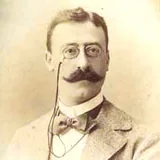
Jacques Mieses played master chess for sixty years, from Nuremberg and Leipzig in 1888 to Hastings after the Second World War. He was an attacking player in the romantic style at a time when positional chess was taking over, and his gambits and king hunts won him more than a dozen brilliancy prizes, one of them at the age of eighty. His best result was first place at Vienna in 1907, ahead of Duras, Maróczy and Schlechter. He organized the San Sebastián tournament of 1911, where Capablanca won his first international event, and he wrote and edited chess books for most of his life. In 1938, at seventy-three, he left Nazi Germany for England, and in 1950 FIDE made him one of its first grandmasters, the first British player to hold the title.
Leipzig
Mieses was born Jacob Mieses in Leipzig on 27 February 1865, into a Jewish merchant family whose roots were in Brody, then part of Austria-Hungary. Chess ran in the family. His uncle Samuel Mieses, a physician, had learned the game from Adolf Anderssen and was a player of master strength, and his cousin Viktor composed chess problems.
He attended the Thomasschule in Leipzig and studied natural sciences at the universities of Leipzig and Berlin. His early interest was in chess problems: he composed them, and his BCM obituary called him a phenomenal solver. He won his first club tournament at seventeen, but his tournament career began in earnest only at twenty-three.
An attacking master
In 1888 he tied for second place with Curt von Bardeleben and Hermann von Gottschall behind Siegbert Tarrasch at Nuremberg, and later that year he finished third in the jubilee tournament of the Augustea society in Leipzig, where he beat Tarrasch in the first round. In 1889 he was third at Breslau, behind Tarrasch and Amos Burn. The young Emanuel Lasker then beat him heavily in a match at Leipzig in 1889–90, and Lasker and Tarrasch soon left him behind.
Mieses's repertoire favoured the older attacking openings. He opened 1.e4 almost exclusively and went on playing the Vienna Game, the Center Game, the Scotch and the Danish Gambit long after other masters had given them up; with Black he often chose the Scandinavian Defense and did much to develop its theory. The style brought him many brilliancy prizes and many short defeats, and his results went up and down.
His writing gives a more measured picture of his attitude to positional chess. In the joint preface to Lehrbuch des Schachspiels (1894), he and Curt von Bardeleben recommended gradual improvement of the position and warned against dubious attacks and uncertain sacrifices. His ideas also reached other masters: Kasparov quotes Capablanca recalling that he borrowed Mieses's 9...Ne4 from games against Rubinstein for the last game of his 1909 match with Marshall.
At Hastings 1895 he finished near the bottom of a field of twenty-two, but he played one line of the Scotch Game there four times, and it has carried his name since. After his draw with Wilhelm Steinitz in that tournament, the former World Champion congratulated him on the quality of his play, a compliment Mieses still recalled with pride almost fifty years later.
“I have always been an erratic player, even when I was at my best. At that time, when Marshall and myself entered a tournament, the general opinion was that we could as well finish at the top as at the tail of it.”
“Lasker's style is clear water, but with a drop of poison which is clouding it. Capablanca's style is perhaps still clearer, but it lacks that drop of poison.”
“Like Marshall, if he is only allowed to obtain the kind of position where imagination and courage are required, he is invariably successful.”
“His name will always be remembered with respect and affection. This is in large part due to the debonair attacking style of his play; he simply won a great number of beautiful games.”
“I liked Mieses’ ninth move 9 ... Ne4, and I decided to play it against Marshall, whom I hoped had not seen the games.”
Vienna and Ostend, 1907
His best year was 1907. At the first Trebitsch Memorial in Vienna he took first place with 10 points from 13 games, ahead of Oldřich Duras, Géza Maróczy, Savielly Tartakower, Milan Vidmar and Carl Schlechter. In the 28-round masters' tournament at Ostend that summer he shared third place with Aron Nimzowitsch, half a point behind the joint winners Ossip Bernstein and Akiba Rubinstein. A few months later, at Carlsbad, he finished in a tie for sixteenth place.
He played 25 matches, most of them short, and won six. One was a blindfold match against Schlechter in 1909, which he won with two wins and a draw, the year before Schlechter drew his world championship match with Lasker. Against the strongest players he usually lost: to Lasker, to Tarrasch in 1916, to Rubinstein, Frank Marshall, Richard Teichmann and Rudolf Spielmann. He drew matches with Carl Walbrodt in 1894 and Dawid Janowski in 1895.
Organizer and writer
Mieses also made his living as a journalist, columnist and organizer. For the San Sebastián tournament of 1911 he insisted that the masters' travel and living expenses be paid, and the practice became normal afterward. It was the first international tournament of José Raúl Capablanca, who won it.
He revised several editions of Jean Dufresne's Lehrbuch des Schachspiels, published a supplement to the eighth edition of Bilguer's Handbuch in 1921, and wrote more than forty books and booklets. In England his Instructive Positions from Master Chess, The Chess Pilot and Manual of the End Game stayed popular for years. Wolfgang Heidenfeld noted that the wit Mieses showed in person did not carry over into his writing, which was dry and sober.
The 1894 Lehrbuch des Schachspiels records how he and Bardeleben worked together. Veit & Comp. had commissioned a revision of von der Lasa's Leitfaden, but the authors decided that the task required a new book. Their preface assigns the opening theory, a small share of the illustrative games and the appendix to Bardeleben, and the rest to Mieses. In his chapter on chess problems, Mieses acknowledged that beginners could let imagination displace sound positional judgment. Yet he preferred too much combinational imagination to too little, trusting experience to correct the excess; he also valued composition for its beauty, independently of its usefulness in practical play.
He kept playing. In 1923 he won the Northern Counties tournament at Liverpool with 8 points from 9, ahead of Maróczy, Frederick Yates and Sir George Thomas, and in 1927, at sixty-two, he played for Germany at the first Chess Olympiad in London.
At Paris in 1930 he beat the young Andor Lilienthal in sixteen moves. Kasparov recounts that Lilienthal credited this defeat with prompting him to study opening theory and the French Defence.
Exile in England
In 1937, during the tournament at Kemeri in Latvia, he was badly hurt in a bus accident and was left lame in one leg; asked about it later, he said, "It was my turn to move." As a Jew he had been shut out of German chess under the Nazis, and in 1938, at seventy-three, he left Leipzig for England. D. J. Morgan, who visited him soon after he arrived, wrote that he had brought "little with him except his wonderful chess endowments."
English players took him in. In 1942, at seventy-seven, he played a ten-game match with Vera Menchik, the Women's World Champion, and lost it by four wins to one with five draws. In March 1945, to mark his eightieth birthday, friends and admirers gathered at the Lud-Eagle Chess Club in London and presented him with a gift of money raised by its members.
At the Hastings Christmas Congress of 1945/46, fifty years after Hastings 1895, he won the brilliancy prize for his game against Martin Christoffel and drew a 108-move game of seven and a half hours against Prins, defending rook against rook and bishop. He became a naturalized British citizen on 7 June 1947. In 1949, at eighty-four, he gave simultaneous displays across the Netherlands, Belgium and Luxembourg, and in The Hague he beat the 86-year-old Dirk van Foreest in a game arranged by the Royal Dutch Chess Association. He announced the result with the words "Youth has triumphed."
When FIDE awarded the grandmaster title for the first time in 1950, Mieses, at eighty-five, was the oldest of the 27 players to receive it, and as a British citizen he became the first British grandmaster. FIDE made him an International Arbiter the following year.
Legacy
Mieses died in a London nursing home on 23 February 1954, four days before his eighty-ninth birthday, and was buried in the East Ham Jewish Cemetery. He had kept up his daily swim until a few days before his death. His BCM obituary called him the last surviving link with the era of Zukertort, Charousek and Chigorin, and expected his prize-winning finishes against Janowski, Reggio, Znosko-Borovsky and Schlechter to remain favorites of the anthologists. His name is still attached to the openings he played: 1.d3 is the Mieses Opening, and there are Mieses Variations of the Vienna Game (3.g3) and the Scotch Game (5.Nxc6 bxc6 6.e5).
Books
Books Jacques Mieses wrote, co-wrote, edited, or contributed to. Translations and reprints are grouped under the same work.
-
Handbuch des Schachspiels, eighth edition
Contributor — opening theory
-
Das Buch der Schachmeisterpartien
Coauthor — Jean Dufresne
-
Das Blindspielen
Author
-
Das Damengambit
Author
-
Das Endspiel in der modernen Meisterpraxis / Chess Endings from Modern Master-Play
Author
-
Das nordische Gambit
Author
-
Der fünfte Kongress des Deutschen Schachbundes, Frankfurt 1887
Coauthor — Curt von Bardeleben and Hermann von Gottschall
-
Der Schachlotse / The Chess Pilot
Author
-
Der siebente Kongress des Deutschen Schachbundes, Dresden 1892
Coeditor — Paul Schellenberg, Johannes Metger and Paul Lipke
-
Die französische Partie
Author
-
Die skandinavische Partie
Author
-
Die Weltmeisterschaft im Schach
Author
-
Fünfzehn ausgewählte Partien des Schachmeisterturniers in Kaschau
Author
-
Hundert lehrreiche Stellungen aus Schachmeisterpartien / Instructive Positions from Master Chess
Author
-
II. Internationales Schachturnier zu San Sebastian 1912
Coauthor — Moritz Lewitt
-
Kurze Anleitung zur Erlernung des Schachspiels
Author
-
Lehrbuch des Schachspiels (Dufresne–Mieses)
Editor and reviser — Jean Dufresne’s textbook
-
Lehrbuch des Schachspiels für Anfänger und fortgeschrittene Spieler
Author
-
Lehrbuch des Schachspiels: Auf Grund des gegenwärtigen Standes der Theorie und Praxis
Coauthor — Curt von Bardeleben
-
Lehrreiche Blumenlese aus Schachmeisterpartien
Author
-
Moderne Endspielstudien
Author
-
Praktisches Lehrbuch des Schachspiels
Author
-
Schach / Schack
Author
-
Taschenbuch des Endspiels / Manual of the End-Game
Author
-
Internationales Schachturnier zu San Sebastian 1911
Coauthor — Moritz Lewitt
-
Wie erlernt man schnell und leicht das Schachspiel? / Hoe leer ik vlug en gemakkelijk schaken
Author — Dutch adaptation with Lodewijk Prins