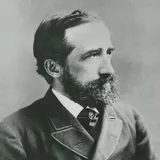
Johannes Zukertort made his living from chess: playing matches, giving blindfold displays and editing the games of his contemporaries. His victory at London 1883 brought him into direct rivalry with Wilhelm Steinitz, and in 1886 they contested the first official World Championship. Zukertort lost the match. Two years later he collapsed during a game in London and died in hospital the following morning.
From Breslau to London
Born in Lublin on 7 September 1842, Zukertort grew up in Breslau, now Wrocław. He enrolled in the university’s medical faculty in 1861, but chess became his profession. Adolf Anderssen was his teacher and regular opponent. In the Grosses Schach-Handbuch, written with Jean Dufresne, Zukertort credited one King’s Gambit novelty jointly to Anderssen and himself. He also claimed a defensive sacrifice in the Muzio Gambit, 16…d5, as his own. He said he first played it against Anderssen in July 1865, always with success, and that Anderssen agreed it broke the attack. Their 1871 match ended five wins to two in Zukertort’s favor, a result that established the pupil as a leading master.
Stories about Zukertort credited him with an extraordinary range of linguistic, military and musical accomplishments. Later historical research cast doubt on these tales. His documented chess work is substantial enough: playing, writing, editing and performing some of the period’s most demanding blindfold displays.
Chess and journalism
In Germany he edited the Neue Berliner Schachzeitung with Anderssen. The Grosses Schach-Handbuch, an undated 804-page manual published in Berlin around 1872, names Dufresne and Zukertort as its authors. The printer’s labels at the foot of each sheet name Dufresne for pages 1–384 and Zukertort for pages 385–804, so the second half of the book is his work. His half includes the King’s Gambit, the French, Sicilian and queen’s-pawn openings, the endgame and an appendix on the Evans Gambit. In it he cited his own analysis in the Neue Berliner Schachzeitung of 1868–69 to argue that Black’s 4…g4 in the King’s Knight’s Gambit was fully justified. He hoped the question mark that earlier handbooks gave the move would become an exclamation mark.
He moved to London in 1872 to earn his living as a chess professional. Jimmy Adams’s introduction to Johannes Zukertort: Artist of the Chessboard describes him playing for stakes at Simpson’s Divan, joining the London club scene and travelling to give simultaneous exhibitions.
His journalism linked those activities. He served as games editor of the Westminster Papers, contributed to the City of London Chess Magazine, and founded The Chess Monthly with Leopold Hoffer in 1879. Its pages became a forum for his disagreements with Steinitz. Away from print, his 1876 blindfold display of sixteen games produced eleven wins, four draws and one loss.
“Mr. Blackburne underrated, I think, the power of the coming attack.”
“Zukertort relied on combinations, and in that field he was a discoverer, a genius.”
London 1883
At London in 1883, fourteen players contested a double round-robin. Zukertort won twenty-two of his first twenty-three games before losing the last three. His final 22/26 was still three points ahead of Steinitz. Kasparov calls it the greatest success of his career: the result reopened the question of who was the world’s strongest player.
The first-round win over Blackburne became Zukertort’s Immortal. Its finish includes 28.Qb4 and 29.Rf8+, with resignation after 33.Qxe7. The annotations collected by Adams also preserve a dispute about the earlier 21.Re3: tournament organizer J.I. Minchin said Zukertort had foreseen the ensuing combination, while Steinitz challenged claims of a thirteen-move calculation. Steinitz thought the move’s strength against different replies, and the judgment behind it, deserved more credit than a story about one elaborate trap.
The first World Championship
The 1886 match was played in New York, St. Louis and New Orleans from 11 January to 29 March, with the title going to the first player to win ten games. After losing the opener, Zukertort won four straight games and left New York leading 4–1. The tournament winner of 1883 appeared close to confirming his claim in a match.
Steinitz recovered in St. Louis and took control in New Orleans. The twentieth game gave him his tenth win: the final score was ten wins to five, with five draws. In My Great Predecessors, Part I, Kasparov argues that Steinitz adapted to Zukertort’s play and gradually undermined his confidence.
The final years
Zukertort lost a return match to Blackburne in 1887. On 19 June 1888 he spent the afternoon at the British Chess Club, then went to Simpson’s Divan and fell ill while playing Sylvain Meyer. The contemporary Chess Monthly account records his transfer to Charing Cross Hospital and his death at about ten the next morning. He was forty-five. He was playing a casual game.
He was buried at Brompton Cemetery on 26 June 1888. Stuart Conquest rediscovered his neglected grave in 2011. Adams records how Conquest and Marek Stella-Sawicki of the Polish Heritage Society arranged a new headstone, dedicated on 26 June 2012.
Legacy
London 1883 and the Blackburne brilliancy give Zukertort a place in chess history beyond his defeat in the first championship match. His games joined Anderssen’s attacking tradition to the developing methods of positional play, and his work as an analyst and editor helped preserve the chess of his generation. The shorter Leitfaden des Schachspiels he wrote with Dufresne was still in print in 1897, when Oskar Cordel published a fifth edition, completely revised. The Zukertort Opening, 1.Nf3, still carries his name.
Books
Books Johannes Zukertort wrote, co-wrote, edited, or contributed to. Translations and reprints are grouped under the same work.
-
Grosses Schach-Handbuch
Coauthor — Jean Dufresne
-
Neuester Leitfaden des Schachspiels
Coauthor — Jean Dufresne
-
Sammlung der auserlesensten Schachaufgaben, Studien und Partiestellungen
Author