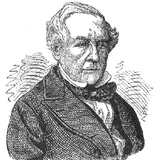
John Cochrane
He was a Scottish naval midshipman who became a Calcutta barrister, and in between he was, for a few years around 1820, arguably the most dangerous attacking player alive. John Cochrane beat the Turk, beat Deschapelles and La Bourdonnais in the Café de la Régence, wrote a treatise at twenty-four — and then sailed for India and spent the rest of his chess life playing the finest players in Bengal, thousands of miles from the tournaments that made reputations. The openings named after him are all sacrifices. So is the shape of his career.
◈The Navy, and a rumour about Napoleon
He was born on 4 February 1798 into a branch of the family of the Earls of Dundonald — his father the Honourable John Cochrane, his grandfather the 8th Earl — and grew up at Newhaven near Leith. He went into the Royal Navy as a midshipman and served on HMS Antelope; the story that has followed him ever since is that he was aboard HMS Bellerophon in 1815 when it carried Napoleon Bonaparte into British captivity. The claim is repeated in most accounts of his life and has never been firmly established.
The post-war Navy had no use for so many young officers. Cochrane left it, read for the Bar without going to university, was admitted to the Inner Temple in May 1819 and called to the Bar in June 1824.
◈Café de la Régence
Those five years between the Navy and the Bar are the years in which he was one of the best players in the world. In 1819 he played the Turk — the chess automaton — at odds of pawn and move over five games. In this archive is a win over the machine from 1820, thirty moves ending with a rook thrown onto c8 and the queen taking on c8 behind it.
Then Paris. At the Café de la Régence he faced Alexandre Deschapelles and Louis-Charles de La Bourdonnais, who between them were acknowledged as the strongest players in Europe. Both games in this archive are Cochrane's wins, and both are pure Cochrane: against Deschapelles in 1821 he gives a bishop on f7 at move six and finishes by promoting a pawn with check on move thirty-one; against La Bourdonnais in the same year he plays the King's Gambit line now named for him, walks his king to d3 on move ten to keep the attack alive, and hands over his queen — 16.Qf1 Bf5 17.Qxg2 Nf2+ — for a bind that wins the endgame outright.
In 1822, still only twenty-four, he published A Treatise on the Game of Chess, a substantial book of original analysis. He also played a leading part for London in the great London–Edinburgh correspondence match begun in 1824, before India took him away from it.
◈Calcutta
He went out to India as soon as he was called to the Bar, and he made his career there: a leading advocate of the Calcutta bar, later called its Father, arguing Indian appeals before the Privy Council and writing legal treatises — among them a Defence of the Daya Bhaga in 1872, on Hindu inheritance law. There is a story told of him that he gave an entire fee away to famine relief.
Chess in Calcutta meant the Chess Club, which he helped to found and of which he was president by 1848. It was not a provincial outpost: when the first international tournament was organised in London in 1851, the Calcutta Chess Club sent one of the largest donations of any subscriber, and Cochrane personally one of the largest individual contributions.
His one long leave home, from 1841 to 1843, produced the largest body of games he ever played against a European: roughly 120 on level terms with Howard Staunton, then the strongest player in the world. Staunton won about twice as many as he lost; at odds of pawn and move the two were level. Cochrane helped Staunton prepare for his second match with Saint-Amant, and beat Saint-Amant himself during the same stay. He also complained, with some justice, that Staunton under-reported his wins.
◈The Brahmin
In the autumn of 1848 a member of the Calcutta club heard of a Brahmin in a village outside the city who had never been beaten, went out to play him, and lost. Moheschunder Bannerjee was brought to Calcutta, Cochrane played him, and although Cochrane won that first encounter he was impressed enough to have the man engaged as a paid attaché of the club. It was the most consequential thing he ever did for chess.
For the next twelve years Cochrane had at last what he had spent his career looking for — an opponent worth the trouble. Two hundred and eighty-eight of the games in this archive are wins against Moheschunder, and Moheschunder's own archive here holds a hundred and twenty-seven going the other way; a second Indian player, Somacarana, accounts for another hundred and twenty-four Cochrane wins. Cochrane sent the games home, and from 1851 the Chess Player's Chronicle printed them, which is the only reason any of this survives.
He wrote of Moheschunder that he “possesses as great a natural talent for chess as any player he ever met with, without one single exception.” It was Cochrane who called the fianchetto systems his opponent kept playing the Indian defences — the name they still carry.
◈The gambits
Three things in chess are named after him and two of them give away a piece. The Cochrane Gambit against Petrov's Defence — 1.e4 e5 2.Nf3 Nf6 3.Nxe5 d6 4.Nxf7 — throws a knight at f7 on move four to drag the black king into the open; its first recorded outing was against Moheschunder in 1848. It is generally held to be unsound, which has never entirely stopped anyone: Veselin Topalov used it to draw with Vladimir Kramnik at Linares in 1999. The archive holds a Cochrane Gambit win over Moheschunder from 1850 that ends in mate on move twenty-nine, 29.Rc6#.
The Cochrane Variation of the Salvio Gambit is the King's Gambit line he used to beat La Bourdonnais. The third is the odd one out and much the most respectable: the Cochrane Defence is a drawing method in the rook-and-bishop against rook endgame, and it remains the technique top players reach for in that ending to this day.
George Walker, who watched him for decades, summed the whole thing up in 1844: “Mr Cochrane is the most brilliant player I have ever had the honour to look over or confront; not even excepting De la Bourdonnais; and pity it is that his very brilliancy so often mars success.”
◈Bryanston Street
He came home for good and lived at 12 Bryanston Street in Marylebone, still practising law part-time and still writing on it. The chess had shrunk to casual games of about a quarter of an hour, most often with Johann Löwenthal. He went deaf in his last years, which did nothing to quiet his running commentary on the games in front of him; he was remembered as excellent company and generous to young players.
He died on 2 March 1878, aged eighty, and was buried at Brompton Cemetery six days later. His estate came to under £200. La Stratégie, printing his obituary that month, called him the most brilliant player of the century.
“He possesses as great a natural talent for chess as any player he ever met with, without one single exception.”
“Mr Cochrane is the most brilliant player I have ever had the honour to look over or confront; not even excepting De la Bourdonnais; and pity it is that his very brilliancy so often mars success.”
“Mr Cochrane could have been the Philidor of the age; but would not.”
“The most brilliant player of the present century.”
◈From the archive
◈Legacy
Cochrane's own verdict on his career would probably have been that India cost him a reputation, and in narrow terms it did: he left Europe in the decade he might have contested the informal championship of the world, and the tournaments that made Staunton and Anderssen famous happened without him. What he got instead was Moheschunder Bannerjee. The fianchetto defences he met across a Calcutta board for twelve years, wrote up, named, and posted back to London are now the King's Indian, the Grünfeld, the Nimzo-Indian and the Queen's Indian — the backbone of modern chess with the black pieces. He is remembered for a gambit that sacrifices a knight on move four. He deserves to be remembered for a habit of publishing games he had lost.