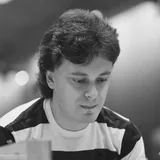
John Nunn went up to Oxford to read mathematics at fifteen, took a doctorate in algebraic topology and in 1981 left his lectureship to play chess for a living. He became a grandmaster in 1978 and British Champion in 1980, won the Hoogovens tournament at Wijk aan Zee three times, and at the 1984 Thessaloniki Olympiad scored 10/11 on board two for England. In January 1985 he was ninth in the world. He won the World Chess Solving Championship three times, wrote dozens of books, three of which won the British or English Chess Federation Book of the Year award, and in his late sixties won the World Senior Championship for players over sixty-five in 2022 and again in 2023.
Oxford at fifteen
Nunn was born in London on 25 April 1955. In Secrets of Grandmaster Chess (1997) he recalled learning the moves at four, when his father was trying to teach his elder brother David, and playing his first tournament at seven; in his whole life, he wrote, he had only twelve hours of lessons from a coach. In 1967, at twelve, he won the British under-14 championship, and at fourteen he was London under-18 champion for 1969–70. Less than a year later, at fifteen, he went up to Oriel College, Oxford, to read mathematics, the youngest Oxford undergraduate since Cardinal Wolsey in 1520.
He graduated with first-class honours in 1973 and stayed on to work for a doctorate. In the summer of 1976, with the thesis unfinished and his grant at an end, he took a post teaching mathematics at Maidstone Grammar School, where he stayed a year, and in 1977 he returned to Oxford as a junior research fellow at Oriel College. He completed the doctorate in 1978 with a thesis titled "Some Problems in Algebraic Topology", supervised by John Hubbuck. His Oxford post, in which he lectured in mathematics, was due to end in September 1981, and that year he left to become a professional chess player.
Grandmaster and British Champion
Nunn won the European Junior Championship at Groningen in 1974/75, which made him, at nineteen, the youngest international master in the world. Annotating a game of Alexander Kotov's for The Mammoth Book of the World's Greatest Chess Games, he recalled that he "gained the first part of my grandmaster title with a last-round draw against him in 1977." He completed the title at Budapest in 1978, where he needed to beat the lowest-rated player in the field with White in the last round, and won after being a pawn down in a worse position. In 1980 he tied for first in the British Championship at Brighton with William Hartston, and he took the title by winning their play-off match in February 1981, 3½–2½, with a single decisive game. In 1982 he shared first place at the Hoogovens tournament in Wijk aan Zee with Yuri Balashov, on 8½/13. Later that year, at Tilburg, he beat the former World Champion Tigran Petrosian in 20 moves.
Nunn played in three series of the BBC's The Master Game, in which the players' recorded thoughts were heard as the moves were shown. In the 1976–77 series he beat Tony Miles in the semi-final and lost the final to Hartston; in 1979 he drew with Vlastimil Hort and lost the replay, and in 1980 he drew all three of his group games. Thinking aloud against Helmut Pfleger, as printed in Jeremy James and William Hartston's The Master Game, Book Two (1981), he said he was "a bit suspicious of a move I arrive at by a process of elimination."
“If a strong grandmaster such as Portisch can overlook a mating pattern, then anybody can.”
“This combination had a profound effect on me. It suddenly seemed that chess was worth all the blunders and lost games, if only one could produce such a beautiful and profound combination.”
“If you play a game such as this, thinking of it will give you a warm glow for at least the next 25 years.”
“Using a modern-day Silicon Oracle is at the same time stimulating and humbling. Stimulating, because your every question can be answered in a few seconds, but humbling because ... the answers often proved so cryptic that it would take an hour to uncover the logic underlying them.”
“My view is that if an author makes analytical errors which could have been eliminated had he troubled to turn on Fritz for 0.1 seconds, it isn't likely that he paid much care and attention to the other parts of the book.”
“A polymath, Nunn has written authoritative monographs on openings, endings and compositions, as well as annotated games collections and autobiographical volumes. As an annotator he is equally at home presenting lucid prose descriptions for the relative novice and analysis of extreme depth for the expert.”
“I am convinced that the reason the Englishman John Nunn never became world champion is that he is too clever for that. ... His enormous powers of understanding and his constant thirst for knowledge distracted him from chess.”
“John has done six months of original research to find the instructive checkmate positions for this book, and the selection of puzzles is simply outstanding.”
“He is an original and resourceful player – there are not many who would deliberately fork their own knights on a pawn as he did in his game against Miles in the second series ...”
Thessaloniki and the world top ten
At the 1984 Olympiad in Thessaloniki, Nunn scored 10/11 on board two as England took the team silver medals. He won three individual gold medals there: for the best score on his board, for the best rating performance of the Olympiad, and in the problem-solving competition held during the event. In January 1985 he reached ninth place in the world rankings, and that month at Wijk aan Zee he beat Alexander Beliavsky in the King's Indian game sometimes called "Nunn's Immortal". Annotating it for the Mammoth Book, Nunn wrote that after his piece sacrifice "the position is roughly level but, as so often, the defender is under more psychological pressure and is the first to crack." In Grandmaster Chess Move by Move (2005) he recorded that the Moscow Olympiad of 1994 was his tenth in a row for England and his last; over the ten he scored 48 wins, 37 draws and 14 losses.
His best result in the World Championship cycle came in 1987, when he lost a play-off match to Lajos Portisch for a place in the Candidates. He finished sixth in the 1988–89 World Cup, a series of tournaments for the world's leading players, and in the last round at Rotterdam in 1989 beat Anatoly Karpov, who had started the round level with Jan Timman for first place. He won at Wijk aan Zee outright in 1990 and again in 1991, and he reached his highest rating, 2630, in January 1995. In Grandmaster Chess Move by Move Nunn looked back on 1988–90 as his best period, the years of his World Cup sixth place and his two successive wins at Wijk aan Zee.
In 1001 Deadly Checkmates (2011), Nunn recalled his win against Lajos Portisch at the Reykjavik World Cup in 1988. When he sacrificed his queen on h7, "for a moment Portisch looked stunned." Portisch had overlooked the mating pattern and resigned when he saw the forced mate.
Problems, endings and computers
Nunn also composed chess problems and solved them for the British team, and wrote Solving in Style (1985) on the subject. He won the British solving championship three times, but his best place in the world championship had been second until 2004, when he used the time freed by giving up international over-the-board play to train, and won the World Chess Solving Championship in Halkidiki, Greece. With his earlier norms from 1978 and 1990, the win brought him the solving grandmaster title. He won the championship again in 2007 and 2010, and was the third player to hold grandmaster titles both over the board and in solving.
He took an early interest in computer chess. In 1984 he began annotating games between computers for Personal Computer World, and in 1987 he was named the first editor of the new ChessBase magazine. His Secrets of Rook Endings (1992), followed by Secrets of Pawnless Endings and Secrets of Minor-Piece Endings, turned the results of computer endgame tablebases into methods a human player could use. Every move in the rook book was checked against Ken Thompson's database, and Nunn wrote that without Lars Rasmussen's interface program it "would have required six years rather than six months to write." He asked a number of grandmasters how many positions of reciprocal zugzwang the ending of rook and pawn against rook contained; most guessed between 5 and 25, and the database showed 209.
One of his own games became an example. At Birmingham in 1975 he drew a queen ending against the grandmaster Milan Matulović after 150 moves and 18½ hours of play, which he called in Secrets of Grandmaster Chess the longest game of his career. He had believed his position was a draw, and in Nunn's Chess Endings (2010) he wrote that he was "astonished" when an endgame database built many years later showed it was lost. He added: "I'm still rather proud of playing 25 consecutive optimal moves in this ending!"
The writer
Nunn's books range from opening monographs to annotated game collections. Secrets of Grandmaster Play (1987), written with Peter Griffiths, won the British Chess Federation Book of the Year award in 1988, and Nunn rewrote it alone as Secrets of Grandmaster Chess (1997). John Nunn's Best Games won the award in 1995, and the two volumes of Nunn's Chess Endings won the English Chess Federation award in 2011. With Graham Burgess and John Emms he compiled The Mammoth Book of the World's Greatest Chess Games (1998; revised 2004, 2010 and 2021), and his later titles include Understanding Chess Endgames (2009), Understanding Chess Middlegames (2011) and John Nunn's Chess Course (2014). In February 1997 he founded Gambit Publications with Murray Chandler and Graham Burgess, taking charge of production.
In the preface to 1001 Deadly Checkmates, Murray Chandler said Nunn had spent six months researching the positions. Nunn described beginning with about 10,000 candidates and devoting roughly two-thirds of his writing time to the selection. He chose examples from actual games, including unfamiliar mating patterns that even strong players had missed.
The senior years
In Grandmaster Chess Move by Move Nunn described retiring in 2003. His Bundesliga club, Lübeck, lost its sponsor shortly before the 2003/4 season, and as his chess activities had been winding down for several years and his fiftieth birthday was not far off, "this seemed like a good place to retire, at least from international play." He still played occasional events, and after August 2006 he played no more FIDE-rated chess until he returned for veterans' events, finishing third in the World Senior Championship for players over fifty in 2014 and second in the European Senior Championship in 2015. In 2022, at Assisi, he won the World Senior Championship for players over sixty-five, and he won it again at Terrasini in 2023. In October 1995 he married the German player Petra Fink, now Petra Fink-Nunn, a Woman FIDE Master, whom he had met at a tournament in Vienna in 1991. In later years he has taken up astronomy.
Legacy
Nunn left a university career for chess and reached the world's top ten, and over the board he beat the World Champions Tigran Petrosian, Mikhail Tal, Anatoly Karpov and Viswanathan Anand. He became a world champion three times in problem solving and twice in senior chess, and his books, from the endgame studies built on computer tablebases to the annotated collections of his own games, won the British Chess Federation Book of the Year award twice and the English Chess Federation award in 2011.
Books
Books John Nunn wrote, co-wrote, edited, or contributed to. Translations and reprints are grouped under the same work.
-
The Pirc for the Tournament Player
Author
-
Tactical Chess Endings
Author
-
The Master Game, Book Two
Contributor — game annotations
-
Draw
Editor — Wolfgang Heidenfeld’s game collection
-
Sicilian Defence: Najdorf Variation
Coauthor — Michael Stean
-
The Benoni for the Tournament Player
Author
-
Beating the Sicilian
Coauthor — Joe Gallagher (third edition)
-
Solving in Style
Author
-
Secrets of Grandmaster Chess
Coauthor — Peter Griffiths (original Secrets of Grandmaster Play edition)
-
The Najdorf for the Tournament Player
Author
-
The Complete Pirc
Author
-
The Marshall Attack
Author
-
The Classical King’s Indian
Author
-
Secrets of Rook Endings
Author
-
New Ideas in the Four Knights
Author
-
New Ideas in the Pirc Defence
Author
-
Secrets of Pawnless Endings
Author
-
John Nunn’s Best Games: 1985–1993
Author
-
Secrets of Minor-Piece Endings
Author
-
Alexander Alekhine’s Best Games
Contributor — revised annotations
-
The Complete Najdorf: 6 Bg5
Author
-
The King-Hunt
Coauthor — William Cozens
-
The Main Line King’s Indian
Coauthor — Graham Burgess
-
Chess: The Complete Self-Tutor
Contributor — revised edition of Edward Lasker’s text
-
Paul Keres: The Quest for Perfection
Contributor — chapters 7–8 and revised annotations
-
Richard Réti’s Best Games
Contributor — revised annotations
-
The Development of Chess Style
Contributor — revised edition of Max Euwe’s text
-
The New Classical King’s Indian
Coauthor — Graham Burgess
-
Secrets of Practical Chess
Author
-
The Complete Najdorf: Modern Lines
Coauthor — Joe Gallagher
-
The Mammoth Book of the World’s Greatest Chess Games
Coauthor — Graham Burgess and John Emms
-
The Ultimate Pirc
Coauthor — Colin McNab
-
Vishy Anand: My Best Games of Chess
Contributor — editorial work
-
101 Brilliant Chess Miniatures
Author
-
John Nunn’s Chess Puzzle Book
Author
-
Nunn’s Chess Openings
Editor and coauthor — Graham Burgess, John Emms and Joe Gallagher
-
Learn Chess
Author
-
Understanding Chess Move by Move
Author
-
Endgame Challenge
Author
-
Learn Chess Tactics
Author
-
Grandmaster Chess Move by Move
Author
-
Grandmaster Secrets: Winning Quickly at Chess
Author
-
Understanding Chess Endgames
Author
-
Nunn’s Chess Endings, Volume 1
Author
-
Nunn’s Chess Endings, Volume 2
Author
-
1001 Deadly Checkmates
Author
-
Understanding Chess Middlegames
Author
-
Vishy Anand: World Chess Champion
Coauthor — Viswanathan Anand
-
John Nunn’s Chess Course
Author
-
The Chess Endgame Exercise Book
Author