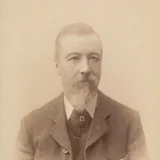
He learned the moves in his late teens, in a Manchester that took draughts more seriously than chess, and then spent sixty years teaching Britain what chess looked like. Joseph Henry Blackburne played an estimated hundred thousand games, and most of them were not tournament games at all: they were club rooms and assembly halls, ten and twelve boards at a time, played sightless with a glass of whisky at his elbow. Vienna gave him the name that stuck. At home he was simply the professional — the man who arrived by train, beat everybody, and moved on.
Late to the board
He was born in Manchester on 10 December 1841, the son of Joseph Blackburn — phrenologist, small businessman and temperance lecturer. The son would take a rather different view of drink, and after his marriage he added an 'e' to the family name to distinguish himself from his father. Draughts came first; chess arrived only in his late teens, when reports of Paul Morphy's tour of Europe reached the north of England and made the game briefly famous. P. Anderson Graham, in the sketch of his life that opens Mr. Blackburne's Games at Chess (1899), dates it to 1860. Blackburne learned the moves from a little book bought for twopence at a bookstall and lost his first game while still wondering whether he remembered the knight's move; then he studied Staunton's handbook, and “in a very few weeks was giving odds to his whilom conqueror.”
He joined the Manchester Chess Club in 1861 and lost his first five games to its champion, Edward Pindar. A few months later he beat him. By 1862 he was club champion himself, ahead of Bernhard Horwitz, the endgame composer who taught him most of what he knew about endings — and endgames would remain unusually strong in a player remembered chiefly for his attacks. That summer he was invited to the great London international tournament, the first all-play-all in the history of the game. He finished ninth, beat a young Wilhelm Steinitz in the first of their many meetings, and suggested that congresses replace their sand-glasses with clocks.
Sightless, on twelve boards
In November 1861 Louis Paulsen came to Manchester and gave a blindfold display, beating Blackburne among others. “It was this game, and the noise about the great American, that led me to try sans voir on my own account,” Blackburne wrote in his note to it. Within a month Blackburne was playing three games blindfold; by January 1862 he had managed four, then seven, then ten. At the London congress that July he conducted ten blindfold games at once, and in June 1863, at Stewart's Dining Hall in Manchester, he played twelve — a world record that stood until Johannes Zukertort managed sixteen in 1876.
This became his living, and it is the part of his life the tournament tables cannot show. For half a century he toured: club to club, town to town, an annual circuit of England with excursions to Europe, Australia and the United States. In blindfold displays alone he is reckoned to have played more than 2,440 games, winning over 1,550 of them and losing barely 200. Asked in 1888 how he held it all in his head, he was matter-of-fact: “I never have any uncertainty as to the position on the board, for if necessary I pass the game through my mind move by move.” His last blindfold exhibition came in January 1912, at Cranleigh in Surrey — four opponents, four wins, at seventy.
“Chess is a kind of mental alcohol. It inebriates the man who plays it constantly.”
“I play this move not that I like it, but because my opponent likes it less.”
“The only difference between amateurs and professionals at chess is that amateurs make more out of it.”
“It is a game I never play in a tournament, except when I feel a little off colour and am content with a draw, and then it usually means losing half a point.”
“The pale, lean, muscular young man opposite is the iron Blackburne, the Black Death of chessplayers. But very seldom there falls from his moustache-covered lips a laconic English word.”
“Multitudinous have been his victories in international contests, and at Berlin, in 1881, he won the championship of the world.”
“the most vivid representative of the combinative school”
“It is a delusion to estimate the merits of two players by the score only.”
The Black Death
The name was minted at Vienna in 1873, where he tied for first with Steinitz and lost the play-off. The tournament book set him down as “the iron Blackburne, the Black Death of chessplayers”, a silent Englishman from whose lips very seldom fell even a laconic word. The chess matched the billing: wide open, combinative, willing to give material for the initiative, and productive of brilliancy prizes across four decades. Two things still carry his name — Blackburne's Mate, the two-bishops-and-knight pattern he demonstrated in a famous finish, and the Blackburne Shilling Gambit, so called because he is said to have used it to win the shilling wagered by amateurs. Steinitz thought it worth a mention in The Modern Chess Instructor in 1889.
The record built steadily. In 1868–69 he won the second competition for the British Chess Association's challenge cup, in effect becoming British Champion. Third at Baden-Baden 1870, sharing the prize with Neumann, behind Anderssen and Steinitz; second at London 1872; joint first at Vienna 1873; first at the London Divan tournament of 1876 with 10/11, ahead of Zukertort, in the same spring that Steinitz had crushed him in a match; joint first at Wiesbaden 1880. And then Berlin 1881, the tournament of his life: outright first, three full points clear of Zukertort. Chessmetrics places him regularly among the world's top five players from 1871 to 1889, and as high as second.
Baden-Baden was played as France and Germany prepared for war, and on a free day Blackburne made an excursion to the fortified town of Rastatt, where, Graham wrote, a German officer “placed two sentinels at the door, and asked to see his papers.” He was held overnight on suspicion of spying for France and released the next morning with his expenses paid; his driver of the night before turned out to be the real spy, hoping to get into the town. At Vienna in 1873 he made his much-debated sacrifice against Anderssen, by his own note, “entirely on the spur of the moment, and instantaneously”. “Herr Anderssen started as if a mine had been sprung on him,” and afterwards he and Steinitz would scarcely believe that the idea had not been prepared beforehand.
Steinitz, Zukertort, and the trouble with matches
Over a tournament field he was formidable for twenty years. Across a table from one man, for a stake, he was something less. Steinitz beat him in their first match in 1862–63, beat him again in 1870, and in 1876 beat him seven games to nothing — a contest for £60 a side, winner take all, and the first chess match at which spectators were charged at the door. Zukertort had the better of him in 1881. Lasker beat him without losing a game in 1892.
Steinitz's own Chess Match Between Messrs. Steinitz & Blackburne (1876) gives a more careful account of that 7–0 defeat. In the introduction (pp. 8–10), he wrote: “It is a delusion to estimate the merits of two players by the score only.” He credited Blackburne with winning chances in the second and third games. In the second, Steinitz reported offering a draw and wrote that Blackburne admitted he should have accepted it. He also rejected the suggestion that Blackburne had repeatedly spoiled winning positions after dinner: his game-by-game account placed the missed chances before the adjournments, and the seventh game had no adjournment at all.
Steinitz also reported Blackburne's explanation for an early knight retreat in the sixth game: it was a “finger-slip”, caused by helping the scorers keep up with the players' rapid opening moves. Blackburne then gave up a second pawn to sustain his attack (sixth game, p. 44).
In My Great Predecessors, Part I (2003), Kasparov calls Blackburne “the most vivid representative of the combinative school” in the 1870s. He uses the fourth game of the 1876 match to show Steinitz accepting an attack and gradually preparing a counterattack. His analysis also finds a stronger fifteenth move for Blackburne: exchanging a bishop would have kept the initiative and made it difficult for Steinitz to complete his development (chapter 2, “Wilhelm the First”, game 15).
But he took the return from Zukertort in 1887, and he never became easy to beat. Lasker's own verdict was that Blackburne had more talent than Steinitz and lacked only the will and the appetite for hard work that the world title demanded — which is more or less how his contemporaries saw him: a player of extraordinary natural gift who preferred to earn his money at the boards rather than in the study.
Whisky, temper, and the grand old man
He drank, and he was entirely unembarrassed about it. “I find that whiskey is a most useful stimulus to mental activity, especially when one is engaged in a stiff and prolonged struggle,” he told an interviewer in 1899. “Speaking for myself, alcohol clears my brain, and I always take a glass or two when playing.” The stories multiplied around him — Cambridge students setting two bottles beside the boards to distract him; the celebrated quip about draining an opponent's glass in a simultaneous display, “He left it en prise, so I took it en passant.” That last one has never been traced to a contemporary source, and is best enjoyed as folklore rather than fact. One whisky story does have a witness. In his introduction to the 1979 Dover reprint of Blackburne's games, David Hooper quotes the English master William Winter on a display in 1919: Winter “had heard that he [Blackburne] was inclined to be slow” and set out two bottles of whisky, one at each end of the room, and Blackburne “fairly galloped up and down, and finished the twenty boards in less than three hours without a single loss.”
The younger Blackburne was harder company than the legend allows. Steinitz — no friend — published in his International Chess Magazine in 1889 an account of two violent encounters in the 1860s: a blow to the eye at Purssell's coffee house, and a night in a Paris hotel that ended with Steinitz breaking a window pane with Blackburne's head. The story circulates today with the roles reversed, Steinitz sailing through the glass. It was the other way round.
His life outside chess was harder still, in ways the anecdotes never record. He married Eleanor Driscoll, a carpenter's daughter, around 1865; she died in 1874, and both their sons died young. His second wife, Beatrice Lapham, had two sons with him. She died early in 1880, a few weeks after childbirth, and the baby died later that year. Her surviving son Julius accompanied Blackburne to Australia in 1884–85. At the end of 1880 he married Mary Jane Goodway, a widow with children of her own; they had a son, Frederick William, in 1881, and she stayed with him for forty-two years. When he nearly died of illness in 1884 the chess public subscribed the fare to send him to Australia for the winter, and he gave displays in Melbourne, Sydney and Adelaide — arriving with a five-pound fine for striking a fellow passenger on the voyage out. In age he mellowed into something British chess had not had before: a grand old man wholly of the game, who had made a respectable living from it. “The only difference between amateurs and professionals at chess,” he observed, “is that amateurs make more out of it.”
The long ending
Illness hurt his results through the 1890s, and the family moved to Hastings, perhaps on medical advice. He was still dangerous. He beat the world champion Emanuel Lasker at Hastings in 1895, and again at London in 1899, at fifty-seven. That same year he published his only book, Mr Blackburne's Games at Chess: over four hundred games and a score of his own problems, selected and annotated by himself and edited by P. Anderson Graham. Of a printing of 3,001 copies, all but a hundred had sold by 1914.
Illness kept him out of Paris 1900 and forced his withdrawal from Monte Carlo 1902, but he did play at Monte Carlo in 1901. He returned to regular competition for the first modern British Championship in 1904 and kept going: Ostend in 1905, 1906 and 1907, and finally St Petersburg in 1914, at seventy-two, where he failed to reach the final section but drew with Alekhine and Rubinstein and took a special brilliancy prize for his win over Aron Nimzowitsch. That August he tied for first in the British Championship with F. D. Yates and was too unwell to contest the play-off; the federation awarded the title to Yates.
He was still giving displays at eighty. At the Imperial Chess Club in December 1921 he played twenty games at once and scored nine wins, ten draws and a single loss — to a Mrs Banting. Lying in St Thomas' Hospital near the end, with no pharmaceutical knowledge whatever, he passed the time memorising the Latin names on the medicine bottles and reciting them backwards.
Legacy
Mary died in 1922; Blackburne followed on 1 September 1924, at eighty-two, at his home in Lewisham. They lie together in Ladywell cemetery, under a stone that has since toppled and is hard to find, and Tim Harding reports no known living descendants; the later fate of Julius remains uncertain. His exhibitions left a habit: fifty years of trains and club rooms and gaslight, of ten boards at a time played without sight of them, and several generations of English amateurs who could say for the rest of their lives that they had once sat across the board from the Black Death. Tim Harding's 2015 biography gathers more than a thousand of his games. He never held the world title and was never truly close to it, but between Staunton and the modern era no English player came nearer — and none did half as much to put the game in front of ordinary people.
Books
Books Joseph Blackburne wrote, co-wrote, edited, or contributed to. Translations and reprints are grouped under the same work.
-
Mr. Blackburne’s Games at Chess
Author — selected and annotated games; edited by P. Anderson Graham
-
The Hastings Chess Tournament, 1895
Contributor — game annotations