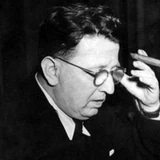
Karel Opočenský played competitive chess for more than forty years, from a master's title in 1913 to a share of third place in the Czechoslovak championship at sixty-four. He was champion of his country three times, won an individual gold medal at the 1933 Olympiad without losing a game, and in 1941 beat Alexander Alekhine while Alekhine was World Champion. His name survives in the openings: a line of the Najdorf Sicilian, a line of the Grünfeld, and 1.d4 Nf6 2.Bg5, sometimes called the Opočenský Opening. In the 1930s he was already playing the ...b5 pawn sacrifice that Pal Benko would popularise thirty years later. When his playing days thinned out he became one of the game's senior officials, and he was chief arbiter of two World Championship matches in Moscow.
A mason's son from Most
Opočenský was born on 7 February 1892 in Most, in northern Bohemia, the middle child of seven in the family of a master mason. He learned the moves from his father and an older brother, and the game took hold of him at the grammar school in Vinohrady, in Prague. In 1913 the Central Union of Czech Chess Players awarded him the title of master. That August, at the Czech championship in Mladá Boleslav, he beat Josef Hrdina in nineteen moves.
He married, had a daughter and a son, and for much of his life supported himself outside chess while playing and writing about it at a high level. Czech chess writers remember him for the Virginia cigar that was always smoking beside the board, and by the nickname "Maestro Opo". A second nickname, "Karel IV", came from the number of times he finished fourth.
Champion of Czechoslovakia
Opočenský was runner-up in the Czechoslovak championship of 1919 and won it in 1927, 1929 and 1938. During the German occupation he won the championship of the Protectorate of Bohemia and Moravia in 1944, and he was still good enough to share third place in the national championship of 1956, at sixty-four.
Abroad, he finished behind only Alekhine and Savielly Tartakower at Paris 1925, and in the same year beat Akiba Rubinstein at Mariánské Lázně. He won the Václav Kautský Memorial in Prague in 1933, the Luhačovice tournament in 1935 and Nice in 1938, and he shared first place at Arbon in 1946 with Daniel Yanofsky and Luděk Pachman. In 1941 he drew a twelve-game match with Jan Foltys, four wins each and four draws.
Four Olympiads
He played in four Olympiads. At Prague in 1931 he scored +7 −2 =4 on fourth board and the team took the bronze medal. At Folkestone in 1933 he had the best result of his career: thirteen games, ten wins, three draws and no defeats, which earned the individual gold medal for board four as Czechoslovakia took silver. He moved up to second board at Warsaw in 1935, where he beat Rudolf Spielmann.
By 1939 Czechoslovakia no longer existed; its players went to Buenos Aires as the team of Bohemia and Moravia, and Opočenský, then forty-seven, played first board. Germany invaded Poland while the Olympiad was under way. On 4 September he beat Erich Eliskases, first board of the German team that went on to win the gold medals, and he finished with +8 −5 =4.
The gambit before Benko
In the King's Indian and Benoni positions after 1.d4 Nf6 2.c4, Opočenský liked to strike at the white centre with an early ...b5, giving up a pawn to open the a- and b-files for his rooks. Wikipedia's history of the Benko Gambit names his games with the idea against Gideon Ståhlberg at Poděbrady 1936, Paul Keres at Pärnu 1937, Erich Eliskases at Prague 1937 and Theo van Scheltinga at the 1939 Olympiad. Against van Scheltinga the pressure on the queenside was over in eighteen moves.
Other lines carry his name more directly. The Opočenský Variation of the Najdorf Sicilian, with 6.Be2, and an Opočenský Variation of the Grünfeld are both in the standard reference books, and 1.d4 Nf6 2.Bg5 is sometimes called the Opočenský Opening. Today it is usually named after Octávio Trompowsky, who played it in the 1930s and 1940s.
Bronstein credited him with an earlier role in the Sicilian too. In The Sorcerer’s Apprentice (1995; corrected reprint 1998), his note to Unzicker–Bronstein at Gothenburg 1955 says that Opočenský played the setup now called the Najdorf Variation before Najdorf did. The comment concerns the position after 5...a6, before the choice of White’s sixth move.
The arbiter
After the war Opočenský moved into the administration of the game. He joined the presidium of FIDE in 1947, and when FIDE published its first list of international titles in 1950 he was on it as an International Master. The International Arbiter title followed in 1951.
That year he was chief arbiter of the World Championship match in Moscow between Mikhail Botvinnik and David Bronstein, and in 1954 he held the same role for Botvinnik's match with Vasily Smyslov. He also directed play at the Helsinki Olympiad of 1952 and the Candidates Tournament at Zürich in 1953. He was deputy editor of Revue FIDE, edited a duplicated weekly chess bulletin for the Czech news agency and wrote the chess column of Rudé právo.
Legacy
Opočenský died in Prague on 16 November 1975, at eighty-three. His playing career ran from the Czech championship of 1913 to the national championship of 1956, and the board gold he won at Folkestone in 1933 came in the Olympiad at which Czechoslovakia finished second. He spent the second half of his life organising, refereeing and writing about the game, and in the 1960s he published Nad šachovnicemi celého světa (1960), Šachy s úsměvem (1961) and Tam všichni hrají šachy (1962). The ...b5 gambit he played in the 1930s is still played today, under Benko's name.
Books
Books Karel Opočenský wrote, co-wrote, edited, or contributed to. Translations and reprints are grouped under the same work.
-
Methodika šachu
Author
-
Nad šachovnicemi celého světa
Author — recollections recorded by Vítězslav Houška
-
Šachy s úsměvem
Coauthor — Karel Opočenský, Vítězslav Houška
-
Tam všichni hrají šachy
Coauthor — Karel Opočenský, Vítězslav Houška