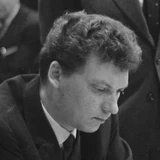
Karl Robatsch played first board for Austria at eleven Chess Olympiads, the last in 1994. At Leipzig in 1960, still an International Master, he scored 84.4% and won the gold medal for the best result on board one, and that year he became Austrian champion. He shared first place at Madrid in 1961 and became a grandmaster the same year. His name stayed attached to the opening 1.e4 g6 2.d4 Bg7, which he revived and played for decades with Black and which is now usually called the Modern Defence. Alongside chess he was an orchid specialist, and he was given the title of Professor for his work on the classification of orchids.
Graz
Robatsch was born in Klagenfurt on 14 October 1929. Early FIDE lists and some reference books gave his birth year as 1928, and FIDE corrected it after January 1993. At seventeen he moved to Graz as a student, spent his time in a café where the city's chess players met, and joined the local club SK Gemeinde. He reached master strength quickly.
His first international results came in the mid-1950s: second place at Kapfenberg in 1955 and a share of second at Varna in 1957. FIDE made him an International Master in 1957.
Leipzig 1960
Robatsch played first board for Austria at every Olympiad he took part in, eleven in all, the last in 1994, and also played in one European Team Championship. His best result came at Leipzig in 1960, where he scored 84.4% and won the board-one gold medal while still an International Master. He won the Austrian championship the same year.
In 1961 he shared first place at Madrid with Borislav Milić and shared second at Utrecht, and he became a grandmaster. He shared second again at Beverwijk in 1962, and at the Halle zonal of 1963 he tied for third with Borislav Ivkov, behind Lajos Portisch and Bent Larsen. Later results included a share of second at Venice in 1969 and third places at Olot in 1972, on the Costa Brava in 1973 and in Vienna in 1979. His highest rating was 2460, in July 1971, and he kept playing into the late 1990s.
1.e4 g6 2.d4 Bg7
Robatsch played combinatively as a young man and more positionally later, and his openings were often experimental. With Black he returned again and again to 1.e4 g6 2.d4 Bg7, a system known since the sixteenth century. Black usually delays the king's knight and challenges the centre with ...e5 after preparatory moves such as ...d6 or ...Nc6. He revived and popularised it, and through the 1960s and 1970s it was widely called the Robatsch Defence. The tenth edition of Modern Chess Openings (1965) grouped it with the Pirc as the "Pirc–Robatsch Defense". The usual name today is the Modern Defence.
He was also known for his own version of the Centre Counter, the opening now usually called the Scandinavian Defence.
Orchids
Robatsch had a second career in botany. He studied orchids and was given the title of Professor for his research on the classification of orchid species and subspecies. Botanical names he authored carry the abbreviation "Robatsch".
Legacy
Robatsch died on 19 September 2000, after a long illness with throat and stomach cancer. He had played first board for Austria at eleven Olympiads, and his Leipzig gold medal remained the high point of his career. The opening he revived is still played, mostly under the name Modern Defence, and some books still call it the Robatsch.
Books
No authored or contributed books are documented in the available sources.