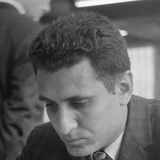
Larry Evans learned chess for ten cents an hour on 42nd Street in Manhattan and was champion of the Marshall Chess Club at fifteen. At eighteen he made the best score of the 1950 Olympiad, and at nineteen he was champion of the United States. He won or shared that title five times across twenty-nine years, won the U.S. Open four times and played for his country at eight Olympiads. He was also one of the most productive chess writers of his time: a syndicated newspaper column, a question-and-answer column in Chess Life for more than thirty years and over twenty books. Bobby Fischer relied on him as a second in the Candidates matches of 1971, and it was Evans who persuaded Fischer to publish My 60 Memorable Games.
Forty-second Street
Evans was born in Manhattan on 22 March 1932 to Jewish parents, Bella and Harry Evans. He learned the game in the chess parlours of 42nd Street, where he played for ten cents an hour. At fourteen he tied for fourth place in the championship of the Marshall Chess Club, and the next year he won it outright, the youngest champion the club had had.
At sixteen he played in his first U.S. Championship, in 1948, and tied for eighth place. In 1949 he shared first place in the U.S. Junior Championship with Arthur Bisguier, whom he would go on to meet in U.S. Championships for the next three decades.
In New Ideas in Chess he returned to his game against Ash in the Marshall Chess Club Junior Championship of 1946, calling it "my very first tournament game." He used one of his own pawn moves to explain wasted time: it did nothing for his development or the struggle in the center. The future champion's early mistakes became examples for his readers.
Dubrovnik and the national title
At the Dubrovnik Olympiad in 1950 the eighteen-year-old played sixth board for the United States and scored eight wins and two draws, 90 per cent. It tied with Yugoslavia's Braslav Rabar for the best result of the whole Olympiad and won him the individual gold medal.
In 1951 he won the U.S. Championship ahead of Samuel Reshevsky, the country's leading player, and the same year he beat the former World Champion Max Euwe at the Wertheim Memorial in New York. In 1952 he defended the title in a match against Herman Steiner. He won the U.S. Open in 1951 and 1952, again in 1954, after a tie-break with Arturo Pomar, and in 1971, shared with Walter Browne. FIDE made him an International Master in 1952 and a grandmaster in 1957.
“I arrived at them by replaying all my tournament games, analyzing why I either won or lost, and then extracting the quintessence from each one.”
“Here is a book for you to learn from when I’m not there to lose my temper.”
“In modern chess most of the beauty resides in the annotations.”
“But let’s face it — nothing can replace the thrill of sitting across the board from a real-live opponent with your clock ticking relentlessly in a tense, nerve-wracking tournament game.”
“I also advise students always to snatch material—if they can do it and live.”
“Finally, I wish to express my gratitude to Larry Evans, friend and colleague, for his invaluable aid in the preparation of the text as well as for his lucid introductions.”
Twenty-nine years of championships
In 1954 the Soviet team came to New York for a team match. The visitors won it 20–12, but Evans beat Mark Taimanov twice. He won the U.S. Championship again in 1961–62 and in 1967–68, and his last title came in 1980, shared with Walter Browne and Larry Christiansen, twenty-nine years after his first.
He played in eight Olympiads over twenty-six years. After his gold medal in 1950 he took an individual silver in 1958 and an individual bronze in 1976, when the United States won the team gold medal, and he was in the team that took silver in 1966. He won the Canadian Open in 1956 and 1966, shared second place with the World Champion Tigran Petrosian at Venice in 1967, and shared first at Portimão in 1975. At the Amsterdam Interzonal of 1964 he finished fourteenth.
Fischer's second
When Bobby Fischer was reluctant to publish a collection of his own games, Evans urged him to, and he wrote the introductions to the games in My 60 Memorable Games (1969). In his author's preface, Fischer thanked his "friend and colleague" for helping prepare the text and for the introductions. Evans's introduction to the Benko game at the 1959 Candidates explained why he valued annotation: sound defense often kept a game's most beautiful possibilities out of the moves actually played.
In 1971 he was Fischer's second in the Candidates matches that led to the World Championship of 1972. The two men fell out before the match with Boris Spassky in Reykjavík, and Evans was not in Fischer's team there. He wrote the book of the match, Chess World Championship 1972, published the following year.
The writer
Evans wrote or co-wrote more than twenty books. New Ideas in Chess (1958) was reprinted more than fifty years later, and Bruce Pandolfini called it "a first-rate chess book." He edited the tenth edition of Modern Chess Openings in 1965, and his other titles included Modern Chess Brilliancies (1970) and, in 2007, This Crazy World of Chess.
As the only American grandmaster among its seven authors, Evans wrote the introduction and the opening chapter, aimed at beginners, of How to Open a Chess Game (1974). The book began at San Antonio 1972, where the publisher Sidney Fried and the editor-in-chief Burt Hochberg "prevailed on us to do a book about openings unlike any ever done before." Evans found one common thread in the seven chapters: "think for yourself, accept nothing on faith, avoid playing by rote."
In the foreword to New Ideas in Chess, Evans explained that he had developed its principles by replaying all his tournament games and examining why he had won or lost. He organized the book around pawn structure, space, force and time, trying to put a master's habits into words that amateurs could understand. Its dedication to Clementine was less formal: "Here is a book for you to learn from when I’m not there to lose my temper."
His weekly column, Evans on Chess, began in 1971 and appeared in more than fifty newspapers across the United States. For more than thirty years, until 2006, he answered readers' questions in Chess Life. He co-founded American Chess Quarterly in 1961, edited Chess Digest and commentated on major matches for Time and for ABC's Wide World of Sports.
How Good Is Your Chess? (2004), previously published as Test Your Chess IQ, gave readers 100 positions, mostly from master games, with three possible moves to choose from. Evans urged them to calculate from the diagrams to practice visualization. He offered a way to study without tournament pressure while making clear how much he still enjoyed the tension of a game against a real opponent.
His journalism also opened a route to competition. Kasparov records in My Great Predecessors, Part IV that Evans played in Havana in 1964 under the exemption that allowed American journalists and businessmen to visit Cuba despite the travel restrictions.
Legacy
Evans died in Reno, Nevada, on 15 November 2010, from complications after gallbladder surgery; he was survived by his wife, the painter Ingrid Evans, and two stepsons. He had been inducted into the U.S. Chess Hall of Fame in 1994. His competitive record ran from a Marshall Chess Club championship in 1947 to a fifth U.S. title in 1980, and his Chess Life column alone ran for more than thirty years.
Books
Books Larry Evans wrote, co-wrote, edited, or contributed to. Translations and reprints are grouped under the same work.
-
New Ideas in Chess
Author
-
Modern Chess Openings, 10th edition
Contributor — reviser of the 10th edition; edited by Walter Korn
-
Chess Catechism
Author
-
Modern Chess Brilliancies
Author
-
Chess World Championship 1972
Coauthor — Larry Evans, Ken Smith
-
How to Open a Chess Game
Contributor — opening chapter; with Larry Evans, Svetozar Gligorić, Vlastimil Hort, Paul Keres, Bent Larsen, Tigran Petrosian and Lajos Portisch
-
What's the Best Move?
Author
-
The 10 Most Common Chess Mistakes
Author
-
How Good Is Your Chess?
Author
-
This Crazy World of Chess
Author
-
Vienna 1922
Author
-
Test Your Chess I.Q.
Author — Larry Evans