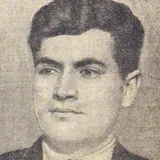
Lev Aronin spent his working days as a Soviet weather forecaster and his evenings among the strongest chess players in the world. He qualified for eight USSR Championship finals in the years when that tournament was the hardest in the world, and at Moscow in 1950 he finished half a point behind Paul Keres and ahead of two players who had just played in the Candidates. FIDE made him an International Master that year. It never made him a grandmaster. David Bronstein, who knew him both at the board and away from it, said flatly that he had deserved the title without any doubt.
Three brothers in Kuibyshev
Aronin was born in July 1920 in Samara — renamed Kuibyshev a few years later — the youngest of three brothers in a large family. Chess belonged to the household before it belonged to him. Grigory, born in 1913, and Efim, born in 1915, played constantly at home, and it was Grigory who taught the eight-year-old Lev the moves. The lessons did not hold for long. Grigory remembered a fourteen-year-old Lev lying on a couch in another room, calling out his moves for two boards at once while his elder brothers — both strong players — sat at the pieces and shouted their replies back. Neither game lasted much past thirty moves.
He took the First Category in the Kuibyshev city championship of 1937. The following year he moved to Moscow and entered the physics-and-mathematics faculty of the Pedagogical Institute, where he became the institute champion and, by the turn of 1941, a Candidate Master. Then the war took him: called up in August 1941, he was unable to give any time to chess until the end of 1944. He would spend the rest of his working life as a meteorological engineer.
Master of Sport, the hard way
His return was not immediately convincing. In late 1944, under the system that let a candidate earn the Soviet master title by beating a holder of it in a qualification match, he challenged the experienced Alexander Konstantinopolsky — and lost the first six games, and the match, by +1 −6 =5. At an All-Union First Category tournament in Gorky in 1945 he finished fourteenth of sixteen.
Within eighteen months he was a different player. He won the All-Union First Category championship at Yerevan in August 1945, then a Candidate Masters' tournament at Kaunas in April 1946 with 11/14 and a single loss. In October 1946, in the semi-final of the 15th USSR Championship at Tbilisi, he scored 11/17 for a share of second place, made the Master of Sport norm, and qualified for the first Soviet final of his life.
That final, at Leningrad in 1947, brought him 7/19 in ferocious company — and one result that announced him. Salo Flohr, who a decade earlier had been reckoned among the likeliest challengers for the world title and was one of the hardest men in Europe to beat, resigned against him. Aronin won the Moscow Region championship the same year with 8½/10, and took it again in 1948 with 11½/13. He did not lose a game in either.
“Lev Solomonovich Aronin played successfully many times in USSR Championships but never managed to actually become the champion. He never received the title of grandmaster which he deserved without any doubt.”
“Aronin's style of play reminds me of Botvinnik and Furman, very positional and safe but occasionally also using his combinative talent.”
“Whenever he called in on him, Aronin would be sitting at that position, pensively moving the pieces about.”
Moscow, 1950
Between 1947 and 1950 Aronin won three consecutive USSR Championship semi-finals outright — the 16th at Leningrad in 1947, the 17th at Moscow in 1949, the 18th at Gorky in 1950, the last of them with 10½/15. The 17th final, in Moscow in 1949, gave him 10/19 and a share of ninth and tenth places: his first result at genuine elite level.
The 18th final opened in Moscow on 10 November 1950 — eighteen players, seventeen rounds, a month of chess. Aronin finished on 11 points, nine wins against four losses, sharing second, third and fourth places with Isaac Lipnitsky and Alexander Tolush. Only Paul Keres, half a point clear, finished above him. Below him were Vasily Smyslov and Isaac Boleslavsky, both of whom had played the Candidates tournament earlier that year, Boleslavsky as its joint winner. Chessmetrics, calculating backwards, puts Aronin's performance in that tournament at 2733 — the best of his career.
On the strength of it FIDE awarded him the International Master title in 1950, at a time when fewer than a hundred players in the world held it and only twenty-seven were grandmasters. It was the highest title he would ever be given.
The pawn ending
The 19th USSR Championship, Moscow 1951, doubled as a FIDE Zonal with five places at the following year's Interzonal at Saltsjöbaden at stake. In the last round Aronin had White against Smyslov. After five hours the game was adjourned in an endgame that offered several straightforward wins, and he had a full day to work on it. At the resumption he chose to liquidate into a pawn ending which looked won at a glance. Smyslov had used his own day better; he had found a study-like saving resource that Aronin had not seen, and the game was drawn. Aronin shared ninth and tenth place.
Then his name was struck from the Interzonal list altogether, in favour of Alexander Kotov — a highly placed figure in Soviet chess administration who had finished a point below him in that same championship, and who went on to win the Interzonal with two rounds to spare. Bronstein set the episode down in print decades later. Yuri Averbakh set it down too.
The Ukrainian master Viktor Zheliandinov recalled that the sporting blow landed alongside private ones — the death of Aronin's father, and the end of a relationship. Genna Sosonko records that years afterwards, when the young Armenian master Karen Grigoryan came to study with him, he would find Aronin sitting at that same adjourned position, moving the pieces about.
A theoretician's chess
Aronin played positionally, and the tactics in his games grew out of the position rather than being forced on it. He was one of the leading players of the King's Indian Defense in the years when it was still being worked out, and a main line of its Classical Variation still carries his name: the Aronin–Taimanov Variation, 9.Ne1, shared with Mark Taimanov. He worked seriously on the Ruy Lopez, the Sicilian and the Old Indian, and Soviet reference books list him as a theorist as readily as a player. Over his career he beat nearly every leading Soviet player of his generation; Mikhail Botvinnik and Smyslov are the notable exceptions.
He never played a single individual tournament outside the Soviet Union. Both his trips abroad came in 1957, both with a team: the first European Team Championship in Vienna, where he scored 1½/3 on a reserve board as the Soviet team took gold, and a two-game match against Bulgaria in Sofia. It has been suggested that his profession counted against him, since a meteorologist's knowledge was the kind of thing the state preferred to keep at home, but the simpler obstacle was the line of players ahead of him. He was thirty-seven by 1957, and foreign invitations went to proven winners and younger men.
One of his most celebrated games was a draw with Tal in the seventeenth round of the 1957 Soviet Championship. Kasparov's My Great Predecessors, Part II reports that Euwe called it the most brilliant draw in chess history. Tal treated Aronin as a fellow creator: “I very much like receiving prizes for brilliancy, as a co-author.” It was the first of four such games in Tal's career, and he said it gave him the greatest pleasure.
The long unwinding
Kotov, writing about him in The Soviet School of Chess in 1955, put down what everyone in Moscow could see: that Aronin was psychologically unstable, and that losses demoralized him. What came later went much further. By Averbakh's account, the events of 1951 broke something in him; he became preoccupied with his health, convinced first that he had heart disease and then cancer, and eventually entered a psychiatric hospital, where the injections wrecked his metabolism and he put on a great deal of weight. Sosonko, who describes him as an outstanding player and theorist burdened with serious mental illness, remembered him at the chess club in the late sixties, playing in some unimportant tournament, his heavy body barely fitting the chair, his mother sitting beside him: a tiny, silver-haired old woman watching her Lyovushka with complete love.
And he kept playing. He was champion of the Russian Republic in 1952 and champion of Moscow in 1965. He took fourth place in the 4th USSR Correspondence Championship of 1957–60. At a strong Moscow international in 1961 he finished fourth behind Evgeni Vasiukov, Smyslov and Friðrik Ólafsson, ahead of several grandmasters. At Riga in 1962 he won the semi-final of the 30th USSR Championship — the fifth time he had come first or joint first in a Soviet championship semi-final, a total nobody else has matched — and scored 10½/19 in the final at Yerevan, beating Mikhail Tal along the way. He was still entering tournaments in the early 1970s.
Legacy
Lev Aronin died in Moscow on October 4, 1982, aged sixty-two, and was buried at the Nikolo-Arkhangelskoye Cemetery. The Soviet magazine 64 headed its obituary simply “A Great Master”. He left no world title and no grandmaster title, but he had eight appearances in the hardest national championship in the world, a King's Indian variation still played at the top level seventy years later, and the same verdict from nearly everyone who played him. Averbakh called him, without qualification, a player of grandmaster class. Bronstein put it more sharply: the title was one he deserved without any doubt. In the country that produced more grandmasters than any other, Aronin is the master people still argue about.
Books
No authored or contributed books are documented in the available sources.