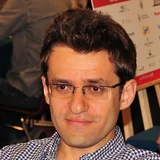
Levon Aronian learned chess from his sister in Yerevan in 1991, won the World Under-12 Championship three years later and became World Junior Champion in 2002. He won the FIDE World Cup in 2005 and 2017, led Armenia on first board to Olympiad gold in 2006, 2008 and 2012, and played in six consecutive Candidates events from 2007 to 2018. His rating peaked at 2830 in March 2014, second in the world behind Magnus Carlsen. In 2021 he moved to Saint Louis, and he has played for the United States since December of that year.
Yerevan
Aronian was born in Yerevan on 6 October 1982, to a Jewish father, Grigory Aronov, and an Armenian mother, Seda Aronova. His sister Lilit, six and a half years older, taught him the game in the summer of 1991, when he was nearly nine. His first coach was Lyudmila Finaryova; from late 1991 to late 1998 he worked with Melikset Khachiyan, whom he has also called his first coach, and later with Arsen Yegiazarian and Arshak Petrosian.
In 1994 he won the World Under-12 Championship, finishing ahead of several future grandmasters, among them Étienne Bacrot, Ruslan Ponomariov, Francisco Vallejo Pons and Alexander Grischuk. On Petrosian's advice, from the age of 15 to 20 the only junior championship he played was the World Under-20. He made his Olympiad debut at home in Yerevan in 1996, as a reserve for Armenia's second team, became an International Master in 1997 and received the grandmaster title in 2000.
Judit Polgar, who beat him in their first game at the 2001 European Championship in Ohrid, noted that at 18 he had been rated 2528, outside the world's top 100 and 14th on the junior list, and called him "the late-developing type". He later visited her in Budapest for training sessions.
Berlin and the junior title
In 2001 Aronian moved from Yerevan to Berlin. "I moved to Berlin 10 years ago in order to give myself a chance to take part in tournaments all around Europe," he said in 2011. In December 2002 he won the World Junior Championship in Goa with 10/13, half a point ahead of Luke McShane, after beating Dmitry Jakovenko in the last round. The same year he won the Armenian Championship, the only time he took the national title.
From October 2003 to May 2004 he was registered with the German federation. "I changed federation – not because I wanted to play for Germany but to show I could do it," he said in 2016; he returned when new people took over the Armenian federation.
At the four-player Essent tournament in Hoogeveen in 2003 he beat the former World Champion Anatoly Karpov and reached the last round level with Polgar, who won their game. In March 2004 he won the blitz tournament that set the pairings for Garry Kasparov's rapid knockout in Reykjavik with 13/15, a point ahead of Kasparov. At the Calvià Olympiad that October he scored 8/12 on second board as Armenia won the bronze medals.
“You're free to express yourself in the game of chess ... You can play anything as long as you are determined to fight for the ideas you put in your moves.”
“What I really love about chess is it's kind of an art form, but at the same time you have a distinct level of judging who's better and who's worse — which is the rating system.”
“Before a game I often listen to something by J.S. Bach or John Coltrane. Those two, a composer and a musician, are always with me.”
“After I became a GM, the biggest figure in my chess life has been Gabriel Sargissian ... at least 80% of my chess DNA comes from Gabi.”
“I consider him to be the most creative player of our time, both over the board and in opening preparation.”
“You could perhaps get this feeling of learned helplessness when you’re facing someone you’ve lost to 10 or 12 times. I’ve experienced it primarily with two players – Aronian and Nakamura, and also Carlsen to some degree.”
“Levon is of course one of the toughest competitors, maybe the toughest. We have had many hard fought battles with several decisive results. I think our games usually are very interesting as Levon is an incredibly creative player and a tremendous fighter as well.”
“Levon's biggest psychological problem seems to be the pressure created by the fact that he is a national hero in Armenia. He will be able to become World Champion only if he frees his shoulders of this burden.”
“The most successful player with an ultra-aggressive style. He achieves this result thanks to his rare intuition in the sharpest positions.”
Into the elite
Aronian won the 2005 World Cup in Khanty-Mansiysk without losing a game, beating Ponomariov in the final by winning both rapid tiebreak games. In 2006 he took sole first place at Morelia-Linares with 8½/14 and shared first at the Tal Memorial, and at Mainz he became the Chess960 World Champion, a title he defended against Viswanathan Anand there in 2007.
He shared first place at Wijk aan Zee in 2007, with Veselin Topalov and Teimour Radjabov, and in 2008 with Carlsen. In the 2007 Candidates matches in Elista he beat Carlsen in a blitz playoff and then Alexei Shirov, which took him to the World Championship tournament in Mexico City, where he finished seventh of eight.
He won the 2008–2010 FIDE Grand Prix series. On the November 2010 rating list he passed 2800 for the first time, and that month he won the World Blitz Championship in Moscow with 24½/38.
Armenia's first board
With Aronian on first board, Armenia won the Olympiad at Turin in 2006, where he scored 7/11, at Dresden in 2008 and at Istanbul in 2012, where his 7/10 also won the individual gold medal on board one. He took the board-one silver at Khanty-Mansiysk in 2010, and in 2011 Armenia won the World Team Championship in Ningbo. Gata Kamsky wrote of Turin that "the main sensation of the event was the Armenian team, led by GM Aronian".
Boris Gelfand dated the team's rise to 2006, "when Aronian entered the elite and took over Board 1 from Akopian". "Levon Aronian is of course one of the greatest players of our time," Gelfand wrote. "However, in team events he is usually even stronger." The coach Vladimir Tukmakov observed that only the team leader "knew individual success that would match the level of success enjoyed by this team".
Armenia named him its sportsman of the year in 2005 and an Honored Master of Sport in 2009, and in 2012 he received the Order of St. Mesrop Mashtots. In 2016 CNN called him "the David Beckham of chess". That year Armenia stayed away from the Olympiad, which was held in Baku.
The Candidates
Aronian played in six straight Candidates events from Elista 2007 to Berlin 2018. At Kazan in 2011 he lost his first-round match to Grischuk in a rapid tiebreak. In London in 2013 he shared the lead with Carlsen at the halfway point, but he lost three games in the second half and finished half a point behind Carlsen and Vladimir Kramnik.
From November 2010 to September 2014 he was always second or third in the world. His rating peaked at 2830 on the March 2014 list, behind only Carlsen. That January he had won at Wijk aan Zee for the fourth time, with 8/11, a point and a half clear of Anish Giri and Sergey Karjakin, but at the Candidates in Khanty-Mansiysk two months later he finished sixth.
He reached the 2016 Candidates in Moscow on the Armenian sponsors' wild card and shared fourth place, and at Berlin in 2018 he finished last. Polgar had written in 2014 that the pressure of being a national hero was his biggest psychological problem.
Tbilisi and Saint Louis
Aronian won the Sinquefield Cup in 2015 with 6/9, a point clear of the field. In 2017 he won the Grenke Chess Classic ahead of Carlsen and Fabiano Caruana, Norway Chess a point ahead of Hikaru Nakamura and Vladimir Kramnik, and the Saint Louis Rapid and Blitz. That September he won the World Cup in Tbilisi for the second time: the classical games of the final with Ding Liren ended 2–2, and he won both rapid tiebreak games.
On 30 September 2017, three days after the final, he married Arianne Caoili at Saghmosavank Monastery in Armenia, with President Serzh Sargsyan among the guests. Caoili died in March 2020, at 33, after a car crash in Yerevan.
In February 2021 Aronian announced that he would move to Saint Louis and play for the United States. "The past year has been very difficult for all of us with a pandemic, a war and in my case there was personal adversity and the state's absolute indifference towards Armenian chess," he said. He moved that September, and FIDE has listed him as a US player since 1 December 2021. He married Anita Ayvazyan in 2023.
He has played for the United States at the Olympiads of Chennai 2022, Budapest 2024, where he scored 8/10 and the team won silver, and Samarkand 2026. In 2025 he won the Freestyle Chess Grand Slam in Las Vegas, beating Hans Niemann in the final, and in December the Grand Slam final, where he beat Carlsen 1½–½ in the last match. That year he also finished third, unbeaten, in the US Championship. In July 2026 he won the Biel Masters Triathlon on his debut.
The artist at the board
Anand called him "a much more tactical player than Carlsen", always "looking for various little tricks to solve technical tasks". Kamsky counted him among "the world's top experts on the Marshall", and Aronian agreed there was "a fair amount of truth" in a line attributed to him: that he played the Marshall when he did not mind a draw, and the Berlin when he wanted to win. chess24 described him as "a dangerous attacker" who "sometimes allows himself an element of bluff".
At the 2011 European Team Championship in Porto Carras, Jacob Aagaard watched Sune Berg Hansen outplay him completely, only for Aronian to set "one last trick": Hansen promoted a pawn and was mated. Aagaard recalled that Aronian, with no sign of the drama he had caused, asked straight away why Hansen had not played 38.Rxg7 Nxg7 39.Qg6, which would have won.
Before games he listens to Bach or John Coltrane. "These days when you read older players complain about younger players that they only know how to push the space bar and have no culture, just think of Aronian," Gelfand wrote. "He has a great knowledge of music, literature, arts and culture in general."
Legacy
Aronian led Armenia to three Olympiad titles and a world team title, won the World Cup twice and spent four years as the world's second- or third-ranked player. He never won the world title, but Gelfand, Shirov and Carlsen all singled out the creativity of his play, and his wins from Linares to Stavanger remain some of the most admired attacking games of their era.
Books
Books Levon Aronian wrote, co-wrote, edited, or contributed to. Translations and reprints are grouped under the same work.
-
Winning with the Najdorf Sicilian: An Uncompromising Repertoire for Black
Contributor — foreword