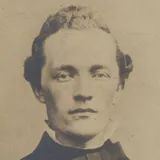
Louis Paulsen grew up on a farm in the Principality of Lippe, spent much of his twenties in the family tobacco business in Dubuque, Iowa, and came out of the American West in 1857 as the second-best player at the First American Chess Congress, behind Paul Morphy. Back in Europe he won at Bristol, Krefeld, Leipzig, Frankfurt and Braunschweig, beat Adolf Anderssen in two matches and played as many as fifteen blindfold games at once. At a time when most masters played for the attack, he trusted careful defense, and Wilhelm Steinitz said that watching him play in 1862 changed his own ideas about chess. Several opening systems still in use carry Paulsen's name, although he never wrote a book.
Nassengrund and Dubuque
Paulsen was born on 15 January 1833 on the family estate of Nassengrund, near Blomberg in the Principality of Lippe. His father, Carl Wilhelm Paulsen, was a farmer and potato breeder who taught chess to all his children. Louis showed unusual talent: by the age of seven he could beat most of the players in his home town. His elder brother Wilfried also became a master, and his sister Amalie was a strong player too.
In 1854 he followed his brother Ernst to Dubuque, Iowa, where Ernst ran a tobacco business. He was soon known as the best player in the town and was invited to Chicago, one of the leading chess clubs in the United States, where he beat all of its players. Henry Bird later wrote that in Chicago and other cities of the West, between 1855 and 1857, Paulsen was the first to play ten games at once without sight of the board (Chess History and Reminiscences, 1893, p. 104). He went further, and the Neue Deutsche Biographie credits him with a world record of fifteen simultaneous blindfold games.
New York, 1857
His reputation earned him an invitation to the First American Chess Congress in New York in the autumn of 1857, a knockout event. Paulsen reached the final, where he met the twenty-year-old Paul Morphy. Morphy won the match with five wins, two draws and one loss. Paulsen's one win came in a Three Knights Opening. Another game of the final, decided by Morphy's queen sacrifice 17...Qxf3, became one of Morphy's most famous wins.
Paulsen and his brother Wilfried were known as remarkably slow players. According to the tournament book, one game of the final lasted eleven hours, most of them used by Paulsen. Henry Bird recalled that after an hour's thought Paulsen once moved his king a single square, and a lady watching remarked that it seemed a long time for such a small move (Chess History and Reminiscences, p. 117).
“… I began to recognize that Chess genius is not confined to the more or less deep and brilliant finishing strokes …”
“Herr Paulsen is one of the most original players that ever appeared in the chess arena …”
“Paulsen discovered a larger number of opening ideas than any of his contemporaries.”
“Paulsen, most modest and distinguished, certainly, one of the greatest players and not second to any but Blackburne as a blindfold artist …”
Bristol, London and the matches of the 1860s
Paulsen returned to Germany at the beginning of the 1860s and lived from then on at Nassengrund, where Wilfried ran the estate and bred new potato varieties, two of which he named Morphy and Anderssen. In 1861 Louis won the British Chess Association congress at Bristol and gave blindfold displays at Bristol and at Simpson's Divan in London. In Manchester that November the young Joseph Henry Blackburne was among the players he beat blindfold, and Blackburne was soon playing blindfold himself. A match with Ignatz Kolisch in London in 1861 was stopped after 31 games with Paulsen leading by seven wins to six, with eighteen draws.
At London 1862, the first international round-robin tournament, he finished second with 11 points from 13, behind Anderssen. A match between the two afterwards ended level at three wins each with two draws. In 1864 he beat Max Lange in Leipzig and Gustav Neumann in Berlin.
In Chess History and Reminiscences (1893, pp. 74, 105), Henry Bird records a twelve-board blindfold display at Simpson's Divan in 1861, against a strong team. At the British Chess Association's gathering the following year, Paulsen and Blackburne were engaged to give blindfold exhibitions, each playing ten games.
Anderssen's equal
Paulsen tied for first with Anderssen at Hamburg in 1869 and lost the play-off, finished fifth at Baden-Baden in 1870, and won at Krefeld in 1871 after a three-way tie with Anderssen and Johannes von Minckwitz. At Vienna in 1873 he opened with 1.e4 e5 2.Nc3 Nc6 3.g3 five times, the line now called the Paulsen Variation of the Vienna Game.
In 1876 he beat Anderssen in a match in Leipzig, five wins to four with one draw, and in 1877 he did it again, after first winning the tournament held in Leipzig in Anderssen's honor with 9 points from 11, ahead of Anderssen and Johannes Zukertort. He won at Frankfurt in 1878 with 8 from 9, finished second to Berthold Englisch at the first German Chess Federation congress in Leipzig in 1879, won at Braunschweig in 1880, and at fifty-six tied for fourth place at Breslau in 1889. In Jeff Sonas's Chessmetrics retroactive ratings he is the world's top-rated player for 39 months between 1862 and 1878.
Defense and the openings
Paulsen was one of the first players to argue that a brilliant attack succeeds only against poor defense, and that against correct defense it would fail. Steinitz took up the idea that attack and defense have equal standing, and Aron Nimzowitsch later counted Paulsen among his six greatest purely defensive players. Nimzowitsch's term "Paulsen pawns" describes the compact center of pawns on d6 and e6 that is typical of the Paulsen Variation of the Sicilian.
The Oxford Companion to Chess says he discovered more opening ideas than any of his contemporaries. Its list includes the Paulsen Variation of the Sicilian Defense, the Paulsen variations of the Vienna Game and the Paulsen Defense to the Kieseritzky Gambit, and it credits him with introducing the Pirc Defense. The modern form of the Sicilian Dragon goes back to him around 1880. He studied opening theory together with Wilfried. He wrote no books, and when the Oxford Companion was published none had been written on his theoretical work.
In My Great Predecessors, Part I (2003, commentary following Game 95), Garry Kasparov points to Schwarz–Paulsen, Leipzig 1879, as an early example of the setup later known as the King's Indian Defense. Paulsen had played it decades before the opening became widely used in the mid-twentieth century.
Wilfried described him as living very simply: he drank only water, took no coffee or tea and did not smoke. Bird remembered him as "the singularly modest Paulsen" (Chess History and Reminiscences, p. 90).
Legacy
Paulsen died at Nassengrund on 18 August 1891, at fifty-eight, probably of diabetes. He never married. His name stays in the openings, from the Sicilian to the Vienna Game, and Steinitz, the first World Champion, credited Paulsen's games with starting the change in his own thinking. A Detmold club, SC Paulsen 1900, was named after him; the club member Horst Paulussen published a book on him in 1982, and in 2019 Hans Renette published Louis Paulsen: A Chess Biography with 719 Games.
Books
No authored or contributed books are documented in the available sources.